Stock Analysis · China Everbright Limited (CEVIF)
Overview
China Everbright Limited is a Hong Kong-listed investment and asset management company within the broader China Everbright Group system. In simple terms, it manages money and invests its own capital across private equity, venture capital, secondary market products, real assets, and structured financing. Its role is less like a traditional bank and more like a platform that raises and manages funds, while also taking direct stakes in businesses and projects.
The business is usually described through two main engines: fee-based asset management and principal investing. Asset management includes raising funds from outside investors, managing those funds, and collecting management and performance fees. Principal investing refers to the company using its own balance sheet to invest directly, which can create larger gains in strong markets but also brings more volatile results when asset values fall.
Based on the company’s recent annual reporting structure, revenue and earnings are mainly tied to the following sources, although exact year-to-year percentages can move sharply because fair-value changes and investment exits can dominate results:
- Principal investments: typically the largest contributor in volatile years, often representing well above 50% of overall income effects. This includes gains or losses from direct investments, fair-value changes, dividend income, and realized exits.
- Management fee income: a recurring source tied to managing private equity, venture capital, real asset, and other funds for third parties. This is usually the most stable operating revenue stream.
- Performance fees and carried interest: earned when managed funds realize profitable exits above agreed thresholds. This can be meaningful in good markets but is irregular.
- Interest income and financing-related returns: generated from structured financing, debt-like investments, and other yield-oriented holdings.
- Dividend and other investment income: additional returns from portfolio companies and listed investments.
The biggest takeaway for long-term readers is that China Everbright Limited is not a simple operating company with predictable product sales. Its reported results depend heavily on investment markets, asset revaluations, financing costs, and the timing of exits.
Over the last several years, the income profile has been unusually uneven. Revenue moved from roughly HK$5.0 billion in 2021 to negative territory in 2022, then rebounded to about HK$5.9 billion in 2023, stayed around HK$5.5 billion in 2024, and dropped to about HK$1.6 billion in 2025. Net income has remained under pressure since 2022, showing how sensitive the model is to market conditions and portfolio marks rather than steady operating demand.
The visual breakdown highlights just how unstable the earnings mix has become. Revenue and gross profit have swung dramatically from year to year, while interest expense has remained large. That combination helps explain why accounting losses have persisted even in years when top-line figures appeared to recover.
Key Figures
| Metric | Value | Sector ⓘ |
|---|---|---|
| Date | Oct 17, 2026 | |
| Context | ||
| Sector | Financial Services | |
| Industry | Asset Management | |
| Market Cap ⓘ | $1.28B | |
| Beta ⓘ | 0.97 | |
Value (Cheapness) | ||
| P/E Ratio ⓘ | N/A | 12.26 |
| P/B Ratio ⓘ | 0.01 | 1.23 |
| FCF Yield ⓘ | 184.00% | 10.40% |
| Dividend Yield ⓘ | 11.84% | 3.02% |
| EBIT / EV ⓘ | N/A | 8.14% |
| PEG ⓘ | N/A | |
Growth (Business expansion) | ||
| Revenue Growth ⓘ | -26.30% | 9.35% |
| RPS Growth (5Y CAGR) ⓘ | 25.27% | 12.19% |
| EPS Growth (5Y CAGR) ⓘ | -17.96% | -9.53% |
| BVPS Growth (5Y CAGR) ⓘ | 39.21% | 4.99% |
| Margin Growth (5Y Trend) ⓘ | N/A | -3.86% |
| FCF Growth (5Y CAGR) ⓘ | -20.92% | 4.81% |
| DPS Growth (5Y CAGR) ⓘ | 11.64% | 8.79% |
Quality (Business durability) | ||
| ROIC (Latest) ⓘ | N/A | 9.49% |
| ROE (Latest) ⓘ | -17.22% | 13.90% |
| ROA (Latest) ⓘ | -6.01% | 1.55% |
| ROIC (5Y Median) ⓘ | -2.21% | 7.86% |
| ROE (5Y Median) ⓘ | -6.69% | 12.17% |
| ROA (5Y Median) ⓘ | -2.37% | 1.30% |
| Net Debt / EBIT (Latest) ⓘ | N/A | 0.96 |
| Net Debt / EBIT (5Y Median) ⓘ | N/A | 0.73 |
| Net Debt / EBITDA (Latest) ⓘ | N/A | 0.92 |
| Operating Margin (Latest) ⓘ | -21.39% | 22.30% |
| Operating Margin (5Y Median) ⓘ | -28.43% | 24.63% |
| Debt to Equity (Latest) ⓘ | 133.27% | 58.56% |
| Profit Margin (Latest) ⓘ | N/A | 26.57% |
| Free Cash Flow (Latest) ⓘ | $2.36B | |
Momentum (Price trend) | ||
| 3Y Return ⓘ | +39.86% | +88.33% |
| 12M Return (excl. last month) ⓘ | -36.78% | +19.38% |
| 6M Return ⓘ | -37.21% | +4.75% |
| Price vs. 200-Day MA ⓘ | +2.85% | +3.50% |
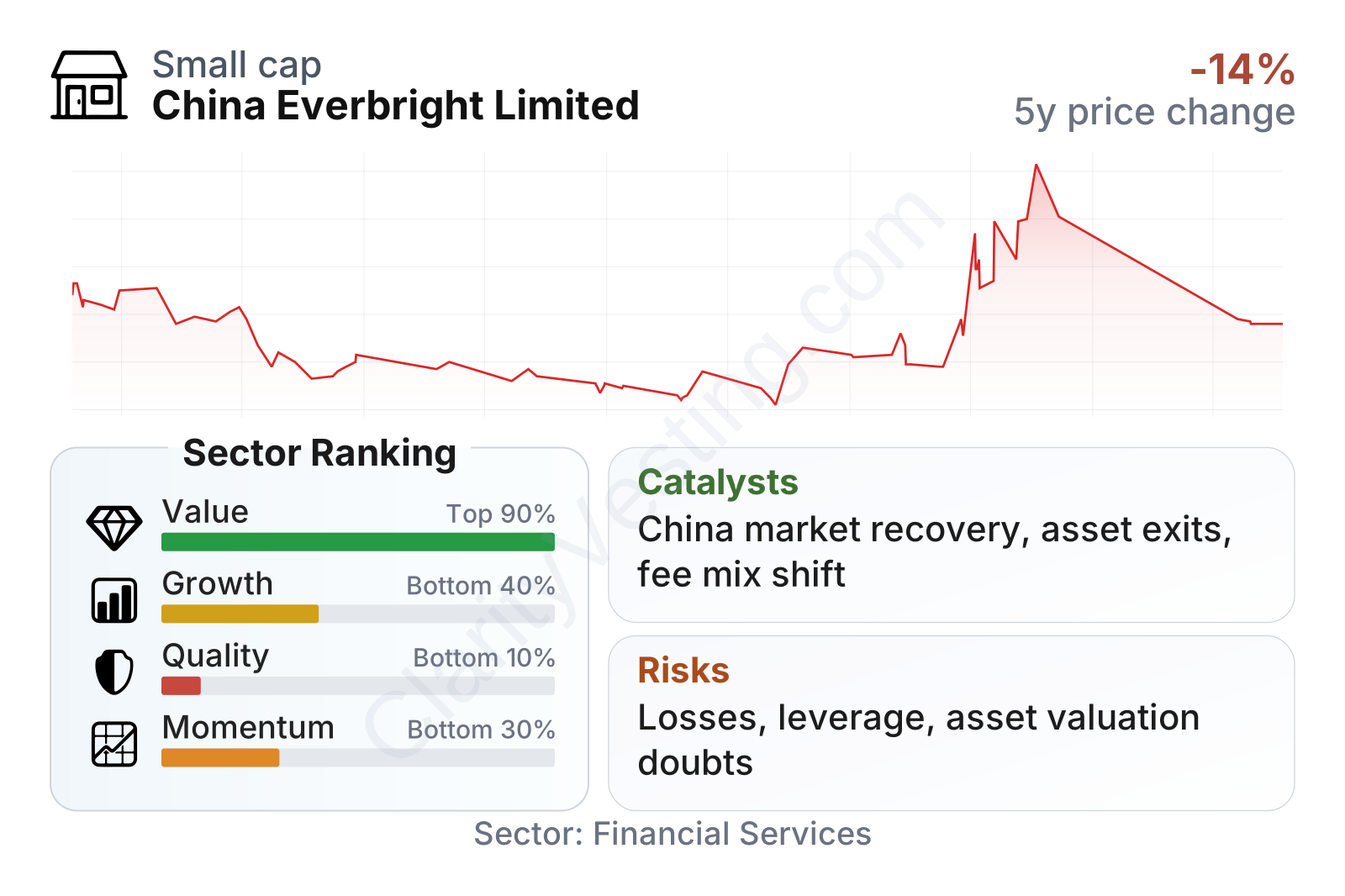
China Everbright Limited is a mid-sized financial company by market value, with share-price volatility close to the broader market rather than extremely high. The striking feature in the latest metrics is valuation: the shares trade at an exceptionally low price-to-book multiple compared with the financial sector median, while the trailing dividend yield screens at a very high level. At the same time, the quality and growth profile ranks weakly versus peers, reflecting negative profitability, shrinking recent revenue, and leverage above the sector median. In other words, the market appears to be pricing in serious doubts about how much of the reported book value can translate into durable shareholder returns.
The stock’s longer-term price record is flat overall, moving from about $0.96 in late 2021 to around $0.99 by mid-2025, but that flat headline masks weak recent momentum. The shares have lagged much of the sector over the last 6 to 12 months, suggesting that market confidence has not improved meaningfully despite the very low valuation multiples.
Growth
China Everbright Limited operates in areas that still have long-term relevance: private markets, alternative assets, wealth-related capital allocation, and China-linked strategic investment themes. These are not obsolete activities. If capital markets normalize and exit channels reopen, an asset manager with established fund platforms and a state-linked network can potentially rebuild fee income and investment gains.
The strategic logic also makes sense on paper. The company has exposure to private equity, venture capital, secondary markets, and cross-border opportunities, which gives it multiple ways to deploy capital. It also benefits from being part of the wider Everbright ecosystem, which can support deal sourcing, fundraising access, and institutional relationships, especially in Greater China.
Still, the growth picture is mixed rather than clean. Five-year revenue-per-share growth has been strong, and dividend growth over five years has also been positive. Book value per share expanded rapidly on a five-year compound basis, far above the sector median, which suggests there have been major portfolio and balance-sheet changes over time.
That said, the recent path of book value has not been consistently upward. It declined from 2021 through 2024 before a very large jump in 2025, which may reflect accounting remeasurement, capital structure changes, or other non-linear balance-sheet effects rather than a smooth compounding pattern. For a long-term reader, this means growth should not be viewed as steady operational expansion; it is more dependent on portfolio valuation outcomes and realized transactions.
A practical catalyst would be a recovery in China and Hong Kong capital markets, which could improve exits, support fund-raising, and lift marks on existing investments. Another potential growth driver is any shift toward a larger share of recurring management fees versus balance-sheet investing. If the company can lean more on fee income and less on volatile fair-value swings, the business would look structurally stronger.
Recent company communications have also emphasized portfolio optimization, risk disposal, and a focus on strategic industries. That is important because the next phase of growth is less likely to come from aggressive expansion and more likely to come from stabilizing existing assets, improving capital efficiency, and restoring profitability.
Risks
This article is for informational purposes only and does not constitute financial advice. Some content is AI-generated. See Disclaimer


