Stock Analysis · Century Aluminum Company (CENX)
Overview
Century Aluminum Company is a U.S.-based aluminum producer focused on primary aluminum, which is the base metal used to make products for transportation, construction, packaging, electrical applications, and industrial equipment. The company operates smelters in the United States and Iceland and also owns a carbon anode production facility, an important input used in the aluminum smelting process. Its business is relatively straightforward: it buys raw materials and power, converts alumina into primary aluminum, and sells that metal to industrial customers.
Revenue is heavily concentrated in primary aluminum products, while a smaller portion comes from by-products and other related sales. Based on company disclosures, the mix is approximately as follows:
- Primary aluminum products: about 90% to 95% of revenue. This includes standard-grade aluminum, value-added products, and billet or other fabricated forms sold to customers.
- By-products and other sales: about 5% to 10% of revenue. This can include items such as excess energy-related activity, carbon products, and other miscellaneous smelter-related output.
Century’s earnings are influenced not only by the volume it ships, but also by aluminum prices, regional premiums, and especially electricity costs. That means the company can look very strong during favorable commodity conditions and much weaker when prices or input costs move against it.
Over the last several years, the business has shown just how cyclical it is: revenue stayed in a fairly similar multiyear range, but profitability swung from losses to very strong gains as pricing and operating conditions changed. That makes Century less like a stable industrial compounder and more like a focused operating lever on the North American aluminum market.
The business flow highlights a major improvement from the loss-making period in 2021 through 2023 to much healthier operating profitability more recently. It also shows how sensitive results are to production costs: even modest changes in selling prices or energy costs can have an outsized impact on operating income and net income.
Key Figures
| Metric | Value | Sector ⓘ |
|---|---|---|
| Date | Oct 17, 2026 | |
| Context | ||
| Sector | Basic Materials | |
| Industry | Aluminum | |
| Market Cap ⓘ | $3.38B | |
| Beta ⓘ | 2.08 | |
Value (Cheapness) | ||
| P/E Ratio ⓘ | 5.90 | 16.90 |
| P/B Ratio ⓘ | 2.74 | 1.65 |
| FCF Yield ⓘ | 4.47% | 5.76% |
| Dividend Yield ⓘ | N/A | 2.13% |
| EBIT / EV ⓘ | 15.71% | 6.30% |
| PEG ⓘ | 0.06 | |
Growth (Business expansion) | ||
| Revenue Growth ⓘ | 19.70% | 11.10% |
| RPS Growth (5Y CAGR) ⓘ | 1.98% | 4.49% |
| EPS Growth (5Y CAGR) ⓘ | 112.11% | -13.47% |
| BVPS Growth (5Y CAGR) ⓘ | 12.06% | 5.51% |
| Margin Growth (5Y Trend) ⓘ | 9.55% | -1.54% |
| FCF Growth (5Y CAGR) ⓘ | N/A | 0.37% |
| DPS Growth (5Y CAGR) ⓘ | N/A | 6.08% |
Quality (Business durability) | ||
| ROIC (Latest) ⓘ | 39.40% | 9.26% |
| ROA (Latest) ⓘ | 24.10% | 4.91% |
| ROIC (5Y Median) ⓘ | -2.84% | 7.70% |
| ROA (5Y Median) ⓘ | -0.93% | 3.86% |
| Net Debt / EBIT (Latest) ⓘ | 0.22 | 1.40 |
| Net Debt / EBIT (5Y Median) ⓘ | 7.88 | 1.70 |
| Net Debt / EBITDA (Latest) ⓘ | 0.19 | 0.95 |
| Net Debt / Assets ⓘ | 4.75% | 13.69% |
| EBITDA / Interest ⓘ | 16.19 | 12.34 |
| Operating Margin (Latest) ⓘ | 23.46% | 13.20% |
| Operating Margin (5Y Median) ⓘ | 1.99% | 11.80% |
| Debt to Equity (Latest) ⓘ | 34.21% | 40.56% |
| Profit Margin (Latest) ⓘ | 22.56% | 6.43% |
| Free Cash Flow (Latest) ⓘ | $151.20M | |
Momentum (Price trend) | ||
| 3Y Return ⓘ | +410.29% | +68.89% |
| 12M Return (excl. last month) ⓘ | +59.22% | +30.21% |
| 6M Return ⓘ | -47.91% | -4.16% |
| Price vs. 200-Day MA ⓘ | -34.18% | -1.27% |
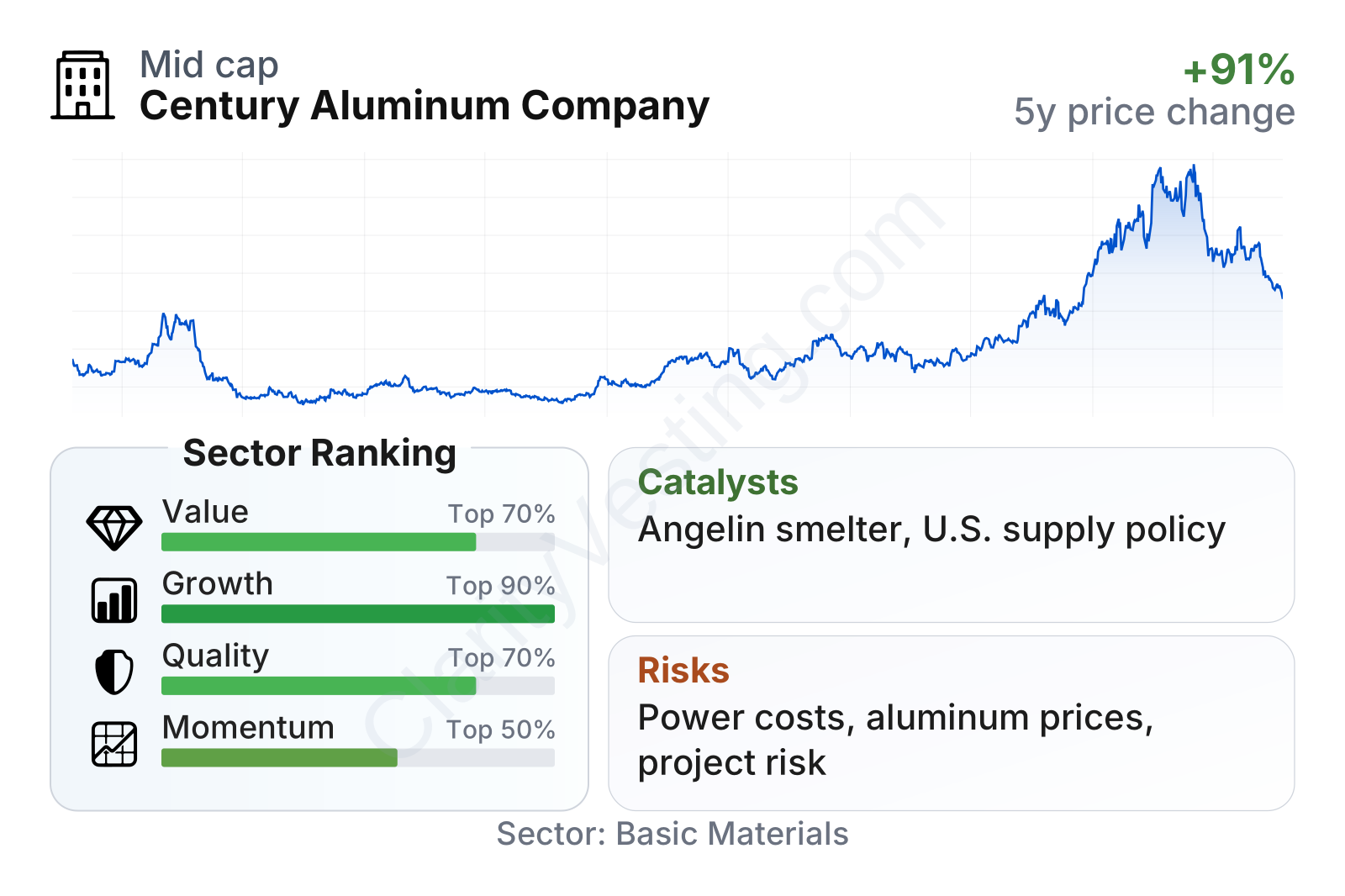
Century is a mid-sized materials company with a stock that has been highly volatile. The share price climbed sharply over the last few years but also experienced deep pullbacks along the way, which fits the pattern of a cyclical commodity producer. In the current snapshot, valuation metrics look inexpensive on earnings and operating profit compared with the sector, while growth ranks very strongly. Profitability and returns on capital are currently well above sector medians, and leverage looks much more controlled than it did a few years ago. At the same time, momentum has weakened in the shorter term, showing that market enthusiasm has cooled after a very strong run.
Growth
The aluminum industry has credible long-term demand drivers. Aluminum is lightweight, recyclable, and widely used in vehicles, power infrastructure, construction, and packaging. It also has strategic relevance in energy transition applications because lighter materials can improve efficiency and because grid expansion requires large amounts of industrial metals. In the United States, domestic metal supply has become more strategically important, which gives producers with U.S. assets a clearer place in the supply chain.
Century’s strategy for growth is centered on increasing exposure to domestic production and securing more competitive input economics over time. A major part of that plan is the proposed new greenfield smelter project in the United States, often referred to as the Angelin project, which has received support through U.S. Department of Energy engagement. If developed successfully, this project could materially increase Century’s production footprint and strengthen its position as a domestic supplier at a time when governments and manufacturers are paying more attention to supply security.
Recent revenue growth has turned positive again after a weak stretch in 2023 and much of 2024. The rebound suggests that shipment mix, realized pricing, or both have improved. Relative to the broader materials sector, Century’s recent year-over-year growth has been stronger, which helps explain why growth metrics rank near the top of its peer group even though its longer-term record remains more uneven.
Cash generation also appears to be moving in a better direction. Free cash flow was negative for several periods, then turned positive more recently. That matters because smelting is capital-intensive, and a company in this industry needs real cash generation, not just accounting profit, to support maintenance, debt reduction, and future expansion.
One recent opportunity comes from policy support for domestic critical industrial capacity. Century has emphasized the importance of expanding U.S. aluminum production, and this theme aligns with broader industrial policy aimed at reshoring strategic manufacturing inputs. The company also benefits when aluminum prices and regional premiums remain supportive, because its earnings can rise quickly when market conditions improve.
Risks
This article is for informational purposes only and does not constitute financial advice. Some content is AI-generated. See Disclaimer


