Stock Analysis · Celcuity LLC (CELC)
Overview
Celcuity is a clinical-stage biotechnology company focused on cancer drug development. Its core aim is to improve treatment selection and outcomes by targeting important signaling pathways that help tumors grow. The company’s lead asset is gedatolisib, a drug candidate being studied mainly in hormone receptor-positive, HER2-negative advanced breast cancer. Celcuity obtained this program through its acquisition of Pfizer’s former asset and is now centered on running late-stage clinical trials that could support future regulatory filings.
At this stage, Celcuity is not operating like a mature pharmaceutical company with a portfolio of marketed products. It is still in the development phase, so its business model is built around research, clinical trials, intellectual property, and the potential future commercialization of approved therapies rather than current product sales.
The company’s revenue base is extremely limited today. Recent annual filings show that revenue is close to zero and is not yet coming from commercial drug sales. Based on reported results, the current sources are approximately:
- Collaboration, licensing, and other minor revenue: about 100% of total revenue. This is very small in absolute terms and appears to reflect limited non-core or agreement-related activity rather than an established recurring business line.
- Product revenue: 0%. Celcuity does not currently have an approved product generating meaningful commercial sales.
That revenue mix is important for long-term readers: the investment case depends far more on clinical progress, regulatory milestones, and financing capacity than on present-day sales trends.
The financial flow also shows a company still firmly in build-out mode. Revenue remains minimal, while research and development has expanded sharply year after year and is by far the largest expense line. That pattern is typical of a biotech moving deeper into expensive late-stage trials, but it also means the path to self-funded operations is still distant.
Key Figures
| Metric | Value | Sector ⓘ |
|---|---|---|
| Date | Oct 24, 2026 | |
| Context | ||
| Sector | Healthcare | |
| Industry | Biotechnology | |
| Market Cap ⓘ | $3.03B | |
| Beta ⓘ | 0.11 | |
Value (Cheapness) | ||
| P/E Ratio ⓘ | N/A | 25.42 |
| P/B Ratio ⓘ | N/A | 3.08 |
| FCF Yield ⓘ | -6.33% | 3.12% |
| Dividend Yield ⓘ | N/A | 1.85% |
| EBIT / EV ⓘ | -4.74% | 0.56% |
| PEG ⓘ | N/A | |
Growth (Business expansion) | ||
| Revenue Growth ⓘ | N/A | 7.50% |
| RPS Growth (5Y CAGR) ⓘ | N/A | 8.60% |
| EPS Growth (5Y CAGR) ⓘ | -2.41% | -17.73% |
| BVPS Growth (5Y CAGR) ⓘ | -21.86% | 3.72% |
| Margin Growth (5Y Trend) ⓘ | N/A | -0.57% |
| FCF Growth (5Y CAGR) ⓘ | N/A | 0.96% |
| DPS Growth (5Y CAGR) ⓘ | N/A | 6.69% |
Quality (Business durability) | ||
| ROIC (Latest) ⓘ | -29.26% | 3.17% |
| ROA (Latest) ⓘ | -34.73% | 2.98% |
| ROIC (5Y Median) ⓘ | -39.23% | 4.56% |
| ROA (5Y Median) ⓘ | -49.75% | 1.87% |
| Net Debt / EBIT (Latest) ⓘ | N/A | 1.34 |
| Net Debt / EBIT (5Y Median) ⓘ | N/A | 1.86 |
| Net Debt / EBITDA (Latest) ⓘ | N/A | 1.00 |
| Net Debt / Assets ⓘ | 69.10% | 5.06% |
| EBITDA / Interest ⓘ | N/A | 9.55 |
| Operating Margin (Latest) ⓘ | -120398.05% | 9.25% |
| Operating Margin (5Y Median) ⓘ | N/A | 7.33% |
| Debt to Equity (Latest) ⓘ | -5902.39% | 26.68% |
| Profit Margin (Latest) ⓘ | N/A | 3.34% |
| Free Cash Flow (Latest) ⓘ | -$192.16M | |
Momentum (Price trend) | ||
| 3Y Return ⓘ | +555.04% | +51.61% |
| 12M Return (excl. last month) ⓘ | +60.22% | +19.90% |
| 6M Return ⓘ | -46.44% | +10.10% |
| Price vs. 200-Day MA ⓘ | -35.60% | +6.44% |
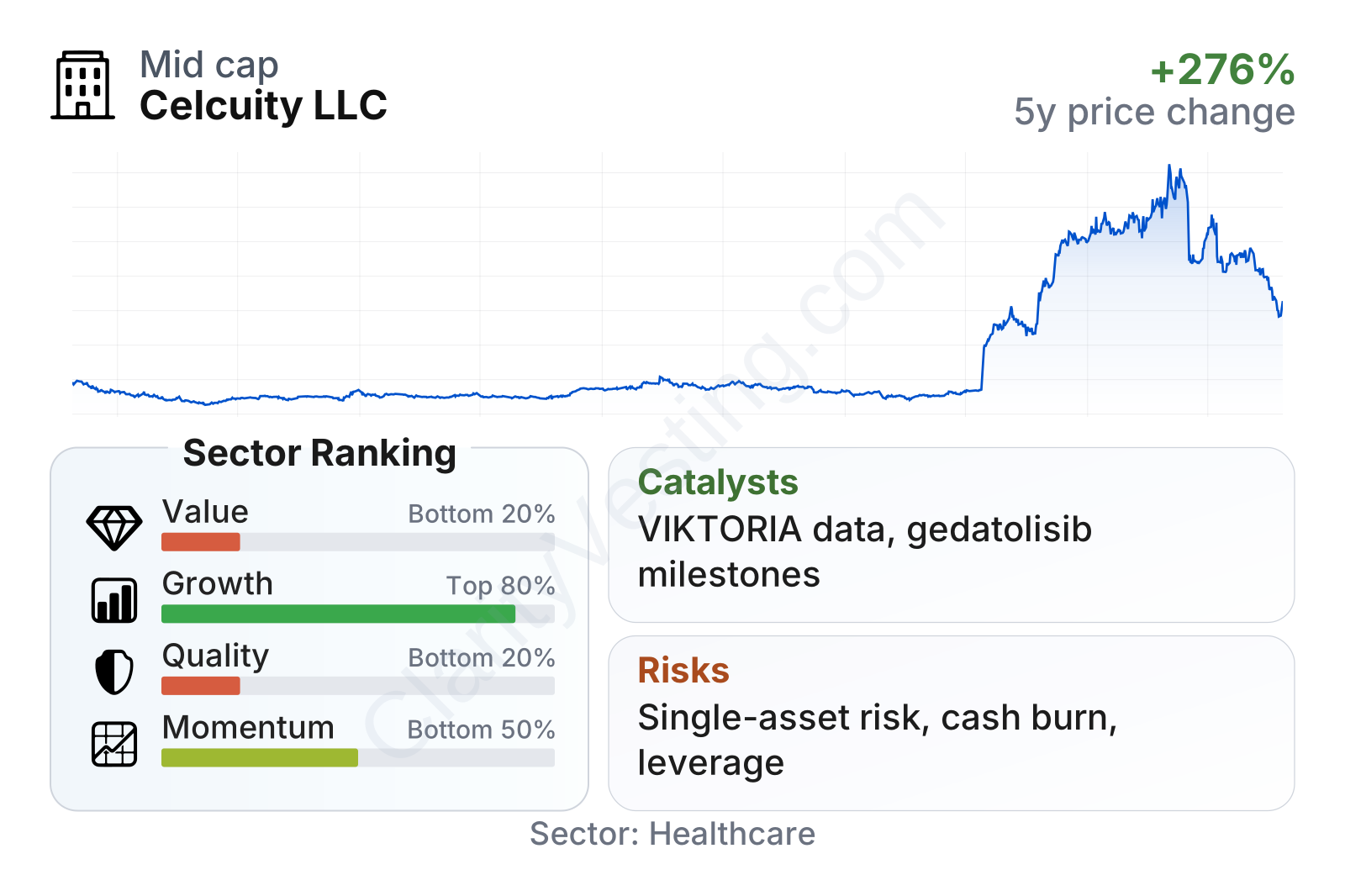
Celcuity sits in the mid-cap range by market value, which is relatively large for a company without meaningful commercial revenue and reflects how heavily the market is weighting future drug potential. The stock has shown very strong multiyear appreciation, but the path has been unusually volatile, including a sharp run-up followed by a pullback. In the factor breakdown, growth ranks better than value and quality, which fits a development-stage biotech: the market is paying for future possibilities, while current profitability and cash generation remain weak. The company’s low beta looks unusual given the large price swings, so the share-price history is likely the better guide to real-world trading behavior.
Growth
Celcuity operates in oncology, one of the most active and best-funded areas in biotechnology. Cancer treatment remains a large and growing market because of rising global incidence, longer treatment durations, and the constant push toward more targeted therapies. Within that broader field, breast cancer is especially important commercially, and drugs that can improve outcomes in well-defined patient groups can become meaningful assets.
The company’s strategy is straightforward and logical for this stage: concentrate resources on a lead candidate with a potentially important role in a large treatment setting, while using biomarker and pathway knowledge to sharpen where the drug may work best. Gedatolisib targets the PI3K/AKT/mTOR pathway, a well-established cancer pathway linked to resistance and tumor growth. If Celcuity can show strong efficacy and manageable safety in late-stage studies, that could materially change its business profile because it would move the company from a pure development platform toward a potential commercial oncology company.
A major catalyst is clinical readout timing. For Celcuity, value creation is tied mainly to pivotal and registration-directed trial progress, especially in advanced breast cancer combinations. Regulatory interactions, enrollment completion, top-line data, and any signal that the drug could compete favorably on efficacy or tolerability would all matter more than near-term accounting results.
Recent company communications have continued to emphasize execution around the VIKTORIA clinical program and additional development work around gedatolisib. For a company at this stage, that is the central opportunity: one successful asset in a large oncology indication can justify substantial commercial expectations if the data are convincing enough.
Cash use has been moving in the wrong direction from a financial comfort standpoint, with free cash flow becoming increasingly negative over time. That is not surprising given the cost of late-stage oncology trials, but it underlines that growth here is driven by clinical investment rather than operating leverage. In practical terms, future expansion depends on trial success arriving before financing pressure becomes too heavy.
Risks
This article is for informational purposes only and does not constitute financial advice. Some content is AI-generated. See Disclaimer


