Stock Analysis · Cadre Holdings Inc (CDRE)
Overview
Cadre Holdings is a specialized equipment company serving government agencies and first responders. Its products are designed for safety, survivability, and mission-critical use. The company sells body armor, explosive ordnance disposal equipment, duty gear, firearms accessories, crowd-control tools, and other protective and operational products used by law enforcement, corrections, military, fire and rescue, and related public-safety customers. Its portfolio includes brands such as Safariland, Med-Eng, and a growing set of niche acquisitions.
The business is built around protective equipment and mission gear that tends to be less discretionary than many industrial product categories. Demand is tied to agency budgets, officer safety requirements, training needs, replacement cycles, and occasional large order waves linked to contracts or security events. That gives Cadre exposure to public-safety spending rather than to consumer cycles.
Based on company reporting, revenue is primarily generated from two operating segments.
- Products segment: approximately 85% to 90% of revenue. This is the core business and includes body armor, bomb suits, robotics-related protective systems, duty holsters, less-lethal and crowd-management tools, and other equipment sold through government contracts, distributors, and commercial channels.
- Distribution segment: approximately 10% to 15% of revenue. This activity mainly distributes third-party products, including hard goods and consumable public-safety items, to law-enforcement and first-responder customers.
Customer concentration is generally higher on the government side than in ordinary industrial markets, but the end markets themselves are broad: local police departments, federal agencies, corrections, military units, and emergency-response organizations. In practice, Cadre is not a giant defense prime contractor; it is a smaller, focused supplier of specialized gear with recognized brands in categories where reliability matters.
The financial flow over the last several years shows a useful pattern: revenue has climbed steadily from the low $400 million range to above $600 million, while gross profit has also expanded. Operating income improved materially from the weak 2022 level, although selling and administrative costs remain a meaningful part of the cost base. That points to a business with improving scale, but one that still needs disciplined execution to convert growth into stronger bottom-line efficiency.
Key Figures
| Metric | Value | Sector ⓘ |
|---|---|---|
| Date | Oct 22, 2026 | |
| Context | ||
| Sector | Industrials | |
| Industry | Aerospace & Defense | |
| Market Cap ⓘ | $1.18B | |
| Beta ⓘ | 1.33 | |
Value (Cheapness) | ||
| P/E Ratio ⓘ | 34.07 | 22.29 |
| P/B Ratio ⓘ | 3.45 | 1.98 |
| FCF Yield ⓘ | 6.61% | 6.26% |
| Dividend Yield ⓘ | 1.44% | 1.92% |
| EBIT / EV ⓘ | 4.56% | 4.83% |
| PEG ⓘ | N/A | |
Growth (Business expansion) | ||
| Revenue Growth ⓘ | 31.80% | 9.30% |
| RPS Growth (5Y CAGR) ⓘ | -1.52% | 7.76% |
| EPS Growth (5Y CAGR) ⓘ | 6.30% | -13.17% |
| BVPS Growth (5Y CAGR) ⓘ | 23.96% | 6.13% |
| Margin Growth (5Y Trend) ⓘ | 3.81% | 0.74% |
| FCF Growth (5Y CAGR) ⓘ | 11.14% | 10.79% |
| DPS Growth (5Y CAGR) ⓘ | -5.49% | 9.41% |
Quality (Business durability) | ||
| ROIC (Latest) ⓘ | 6.93% | 10.75% |
| ROA (Latest) ⓘ | 4.22% | 5.41% |
| ROIC (5Y Median) ⓘ | 9.48% | 9.37% |
| ROA (5Y Median) ⓘ | 6.20% | 4.95% |
| Net Debt / EBIT (Latest) ⓘ | 5.09 | 2.04 |
| Net Debt / EBIT (5Y Median) ⓘ | 2.76 | 2.27 |
| Net Debt / EBITDA (Latest) ⓘ | 3.85 | 1.39 |
| Net Debt / Assets ⓘ | 37.70% | 19.27% |
| EBITDA / Interest ⓘ | 5.74 | 9.58 |
| Operating Margin (Latest) ⓘ | 9.91% | 10.49% |
| Operating Margin (5Y Median) ⓘ | 10.93% | 10.30% |
| Debt to Equity (Latest) ⓘ | 115.29% | 64.82% |
| Profit Margin (Latest) ⓘ | 5.26% | 6.67% |
| Free Cash Flow (Latest) ⓘ | $78.12M | |
Momentum (Price trend) | ||
| 3Y Return ⓘ | +1.50% | +67.77% |
| 12M Return (excl. last month) ⓘ | -20.24% | +12.05% |
| 6M Return ⓘ | -5.66% | 0.00% |
| Price vs. 200-Day MA ⓘ | -15.10% | +0.67% |
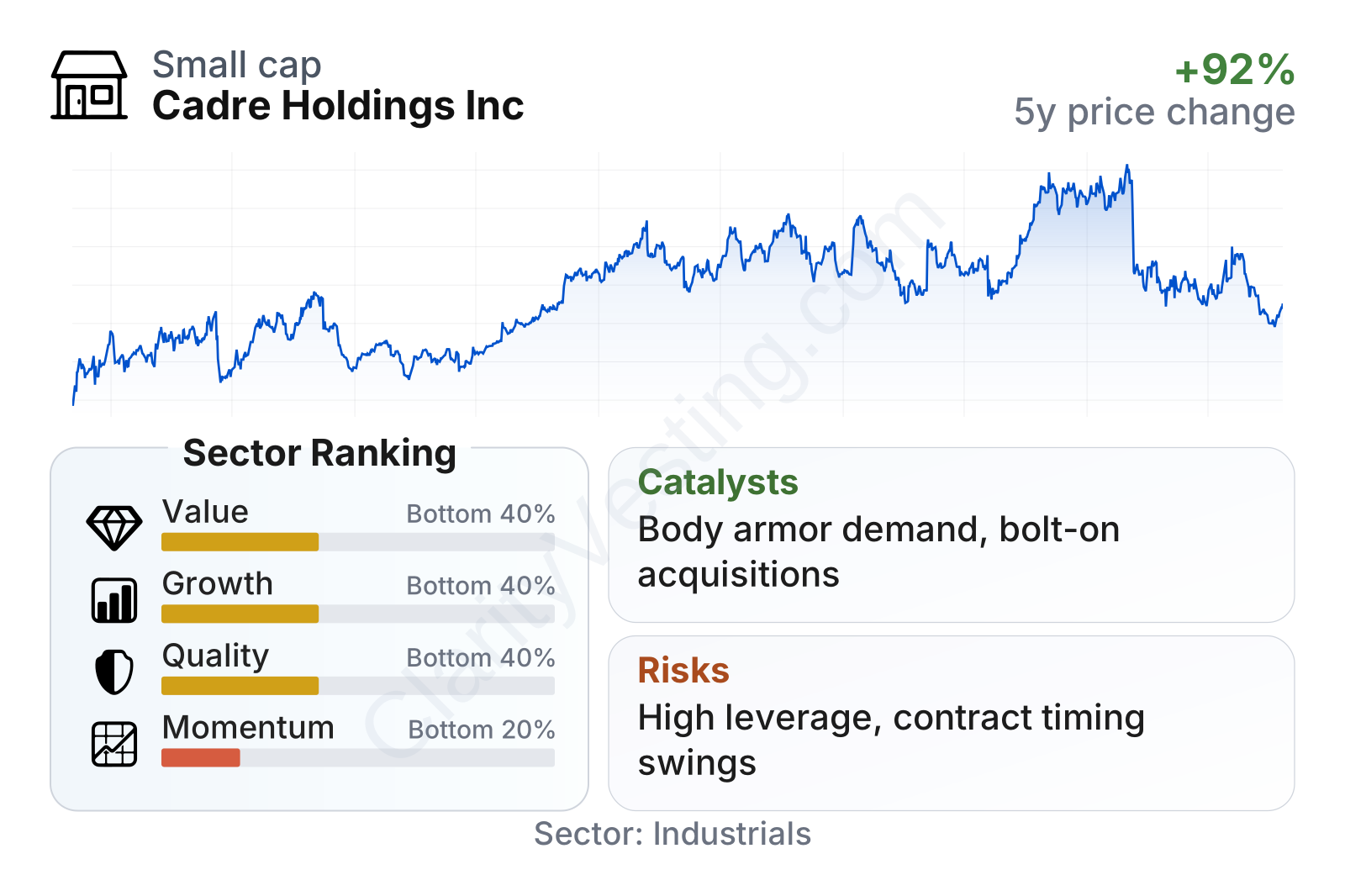
Cadre sits in the small-cap range, which often means more room for growth but also sharper share-price swings. The stock’s beta above 1 suggests volatility higher than the broader market. The factor picture is mixed: recent revenue growth has been strong, free cash flow generation is solid, but valuation, leverage, and recent share-price momentum do not screen as especially attractive relative to much of the industrials universe.
Growth
Cadre operates in a part of the market with favorable long-term support. Public-safety and force-protection needs do not disappear with short-term economic slowdowns, and body armor, bomb disposal gear, and law-enforcement equipment benefit from replacement demand, regulatory standards, and agency modernization. Defense and security budgets can move in cycles, but the broader sector remains supported by persistent safety and preparedness needs.
The company’s strategy also appears coherent. Cadre combines established brands with acquisitions that add product lines, channels, or geographic reach. That can work well in fragmented safety-equipment categories, where cross-selling and procurement relationships matter. Management has emphasized broadening the product set and integrating acquired businesses into a larger platform, which is a sensible path for a company of this size.
Recent top-line growth has been notably strong, with the latest year-over-year increase running above 30%, far ahead of the sector median. The pattern has not been perfectly smooth, because large orders and contract timing can move revenue between quarters, but the overall direction has been favorable. That kind of growth matters because it suggests Cadre is gaining from both market demand and portfolio expansion rather than simply holding a mature position.
Cash generation supports the growth case. Free cash flow has generally risen over time, even with some temporary pullbacks, and the trailing figure remains meaningful for a company of this size. Stronger cash generation gives Cadre more flexibility to fund acquisitions, reduce debt, invest in product development, and maintain its dividend without depending entirely on external financing.
A practical catalyst is continued government and law-enforcement procurement, especially where officer protection, crowd management, and explosive ordnance disposal remain priority categories. Another is acquisition integration: if Cadre can keep adding niche brands and then improve distribution across its network, revenue synergies can build over time. Recent company updates have also pointed to contract activity and product demand that reinforce the idea that its end markets remain active rather than stagnant.
Risks
This article is for informational purposes only and does not constitute financial advice. Some content is AI-generated. See Disclaimer


