Stock Analysis · COPT Defense Properties (CDP)
Overview
COPT Defense Properties is a real estate investment trust, or REIT, focused on owning, operating, and developing office and mixed-use properties that support the U.S. defense and government ecosystem. Its portfolio is concentrated around locations tied to national security missions, including properties near military installations, intelligence agencies, defense contractors, and cybersecurity operations. This is not a broad office landlord trying to fill generic downtown buildings. Its business model is built around highly specific demand from government-related users that often value secure locations, specialized infrastructure, and proximity to mission-critical campuses.
The company’s revenue mainly comes from rental income generated by its operating properties, with a smaller contribution from other property-related activities. Based on recent company disclosures, the revenue mix is broadly structured as follows:
- Rental and tenant recovery revenue: about 95% to 98% — recurring rent from office and data-center-adjacent properties, plus reimbursements from tenants for operating costs.
- Parking and other property income: about 1% to 3% — ancillary income tied to property operations.
- Construction and development-related or other revenue: usually a low-single share of total revenue when present — this can include development-related activities and other non-core items, but it is not the main earnings engine.
The portfolio is also concentrated by tenant type. A large majority of annualized rental revenue comes from tenants connected to the U.S. government and defense industry, either directly or through prime contractors. This concentration is central to the company’s identity: it limits exposure to some of the weakness seen in ordinary office real estate, but it also makes results more dependent on federal budget priorities and defense demand.
Over the last several years, revenue has generally trended upward with some unevenness, while profitability has recovered after a weaker 2023 period. The business remains centered on recurring lease income rather than transaction-driven gains, which is an important distinction for long-term analysis.
The long-term pattern shows a rental business that has expanded revenue since 2021, with a noticeable dip in earnings during 2023 and a rebound afterward. Interest expense has also moved higher over time, which is typical for a property owner operating in a higher-rate environment and is worth watching alongside future development activity.
Key Figures
| Metric | Value | Sector ⓘ |
|---|---|---|
| Date | Oct 17, 2026 | |
| Context | ||
| Sector | Real Estate | |
| Industry | REIT - Office | |
| Market Cap ⓘ | $3.85B | |
| Beta ⓘ | 0.79 | |
Value (Cheapness) | ||
| P/E Ratio ⓘ | 23.23 | 17.38 |
| P/B Ratio ⓘ | 2.60 | 0.85 |
| FCF Yield ⓘ | 6.82% | 7.38% |
| Dividend Yield ⓘ | 3.73% | 4.85% |
| EBIT / EV ⓘ | 4.01% | 3.78% |
| PEG ⓘ | 1.02 | |
Growth (Business expansion) | ||
| Revenue Growth ⓘ | 3.90% | 5.30% |
| RPS Growth (5Y CAGR) ⓘ | 3.35% | 6.02% |
| EPS Growth (5Y CAGR) ⓘ | -1.94% | -11.37% |
| BVPS Growth (5Y CAGR) ⓘ | -3.99% | 0.45% |
| Margin Growth (5Y Trend) ⓘ | 10.72% | -0.22% |
| FCF Growth (5Y CAGR) ⓘ | 3.73% | 5.40% |
| DPS Growth (5Y CAGR) ⓘ | 2.35% | 5.02% |
Quality (Business durability) | ||
| ROIC (Latest) ⓘ | N/A | 5.69% |
| ROE (Latest) ⓘ | 11.08% | 7.56% |
| ROA (Latest) ⓘ | 3.70% | 2.85% |
| ROIC (5Y Median) ⓘ | 5.85% | 4.22% |
| ROE (5Y Median) ⓘ | 9.73% | 6.03% |
| ROA (5Y Median) ⓘ | 3.27% | 2.44% |
| Net Debt / EBIT (Latest) ⓘ | 10.26 | 7.59 |
| Net Debt / EBIT (5Y Median) ⓘ | 10.66 | 8.40 |
| Net Debt / EBITDA (Latest) ⓘ | 6.21 | 5.27 |
| Net Debt / Assets ⓘ | 58.69% | 37.76% |
| EBITDA / Interest ⓘ | 4.56 | 4.10 |
| Operating Margin (Latest) ⓘ | 32.92% | 35.29% |
| Operating Margin (5Y Median) ⓘ | 28.53% | 37.31% |
| Debt to Equity (Latest) ⓘ | 175.00% | 88.87% |
| Profit Margin (Latest) ⓘ | 20.84% | 19.61% |
| Free Cash Flow (Latest) ⓘ | $262.61M | |
Momentum (Price trend) | ||
| 3Y Return ⓘ | +52.20% | +30.75% |
| 12M Return (excl. last month) ⓘ | +18.25% | +4.36% |
| 6M Return ⓘ | +4.38% | -2.52% |
| Price vs. 200-Day MA ⓘ | +1.36% | -2.34% |
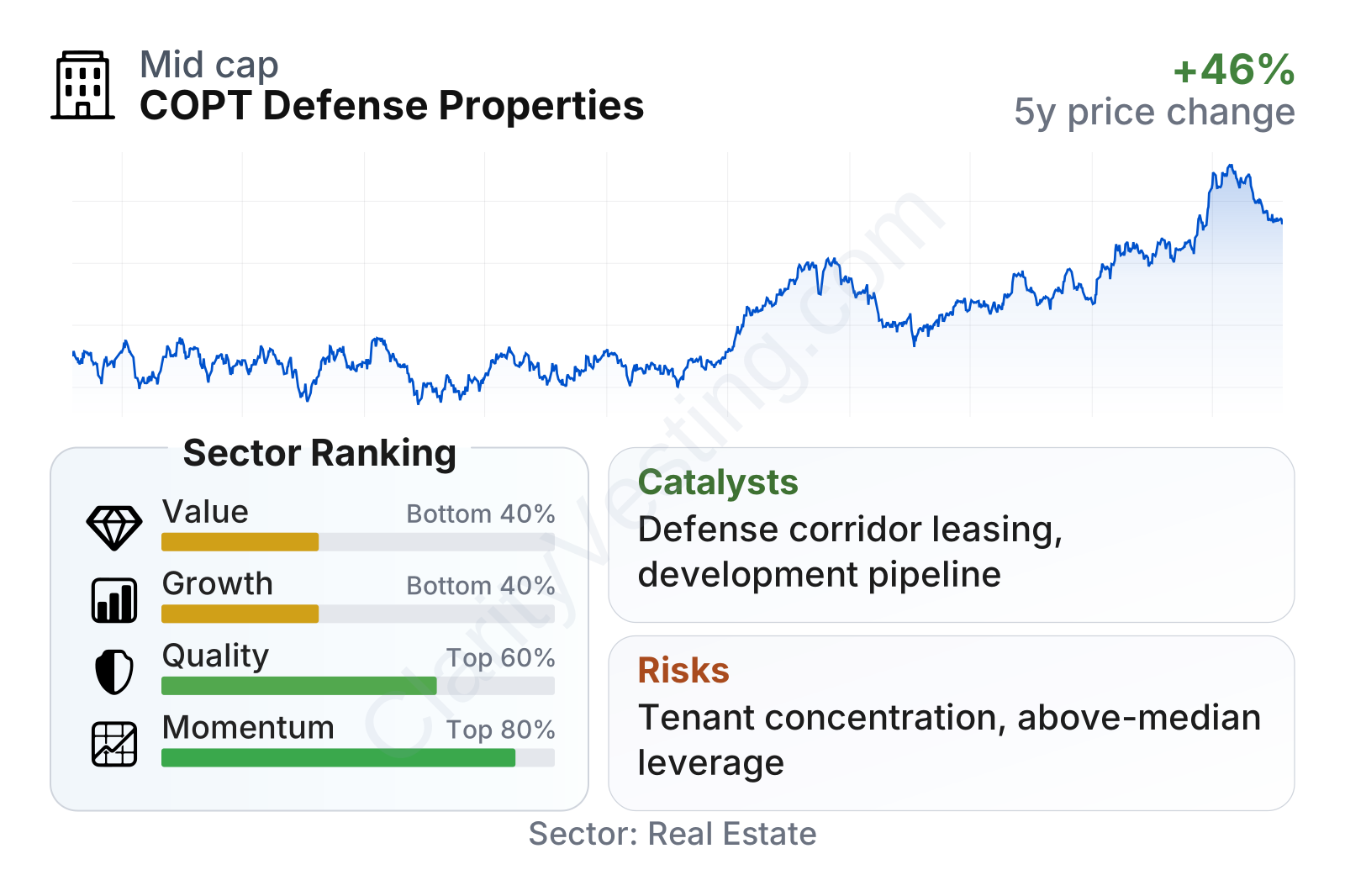
COPT Defense Properties is a mid-sized REIT with below-market share-price volatility, which fits the nature of a landlord with long leases and specialized tenants. The most notable features in the current metrics are strong recent market performance and solid profitability compared with many real estate peers, while valuation looks richer than the sector median. Growth is positive, but it is not especially fast relative to other real estate companies.
The stock’s multi-year price trend has improved significantly, especially from late 2024 through mid-2026. At the same time, the factor breakdown suggests a mixed picture: quality is respectable, momentum is very strong, but value metrics are less favorable because the market is already assigning a premium compared with much of the office REIT universe.
Growth
COPT Defense Properties operates in a part of real estate that looks more resilient than the broader office sector. Traditional office landlords have faced pressure from remote work, weak leasing demand, and elevated vacancy. COPT’s niche is different because many of its buildings support functions that are harder to decentralize, such as defense programs, secure government work, intelligence-related activity, and specialized contractor operations. That does not remove all cyclical risk, but it gives the company a more durable demand base than a standard urban office owner.
The company’s strategy for future expansion is straightforward and logical: develop and lease new properties in defense-oriented corridors where tenant relationships, security needs, and location constraints create barriers to entry. In practice, this means focusing capital on markets with visible federal mission demand rather than chasing broad office recovery. That strategy makes sense because it builds on existing customer relationships and local expertise instead of requiring a major shift in business model.
One of the clearest long-term catalysts is the continued growth of defense technology, intelligence, cybersecurity, and mission-support spending in the United States. These activities often cluster geographically and can require specialized real estate. If federal priorities continue favoring cyber, intelligence, space, and advanced defense programs, landlords with the right footprint can benefit through occupancy, renewals, and development pipelines.
Recent company updates have also pointed to leasing progress, ongoing development activity, and demand in its defense-focused submarkets. That matters because external growth in REITs depends not just on owning properties, but on being able to place new capital into projects that can attract tenants at returns above financing costs. In a sector where many office owners are shrinking or stabilizing, COPT still has a credible development angle.
Revenue per share has moved upward over the past five years, although not in a perfectly smooth line. That pattern suggests the company has been able to expand its rental base without relying entirely on issuing large amounts of new equity that would dilute per-share progress. The pace is moderate rather than rapid, which is consistent with a specialized property owner focused on steady execution.
The dividend per share has also risen gradually over time. The growth rate is not high compared with some other real estate segments, but the direction is positive and aligns with the company’s profile as a steady income-producing landlord. The current yield is below the real estate sector median, which reflects both the share price appreciation and the market’s willingness to pay more for this niche than for weaker office peers.
Risks
This article is for informational purposes only and does not constitute financial advice. Some content is AI-generated. See Disclaimer


