Stock Analysis · CareDx Inc (CDNA)
Overview
CareDx is a healthcare diagnostics company focused on transplant patients. Its products are used before and after an organ transplant to help physicians match donors and recipients, monitor whether a transplanted organ is being rejected, and manage patients over time. The company is best known for blood-based testing in transplant care, especially in kidney and heart transplant monitoring, and it has been expanding into additional organ types and related services.
Its business is built around a mix of testing services, products used by transplant laboratories, and digital or patient-support tools. Based on recent company filings, revenue is still heavily centered on testing services, with the rest coming from transplant laboratory products and smaller service lines.
- Testing services: approximately 75% to 85% of revenue. This includes high-value transplant diagnostics such as AlloSure and other assays used to monitor organ health and detect signs of rejection after transplant.
- Product revenue: approximately 15% to 25% of revenue. This includes transplant laboratory testing kits, HLA typing products, and related instruments or reagents used by transplant centers and labs.
- Services and other: low single-digit contribution when separated in disclosures. This can include digital solutions, patient engagement tools, and certain support offerings tied to transplant care workflows.
The broad financial picture is that CareDx has recovered from a difficult period in 2023, when revenue fell and losses widened, and has since rebuilt growth while keeping a strong gross profit profile. Revenue has climbed again, but profitability remains sensitive to reimbursement, test volumes, and legal or regulatory outcomes.
The company’s financial profile shows a business with strong gross margins but uneven operating results. Revenue and gross profit have improved meaningfully since the 2023 slowdown, while operating expenses remain substantial. That pattern matters because long-term upside depends less on whether CareDx can sell tests at attractive margins—which it generally can—and more on whether it can convert that into steady operating income.
Key Figures
| Metric | Value | Sector ⓘ |
|---|---|---|
| Date | Nov 14, 2026 | |
| Context | ||
| Sector | Healthcare | |
| Industry | Diagnostics & Research | |
| Market Cap ⓘ | $4.26B | |
| Beta ⓘ | 2.49 | |
Value (Cheapness) | ||
| P/E Ratio ⓘ | 34.25 | 25.84 |
| P/B Ratio ⓘ | 9.39 | 4.34 |
| FCF Yield ⓘ | 1.41% | 2.57% |
| Dividend Yield ⓘ | N/A | 1.62% |
| EBIT / EV ⓘ | 0.17% | 2.92% |
| PEG ⓘ | -0.12 | |
Growth (Business expansion) | ||
| Revenue Growth ⓘ | 39.30% | 7.15% |
| RPS Growth (5Y CAGR) ⓘ | 5.87% | 8.64% |
| EPS Growth (5Y CAGR) ⓘ | N/A | -9.67% |
| BVPS Growth (5Y CAGR) ⓘ | -10.63% | 3.71% |
| Margin Growth (5Y Trend) ⓘ | N/A | -0.63% |
| FCF Growth (5Y CAGR) ⓘ | N/A | 1.59% |
| DPS Growth (5Y CAGR) ⓘ | N/A | 6.69% |
Quality (Business durability) | ||
| ROIC (Latest) ⓘ | 4.41% | 5.79% |
| ROA (Latest) ⓘ | 24.39% | 2.88% |
| ROIC (5Y Median) ⓘ | -13.26% | 4.60% |
| ROA (5Y Median) ⓘ | -6.56% | 1.82% |
| Net Debt / EBIT (Latest) ⓘ | -33.02 | 1.33 |
| Net Debt / EBIT (5Y Median) ⓘ | N/A | 1.92 |
| Net Debt / EBITDA (Latest) ⓘ | -7.76 | 0.91 |
| Net Debt / Assets ⓘ | -34.53% | 5.89% |
| EBITDA / Interest ⓘ | N/A | 9.68 |
| Operating Margin (Latest) ⓘ | 1.35% | 9.24% |
| Operating Margin (5Y Median) ⓘ | -16.10% | 7.30% |
| Debt to Equity (Latest) ⓘ | 6.20% | 28.47% |
| Profit Margin (Latest) ⓘ | 25.86% | 3.33% |
| Free Cash Flow (Latest) ⓘ | $60.10M | |
Momentum (Price trend) | ||
| 3Y Return ⓘ | +883.33% | +48.98% |
| 12M Return (excl. last month) ⓘ | +350.80% | +13.65% |
| 6M Return ⓘ | +280.09% | +14.05% |
| Price vs. 200-Day MA ⓘ | +112.16% | +8.64% |
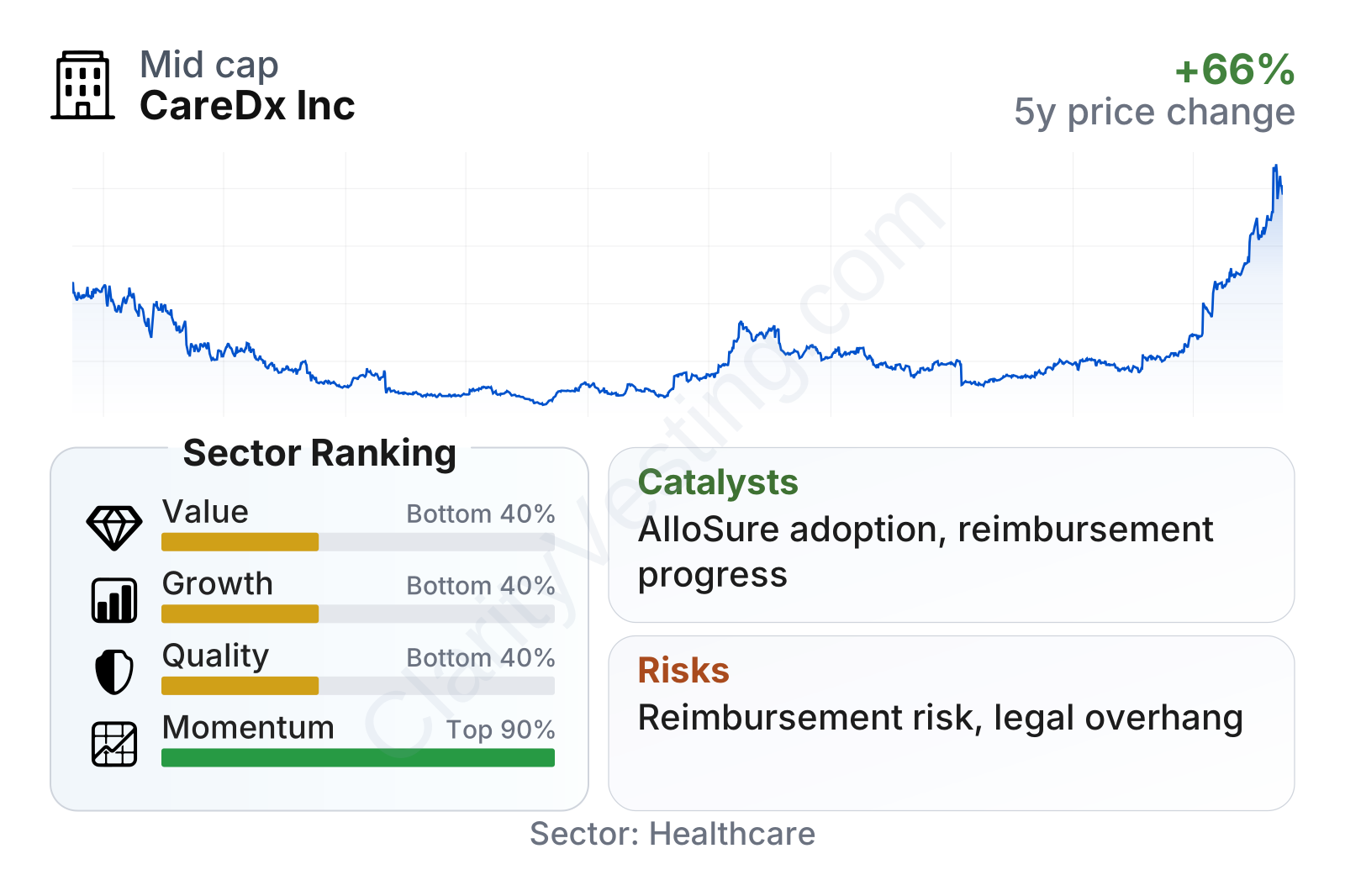
CareDx is now a mid-sized diagnostics company with a stock that has been highly volatile. The share price history shows a sharp collapse from 2021 into 2023, followed by a strong rebound. That usually signals a company whose outlook has changed materially, but also one that remains sensitive to news flow and expectations.
The current factor profile is mixed. Growth is strong in the most recent period, clearly ahead of the sector median, and momentum is exceptionally strong, placing the stock among the better recent performers in healthcare. By contrast, value metrics look less attractive, with valuation multiples above sector medians on several measures, and quality remains weaker than the sector on operating efficiency despite the company’s healthy cash position and low leverage.
Growth
CareDx operates in a niche that has long-term structural support. Organ transplantation is a specialized but important part of healthcare, and transplanted organs require continuous monitoring. That creates recurring demand because patients need follow-up testing well beyond the initial transplant procedure. As transplant volumes grow over time and care standards become more data-driven, companies that provide non-invasive monitoring tools have a logical place in the system.
The company’s strategy also makes sense on paper. Rather than relying on a single product, CareDx has tried to build a broader transplant platform that connects pre-transplant matching, post-transplant surveillance, and workflow support. That approach can deepen its relationship with transplant centers and make its offerings harder to replace than a standalone test.
The recent growth trend is encouraging. After a decline in 2023, revenue growth turned positive again in 2024 and accelerated further in 2026, reaching levels far above the broader sector median. That rebound suggests the business is not simply stabilizing; it is regaining commercial traction. The key question for long-term analysis is whether this acceleration reflects durable testing demand and broader adoption, or a temporary recovery after an unusually weak comparison period.
Cash generation has also improved. Free cash flow moved from negative territory into positive territory and has expanded meaningfully over the last year. That is an important shift because it suggests the company is no longer relying only on revenue growth to support its case; it is also showing signs of financial self-funding.
Recent company updates have pointed to continued adoption of transplant monitoring tests and expanding clinical use across organ types. Another potential catalyst is reimbursement progress. In diagnostics, broader and more stable coverage can have an outsized effect on test volumes and revenue visibility. If CareDx keeps strengthening payer relationships and preserving its role in transplant center workflows, that could support a more durable growth phase.
Risks
This article is for informational purposes only and does not constitute financial advice. Some content is AI-generated. See Disclaimer