Stock Analysis · Comfortdelgro Corporation Ltd (CDGLY)
Overview
ComfortDelGro Corporation is a Singapore-based transportation group operating public transit and mobility services across several countries. Its activities span buses, rail, taxis, private-hire vehicle support, automotive engineering, inspection and testing, and contract transport. In simple terms, it is a large operator of everyday transport networks rather than a single-line taxi company.
The business is diversified by service line and geography, which matters because demand drivers are different across segments. Public transport is usually supported by long-term operating contracts and regulated frameworks, while taxi, private mobility, and automotive services tend to be more sensitive to economic activity and competition.
Based on the company’s latest annual reporting structure, the main revenue sources are broadly ranked as follows:
- Public transport services: approximately 60% to 70% of group revenue. This includes scheduled bus and rail operations, mainly under government-linked or contracted systems in markets such as Singapore, Australia, the United Kingdom, New Zealand, and China.
- Taxi and private mobility: approximately 15% to 20%. This includes taxi rentals, platform-related mobility activity, and associated fleet services.
- Automotive engineering, inspection, testing, and other transport-related services: approximately 10% to 15%. This covers vehicle maintenance, workshops, inspections, and supporting transport solutions.
- Driving centers, leasing, and other smaller activities: typically a low-single-digit to high-single-digit share combined when grouped with miscellaneous operations, depending on classification and year.
Over the last several years, group revenue has expanded from roughly S$3.5 billion in 2021 to nearly S$5.0 billion in 2025, while operating income and net income also moved higher. That suggests the company has been recovering from pandemic-era disruption and adding scale, especially in its contracted transit operations.
One notable pattern is that revenue has grown faster than net profit, showing that the business is expanding but still working through cost pressure, financing costs, and the lower-margin nature of large transit contracts.
The multi-year picture points to a larger company with improving operating earnings, but also with a cost structure that remains important to watch closely, especially labor, fuel, maintenance, and financing expenses.
Key Figures
| Metric | Value | Sector ⓘ |
|---|---|---|
| Date | Oct 17, 2026 | |
| Context | ||
| Sector | Industrials | |
| Industry | Railroads | |
| Market Cap ⓘ | $1.91B | |
| Beta ⓘ | 0.20 | |
Value (Cheapness) | ||
| P/E Ratio ⓘ | 11.67 | 22.10 |
| P/B Ratio ⓘ | 0.85 | 1.97 |
| FCF Yield ⓘ | -5.33% | 6.38% |
| Dividend Yield ⓘ | 7.56% | 1.94% |
| EBIT / EV ⓘ | N/A | 4.79% |
| PEG ⓘ | 18.11 | |
Growth (Business expansion) | ||
| Revenue Growth ⓘ | 5.70% | 9.30% |
| RPS Growth (5Y CAGR) ⓘ | 9.19% | 7.81% |
| EPS Growth (5Y CAGR) ⓘ | -10.67% | -13.06% |
| BVPS Growth (5Y CAGR) ⓘ | -4.73% | 6.14% |
| Margin Growth (5Y Trend) ⓘ | 4.69% | 0.88% |
| FCF Growth (5Y CAGR) ⓘ | N/A | 11.01% |
| DPS Growth (5Y CAGR) ⓘ | 22.81% | 9.48% |
Quality (Business durability) | ||
| ROIC (Latest) ⓘ | 16.47% | 10.84% |
| ROA (Latest) ⓘ | 7.25% | 5.41% |
| ROIC (5Y Median) ⓘ | 8.20% | 9.38% |
| ROA (5Y Median) ⓘ | 3.82% | 4.95% |
| Net Debt / EBIT (Latest) ⓘ | 1.33 | 2.08 |
| Net Debt / EBIT (5Y Median) ⓘ | -0.16 | 2.27 |
| Net Debt / EBITDA (Latest) ⓘ | 0.68 | 1.39 |
| Net Debt / Assets ⓘ | 17.92% | 19.28% |
| EBITDA / Interest ⓘ | 18.92 | 9.58 |
| Operating Margin (Latest) ⓘ | 8.34% | 10.50% |
| Operating Margin (5Y Median) ⓘ | 7.77% | 10.29% |
| Debt to Equity (Latest) ⓘ | 71.40% | 65.48% |
| Profit Margin (Latest) ⓘ | 4.03% | 6.67% |
| Free Cash Flow (Latest) ⓘ | -$101.68M | |
Momentum (Price trend) | ||
| 3Y Return ⓘ | +9.09% | +61.68% |
| 12M Return (excl. last month) ⓘ | +2.20% | +12.58% |
| 6M Return ⓘ | -26.74% | 0.00% |
| Price vs. 200-Day MA ⓘ | -18.92% | +0.02% |
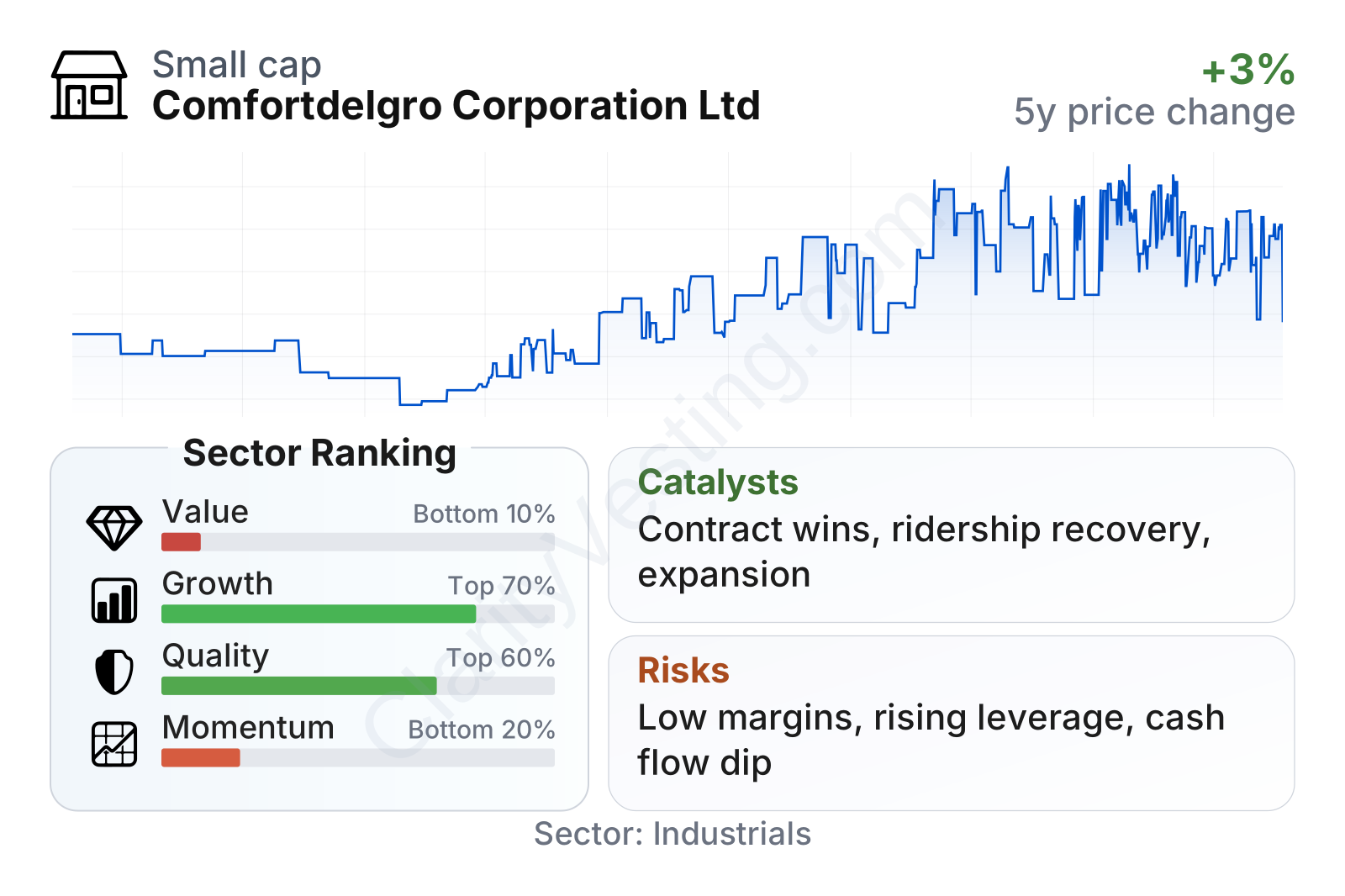
ComfortDelGro is a mid-sized transportation operator with unusually low share-price volatility, reflected in a beta far below the broader market. On valuation multiples, the stock screens below the sector median on earnings and book value, while the dividend yield stands well above the sector norm. Quality and growth indicators are more mixed: returns on capital and interest coverage look solid, but margins remain below sector medians and free cash flow recently turned negative on a trailing basis. Price performance has also lagged much of the sector over the past year, which helps explain why the valuation appears restrained.
Growth
ComfortDelGro operates in a sector with durable long-term demand. Cities continue to need buses, rail links, fleet services, and regulated transport systems. That does not make transport a high-growth industry in the same way as software or semiconductors, but it does support steady demand over time. Urbanization, aging populations, congestion management, and government support for public transit all help keep the sector relevant.
The company’s strategy is logical for that environment. It has been leaning further into contracted and regulated public transport, which usually offers better visibility than more cyclical transport activities. This matters because public transport contracts can create recurring revenue, even if margins are not especially high. At the same time, its taxi and mobility operations provide exposure to day-to-day consumer transport demand, while engineering and inspection add support businesses around the fleet base.
Recent corporate updates have also highlighted expansion through acquisitions and contract wins in overseas markets, particularly in bus and rail-related services. For a business like ComfortDelGro, these developments can be meaningful because scale, route density, depot infrastructure, and operating experience are difficult to replicate quickly. The company is not trying to invent a new transport model; it is building a larger platform in essential mobility.
A point to watch is cash conversion. Free cash flow was strong at the end of 2024 but dropped sharply by mid-2025, even though accounting earnings continued to improve. That does not automatically signal deterioration, since transport businesses often have uneven capital spending and working-capital swings, but it does mean growth is currently more visible in revenue and operating profit than in cash generation.
A further catalyst is the ongoing normalization of ridership and transport activity in key markets since the pandemic period. If passenger volumes, taxi utilization, and contract performance keep improving together, the company could continue to lift earnings even without dramatic top-line acceleration.
Risks
This article is for informational purposes only and does not constitute financial advice. Some content is AI-generated. See Disclaimer


