Stock Analysis · Coeur Mining Inc (CDE)
Overview
Coeur Mining is a U.S.-based precious metals producer. The company operates mines in the United States, Canada, and Mexico, and it also has a development project in Nevada. Its business is straightforward: extract ore, process it, and sell gold and silver, with smaller by-product exposure to zinc and lead. For long-term readers, the key point is that Coeur is primarily tied to precious metals prices, but its results also depend heavily on how efficiently each mine operates.
Revenue is mainly generated from metal sales. Based on the company’s recent annual disclosures and operating mix, the business is led by gold, followed by silver, with base-metal by-products contributing a smaller share.
- Gold: approximately 60% to 70% of revenue. This comes mainly from mines such as Rochester, Palmarejo, Kensington, and Wharf.
- Silver: approximately 20% to 30% of revenue. Rochester and Palmarejo are especially important here, with additional silver contribution from Coeur’s broader asset base.
- Zinc and lead: approximately 5% to 15% combined. These are by-products, primarily associated with the Silvertip operation and certain ore streams.
What matters most is that Coeur’s revenue mix has been shifting toward stronger overall output after the large Rochester expansion. That project has changed the company’s earnings profile by increasing scale and lowering unit-cost pressure when running well. Recent years also show a visible improvement in how much of each revenue dollar is retained after production and operating costs, which is a major reason the market has re-rated the stock.
The multi-year picture points to a major turnaround. Revenue was relatively flat to modestly higher through 2021 to 2024, then stepped up sharply in 2025 as production and profitability improved. The most important change is not only higher sales, but also a much stronger conversion of revenue into operating income and net income.
Key Figures
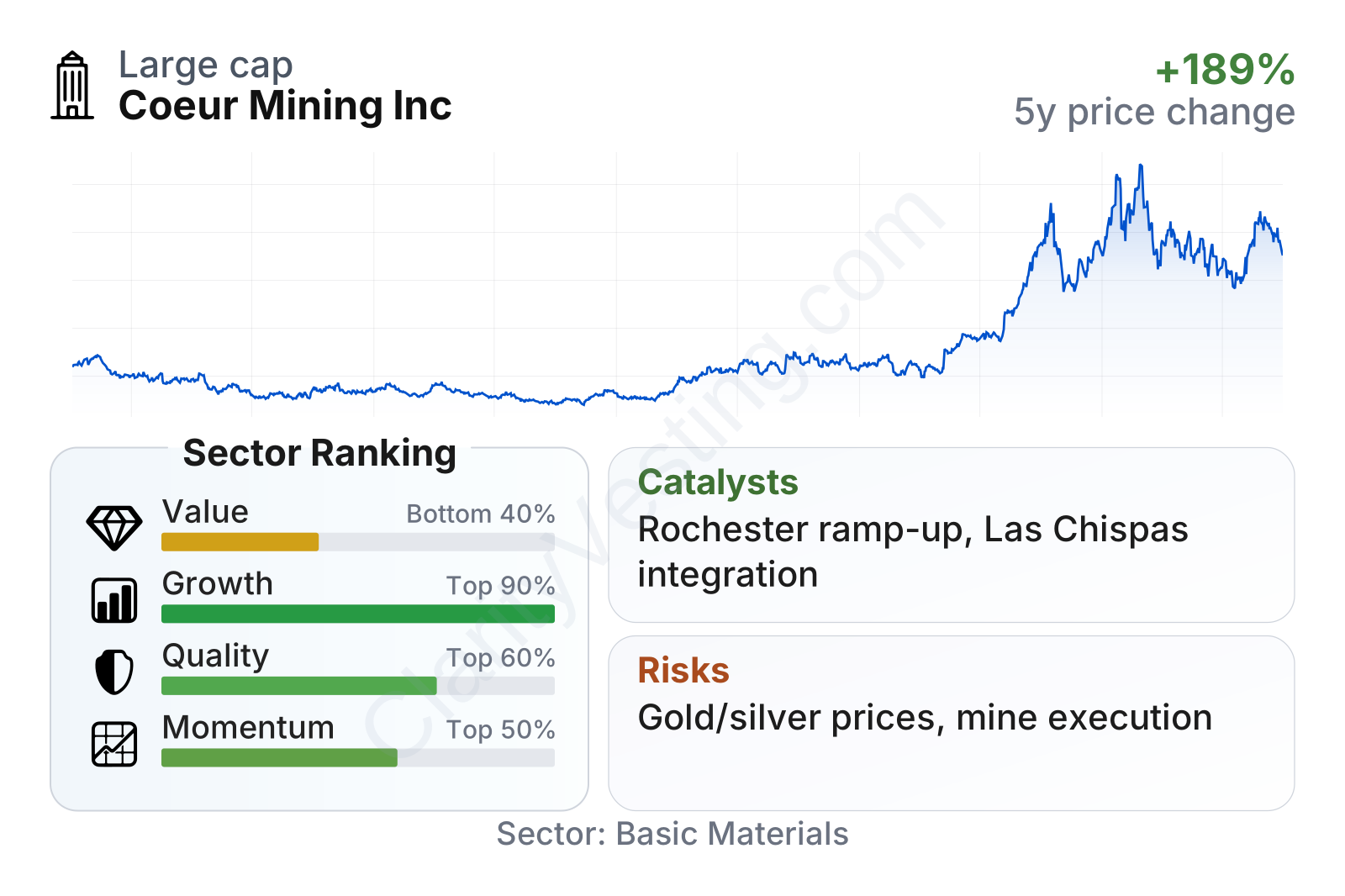
The share price has been highly volatile over the past few years, which is common for mining companies and especially for producers with meaningful silver exposure. The stock moved from depressed levels in 2023 to a much higher range by late 2025 and early 2026, reflecting both stronger company execution and a favorable precious-metals backdrop.
| Metric | Value | Sector ⓘ |
|---|---|---|
| Date | Oct 03, 2026 | |
| Context | ||
| Sector | Basic Materials | |
| Industry | Gold | |
| Market Cap ⓘ | $18.34B | |
| Beta ⓘ | 1.39 | |
Value (Cheapness) | ||
| P/E Ratio ⓘ | 14.99 | 17.61 |
| P/B Ratio ⓘ | 1.75 | 1.77 |
| FCF Yield ⓘ | 6.30% | 5.87% |
| Dividend Yield ⓘ | 0.11% | 2.06% |
| EBIT / EV ⓘ | 5.52% | 6.43% |
| PEG ⓘ | 3.75 | |
Growth (Business expansion) | ||
| Revenue Growth ⓘ | 125.90% | 11.30% |
| RPS Growth (5Y CAGR) ⓘ | -1.14% | 4.46% |
| EPS Growth (5Y CAGR) ⓘ | N/A | -13.11% |
| BVPS Growth (5Y CAGR) ⓘ | 12.30% | 5.51% |
| Margin Growth (5Y Trend) ⓘ | 25.65% | -1.57% |
| FCF Growth (5Y CAGR) ⓘ | N/A | 0.55% |
| DPS Growth (5Y CAGR) ⓘ | N/A | 6.02% |
Quality (Business durability) | ||
| ROIC (Latest) ⓘ | 11.85% | 9.31% |
| ROA (Latest) ⓘ | 8.63% | 4.94% |
| ROIC (5Y Median) ⓘ | -2.17% | 7.91% |
| ROA (5Y Median) ⓘ | -2.00% | 3.93% |
| Net Debt / EBIT (Latest) ⓘ | -0.31 | 1.40 |
| Net Debt / EBIT (5Y Median) ⓘ | 2.97 | 1.70 |
| Net Debt / EBITDA (Latest) ⓘ | -0.21 | 0.91 |
| Net Debt / Assets ⓘ | -2.23% | 13.69% |
| EBITDA / Interest ⓘ | 53.60 | 11.93 |
| Operating Margin (Latest) ⓘ | 34.00% | 13.07% |
| Operating Margin (5Y Median) ⓘ | 8.81% | 11.86% |
| Debt to Equity (Latest) ⓘ | 6.85% | 40.43% |
| Profit Margin (Latest) ⓘ | 26.82% | 6.57% |
| Free Cash Flow (Latest) ⓘ | $1.16B | |
Momentum (Price trend) | ||
| 3Y Return ⓘ | +693.69% | +65.06% |
| 12M Return (excl. last month) ⓘ | +58.20% | +36.05% |
| 6M Return ⓘ | -6.13% | +1.89% |
| Price vs. 200-Day MA ⓘ | -8.59% | +1.03% |
Coeur currently looks strongest on growth, where it ranks near the top of its sector, and solid on quality and momentum. Recent profitability, returns on capital, and balance-sheet improvement are materially better than the typical company in its peer group. The weaker area is value: the stock does not screen as particularly cheap relative to sector norms once the recent rerating is taken into account. The company is also a large and more volatile name, with beta above 1, which fits the cyclical nature of mining shares.
Growth
Precious metals remain a relevant long-term sector, although not a classic secular growth industry like software or semiconductors. Demand is supported by several durable themes: gold’s role as a store of value, central-bank buying, silver’s monetary appeal, and silver’s industrial use in areas such as solar and electronics. That means Coeur’s long-term growth case is less about demand growing every year at a fast pace and more about operating the right mines efficiently during supportive commodity cycles.
Coeur’s strategy makes sense in that context. The company has spent several years reshaping its portfolio around larger, longer-life assets and development upside. The Rochester expansion is the clearest example. It was a costly and complicated project, but it now appears to be delivering the scale that management had targeted. Coeur also has optionality from exploration and development assets, especially the Las Chispas acquisition and the Sterling project in Nevada, which can support future production growth or portfolio flexibility.
Revenue growth has accelerated sharply since 2024 and remains far above the sector median. That kind of growth is rarely explained by metal prices alone. It usually signals a combination of higher production, better grades, improved recovery, and a more favorable sales mix. For Coeur, that is important because it suggests the business is benefiting from internal execution as well as the external commodity environment.
Free cash flow has also improved dramatically, moving from deeply negative levels during the heavier investment period to strongly positive territory. For a miner, this is one of the most important turning points to watch. Positive free cash flow creates room for debt reduction, exploration spending, project development, and a stronger cushion if metal prices become less favorable.
A meaningful recent catalyst is the integration of SilverCrest, which added the high-grade Las Chispas asset to the portfolio. That deal increased Coeur’s silver exposure and added a mine known for stronger grades than many large-scale open-pit operations. Combined with Rochester’s ramp-up, it gives the company two visible drivers of operating leverage. In addition, a higher gold and silver price environment can have an outsized impact on miners that have recently improved their cost structure, because incremental revenue often flows through margins more quickly.
Risks
This article is for informational purposes only and does not constitute financial advice. Some content is AI-generated. See Disclaimer