Stock Analysis · Chaince Digital Holdings Inc (CD)
Overview
Chaince Digital Holdings Inc operates in financial services, but it is not a traditional bank, broker, or asset manager. Based on its public filings, the company has been building a business around digital-finance related services and technology-oriented financial activities. Its reported revenue base is still very small for a public company of its market value, which makes the business harder to assess using the usual long-term benchmarks applied to larger capital-markets firms.
The company’s recent filings indicate that revenue has come from a limited number of operating activities rather than a broad, diversified platform. Public disclosures do not provide a detailed segment split robust enough to present a reliable percentage breakdown across multiple revenue lines. What is clear is that total revenue has remained modest in absolute terms, with meaningful fluctuations from year to year, which suggests the business model is still in an early or transitional stage rather than a mature steady-state operation.
Looking at the income structure over the last several years, the key pattern is not just low revenue but also a large gap between revenue and operating costs. In earlier years, cost of revenue exceeded sales, producing negative gross profit. In 2025, gross profit turned positive, which is an operational improvement, but selling, general, and administrative expenses remained much larger than revenue. That means the company has not yet converted top-line progress into a self-sustaining profit model.
The business therefore appears to be defined less by current scale and more by the possibility of future expansion if management can turn its digital-finance platform into a larger commercial operation.
The operating profile shows some progress in revenue and gross profit, but overhead remains the dominant issue. The main financial bottleneck is not debt pressure; it is that expenses still absorb far more than the business currently earns.
Key Figures
| Metric | Value | Sector ⓘ |
|---|---|---|
| Date | Oct 17, 2026 | |
| Context | ||
| Sector | Financial Services | |
| Industry | Capital Markets | |
| Market Cap ⓘ | $1.20B | |
| Beta ⓘ | 8.17 | |
Value (Cheapness) | ||
| P/E Ratio ⓘ | N/A | 12.26 |
| P/B Ratio ⓘ | 18.21 | 1.23 |
| FCF Yield ⓘ | -0.20% | 10.40% |
| Dividend Yield ⓘ | N/A | 3.02% |
| EBIT / EV ⓘ | -1.11% | 8.14% |
| PEG ⓘ | N/A | |
Growth (Business expansion) | ||
| Revenue Growth ⓘ | 98.40% | 9.35% |
| RPS Growth (5Y CAGR) ⓘ | -21.31% | 12.19% |
| EPS Growth (5Y CAGR) ⓘ | -28.66% | -9.53% |
| BVPS Growth (5Y CAGR) ⓘ | -8.29% | 4.99% |
| Margin Growth (5Y Trend) ⓘ | N/A | -3.86% |
| FCF Growth (5Y CAGR) ⓘ | -8.44% | 4.81% |
| DPS Growth (5Y CAGR) ⓘ | N/A | 8.79% |
Quality (Business durability) | ||
| ROIC (Latest) ⓘ | N/A | 9.49% |
| ROE (Latest) ⓘ | -19.83% | 13.90% |
| ROA (Latest) ⓘ | -17.63% | 1.55% |
| ROIC (5Y Median) ⓘ | N/A | 7.86% |
| ROE (5Y Median) ⓘ | -44.38% | 12.17% |
| ROA (5Y Median) ⓘ | -37.97% | 1.30% |
| Net Debt / EBIT (Latest) ⓘ | N/A | 0.96 |
| Net Debt / EBIT (5Y Median) ⓘ | N/A | 0.73 |
| Net Debt / EBITDA (Latest) ⓘ | N/A | 0.92 |
| Operating Margin (Latest) ⓘ | -168.19% | 22.30% |
| Operating Margin (5Y Median) ⓘ | -314.02% | 24.63% |
| Debt to Equity (Latest) ⓘ | 2.03% | 58.56% |
| Profit Margin (Latest) ⓘ | -182.51% | 26.57% |
| Free Cash Flow (Latest) ⓘ | -$2.42M | |
Momentum (Price trend) | ||
| 3Y Return ⓘ | +809.17% | +88.33% |
| 12M Return (excl. last month) ⓘ | -44.55% | +19.38% |
| 6M Return ⓘ | +139.25% | +4.75% |
| Price vs. 200-Day MA ⓘ | +119.57% | +3.50% |
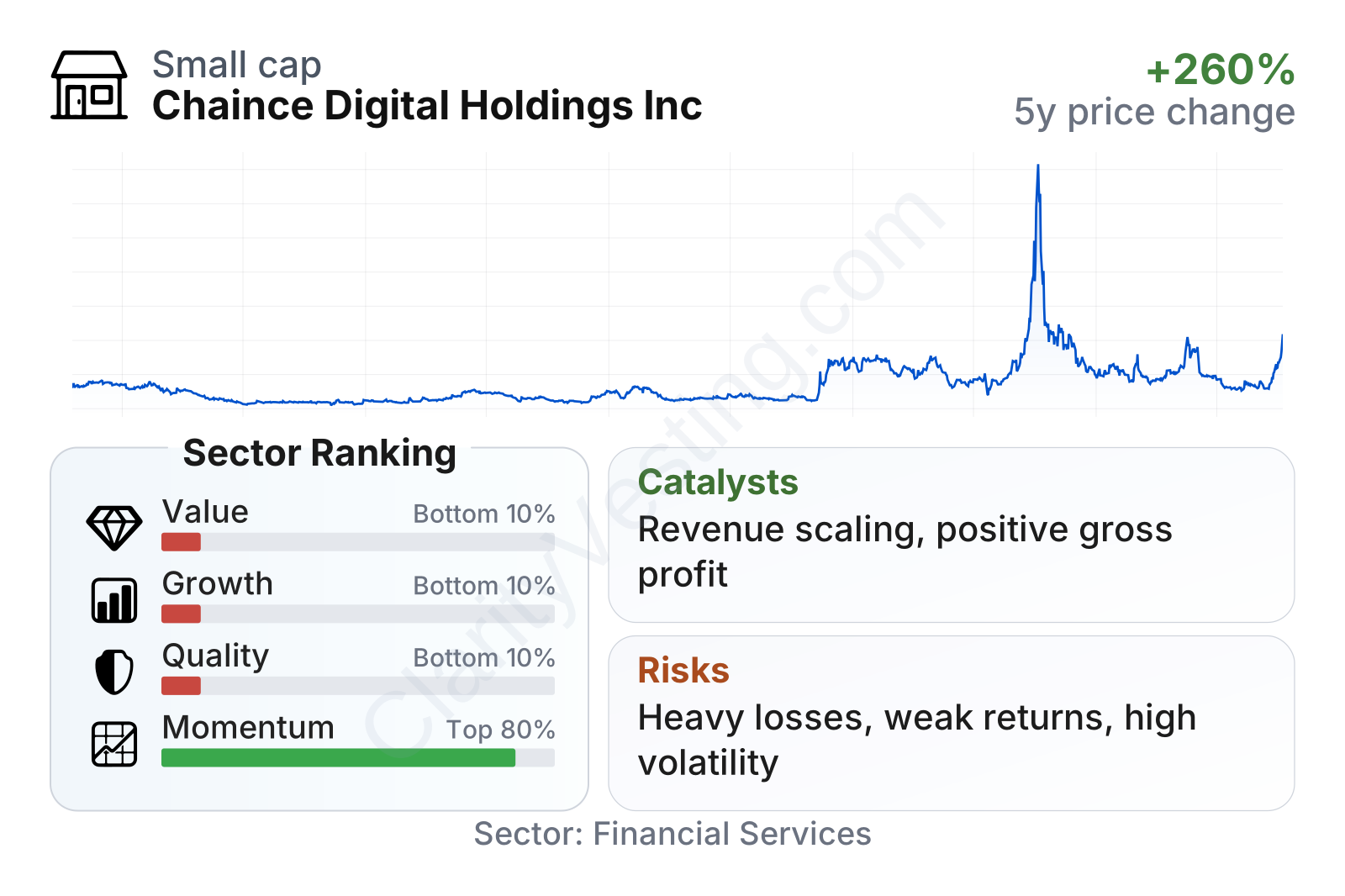
Chaince Digital is a small-cap company with unusually high share-price volatility. Its beta above 8 and the stock-price history both point to a security that can move sharply in either direction over short periods. That kind of behavior is far outside the norm for the financial-services sector and makes market sentiment a major part of the current valuation picture.
On the factor table, the company ranks in the bottom 10% of its sector on value, growth, and quality, while momentum is stronger than most peers. That combination matters: the market has at times rewarded the shares, but the underlying business fundamentals remain weak. Profitability metrics are deeply negative, free cash flow is negative, and valuation multiples such as price-to-book are far above sector norms. In simple terms, the stock has shown bursts of market enthusiasm even though the operating base is still fragile.
Growth
Chaince Digital is connected to a part of the market that can attract long-term interest: digital financial infrastructure, online capital-markets services, and technology-enabled financial operations. Those areas can offer growth because financial activity continues to move toward digital platforms, faster settlement, data-driven services, and cross-border accessibility. In that sense, the company is operating in a sector where expansion is possible.
That said, sector exposure alone is not enough. For long-term growth to become meaningful, the company needs to show that its platform can consistently attract more business without expanding overhead at the same pace. The latest numbers suggest revenue nearly doubled year over year, which is a strong headline improvement. However, the longer record is still uneven: five-year revenue-per-share and earnings trends remain negative, showing that growth has not yet become durable.
The earnings path remains the clearest sign that the turnaround is incomplete. Losses have persisted, and earnings per share have deteriorated over the longer period despite occasional operational improvements. For a company at this stage, future growth depends less on accounting expansion and more on proving that recent revenue gains can continue while costs become more disciplined.
Book value per share has also been unstable. After a steep decline from earlier levels, it recovered somewhat more recently, but the longer-term trend is still negative. That usually signals that the company has not yet created lasting shareholder value through retained profits. A stronger and more stable book-value trend would be an important sign that the business is moving from experimentation toward a more established financial model.
The main potential catalyst is operational scaling. If management can keep revenue growing from a very low base and preserve the shift back to positive gross profit, even modest absolute gains could have a noticeable effect on the income statement. Because the company is still small in operating terms, contract wins, new platform activity, partnerships, or a broader commercial rollout could move results materially. The challenge is that this remains a possibility rather than a demonstrated pattern.
Risks
This article is for informational purposes only and does not constitute financial advice. Some content is AI-generated. See Disclaimer


