Stock Analysis · China Conch Venture Holdings Limited (CCVTF)
Overview
China Conch Venture Holdings Limited is a China-based environmental and industrial services company best known for using cement kilns to co-process waste. In simple terms, it helps industrial clients and municipalities dispose of hazardous and solid waste while also recovering value from that process. Over time, the company has built a broader platform that combines waste treatment, environmental engineering, and investments linked to new energy and resource-related businesses.
The business has historically had two major earnings pillars: its environmental operations and its investment portfolio. That mix matters because reported profit can move not only with the underlying waste-treatment business, but also with changes in investment income and fair-value gains or losses. In recent years, the operating side has become more important as the company continues expanding treatment capacity and related environmental services.
Based on recent annual disclosures, the main revenue sources appear to be roughly the following:
- Industrial and hazardous waste treatment: approximately 50% to 60% of revenue. This includes collecting, treating, and co-processing hazardous waste, sludge, fly ash, and other industrial residues.
- New energy materials and related products: approximately 20% to 30% of revenue. This area has included lithium iron phosphate and other materials tied to batteries and energy storage.
- Equipment, engineering, and project services: approximately 10% to 20% of revenue. This includes environmental project construction, equipment supply, and technical services.
- Other activities: a smaller share, typically below 10%, including ancillary environmental and industrial services.
The broad picture is that China Conch Venture sits at the intersection of environmental compliance, industrial waste disposal, and circular-economy infrastructure. That gives it exposure to long-term regulation-driven demand, but it also creates a more complex business model than a pure-play waste operator.
The long-term financial flow shows a business that kept gross profit fairly resilient even as revenue fell from its earlier peak. Revenue moved down from about RMB 8.0 billion in 2023 to around RMB 6.4 billion in 2025, while gross profit stayed close to RMB 2.2 billion. That suggests pricing and business mix held up relatively well, but operating income and net income were pressured by higher operating costs and still-material interest expense.
Key Figures
| Metric | Value | Sector ⓘ |
|---|---|---|
| Date | Oct 03, 2026 | |
| Context | ||
| Sector | Industrials | |
| Industry | Pollution & Treatment Controls | |
| Market Cap ⓘ | $1.83B | |
| Beta ⓘ | 1.12 | |
Value (Cheapness) | ||
| P/E Ratio ⓘ | 6.38 | 22.45 |
| P/B Ratio ⓘ | 0.03 | 1.98 |
| FCF Yield ⓘ | 162.09% | 6.31% |
| Dividend Yield ⓘ | 39.02% | 1.96% |
| EBIT / EV ⓘ | N/A | 4.81% |
| PEG ⓘ | N/A | |
Growth (Business expansion) | ||
| Revenue Growth ⓘ | 22.90% | 9.10% |
| RPS Growth (5Y CAGR) ⓘ | 1.87% | 7.75% |
| EPS Growth (5Y CAGR) ⓘ | -23.03% | -13.59% |
| BVPS Growth (5Y CAGR) ⓘ | 4.55% | 6.22% |
| Margin Growth (5Y Trend) ⓘ | 2.22% | 0.72% |
| FCF Growth (5Y CAGR) ⓘ | N/A | 10.98% |
| DPS Growth (5Y CAGR) ⓘ | -9.16% | 9.48% |
Quality (Business durability) | ||
| ROIC (Latest) ⓘ | N/A | 10.92% |
| ROA (Latest) ⓘ | 4.65% | 5.41% |
| ROIC (5Y Median) ⓘ | 2.37% | 9.21% |
| ROA (5Y Median) ⓘ | 3.16% | 4.94% |
| Net Debt / EBIT (Latest) ⓘ | 9.60 | 2.07 |
| Net Debt / EBIT (5Y Median) ⓘ | 9.18 | 2.28 |
| Net Debt / EBITDA (Latest) ⓘ | 5.19 | 1.43 |
| Net Debt / Assets ⓘ | 31.59% | 19.27% |
| EBITDA / Interest ⓘ | 3.98 | 9.53 |
| Operating Margin (Latest) ⓘ | 20.99% | 10.50% |
| Operating Margin (5Y Median) ⓘ | 24.46% | 10.27% |
| Debt to Equity (Latest) ⓘ | 58.58% | 65.48% |
| Profit Margin (Latest) ⓘ | 24.68% | 6.62% |
| Free Cash Flow (Latest) ⓘ | $2.96B | |
Momentum (Price trend) | ||
| 3Y Return ⓘ | -8.03% | +58.56% |
| 12M Return (excl. last month) ⓘ | +4.54% | +15.63% |
| 6M Return ⓘ | -9.86% | +4.19% |
| Price vs. 200-Day MA ⓘ | -9.55% | +0.93% |
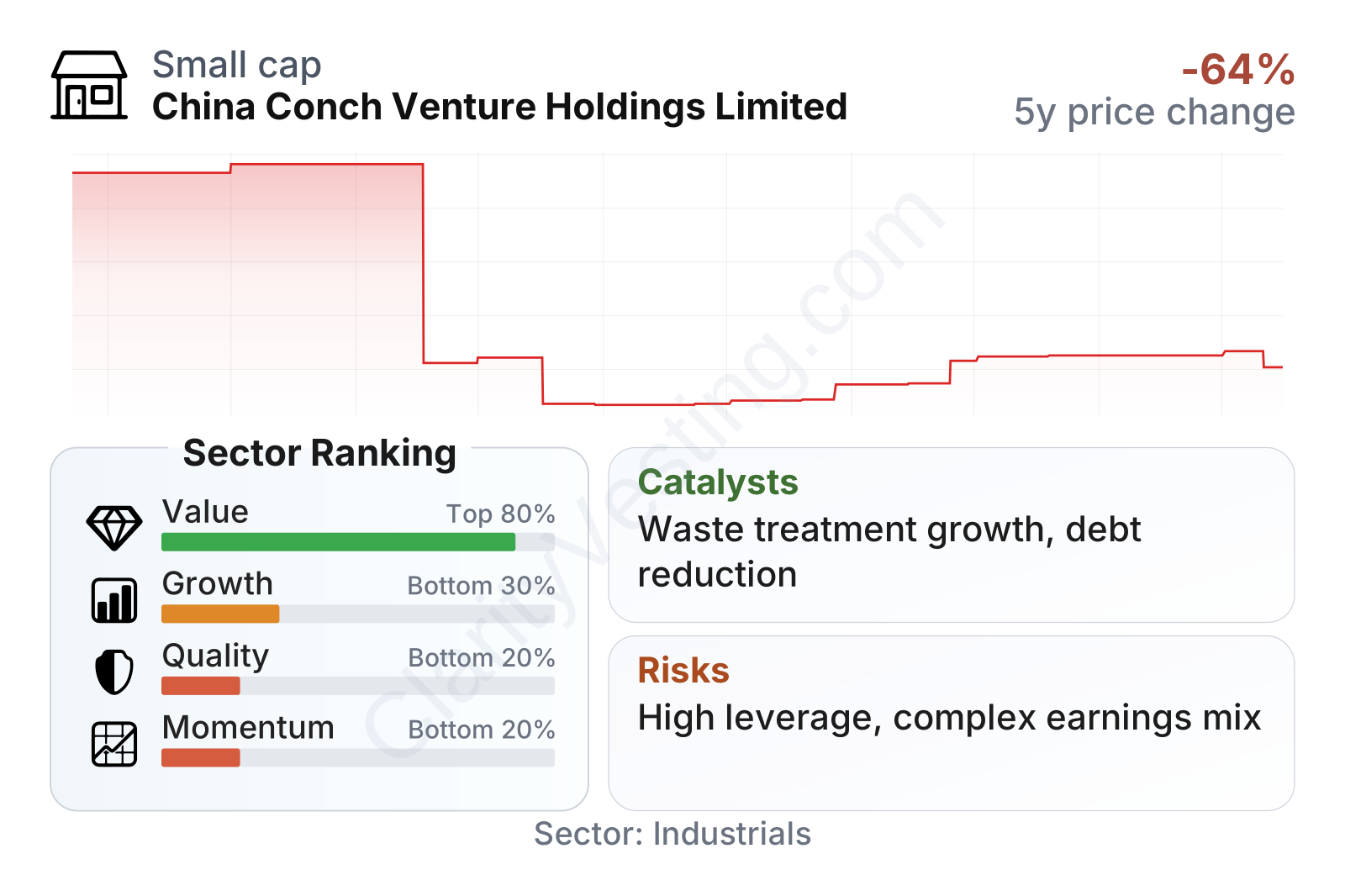
On valuation, the stock screens as unusually cheap versus much of the industrials sector. The earnings multiple is low, price-to-book is far below normal sector levels, and the free-cash-flow yield is exceptionally high. The dividend yield is also very elevated. That combination usually signals that the market is placing a discount on the balance sheet, asset quality, or the durability of profits rather than ignoring the company entirely.
Profitability is mixed. Operating and net margins are strong on an absolute basis and well above sector medians, showing that the company can still earn solid margins in its core activities. However, returns on capital and returns on assets are weaker than many peers, which points to a heavy asset base and imperfect capital efficiency.
Balance-sheet risk is the biggest weak spot in the metrics. Net debt relative to earnings is much higher than sector norms, and interest coverage is noticeably lower. Even though debt-to-equity is not extreme for an industrial company, the company’s ability to service debt depends on maintaining stable operating cash flow and avoiding major earnings shocks.
Growth indicators also require nuance. Recent year-over-year revenue growth has improved, but the longer five-year record is much less impressive, with weak revenue-per-share growth and declining earnings per share. The share-price record reflects that tension: the stock has recovered from its lows, but it still sits well below levels seen several years ago and trails much of the sector on medium-term performance.
Growth
The company operates in a sector with real long-term structural support. China continues to tighten environmental standards, upgrade industrial waste management, and invest in circular-economy infrastructure. Hazardous-waste disposal is not a discretionary service for many customers; it is driven by regulation, licensing, and compliance needs. That gives the industry a more durable demand base than many traditional industrial markets.
China Conch Venture’s strategy also makes industrial sense. Its core model uses existing cement-kiln infrastructure to treat waste at scale, which can create cost advantages and high barriers to entry in locations where permits, logistics networks, and industrial relationships matter. The company has also tried to broaden beyond basic waste treatment into resource utilization and battery-material-related activities, which could open additional growth paths if those operations achieve better scale and profitability.
A practical catalyst is continued capacity utilization in hazardous-waste and solid-waste treatment. If treatment volumes rise faster than fixed costs, margins can improve meaningfully. Another possible catalyst is a better contribution from new energy materials after a difficult period across the battery-material supply chain. The company’s valuation leaves room for sentiment to improve if operating performance stabilizes and leverage trends begin to improve.
Recent corporate updates have also highlighted ongoing project development and operational expansion in environmental businesses. The opportunity is straightforward: stricter environmental enforcement, more industrial waste generation, and wider use of co-processing solutions could support steady demand even in a slower macroeconomic backdrop.
Risks
This article is for informational purposes only and does not constitute financial advice. Some content is AI-generated. See Disclaimer