Stock Analysis · CITIC Telecom International Holdings Limited (CCTTF)
Overview
CITIC Telecom International Holdings Limited is a Hong Kong-based telecom and information and communications technology company. It provides international telecommunications services, enterprise networking, cloud and cybersecurity services, mobile communications in Macau, and internet data center capacity. In simple terms, it operates digital infrastructure and connectivity services that help carriers, multinational companies, and local businesses move data, connect offices, host systems, and secure networks.
The business is relatively diversified across telecom and enterprise services, although traditional connectivity still matters a lot. Based on the company’s annual reporting structure and recent revenue mix, the main sources of revenue are approximately:
- Internet services and enterprise solutions: roughly 35% to 45% of revenue. This includes internet access, cloud, data centers, cybersecurity, managed network services, and corporate digital solutions.
- Mobile services in Macau: roughly 25% to 35%. This covers mobile subscriptions, roaming, handset-related activity, and related telecom services through CTM.
- International telecommunications services: roughly 20% to 30%. This includes international voice, messaging, carrier services, and global connectivity.
- Fixed-line and local telecom services: roughly 5% to 15%. This includes local voice, broadband, and other fixed communications activities.
The broad revenue picture suggests a business in transition: legacy telecom services remain important, but the company has been trying to build a larger role in enterprise digital infrastructure and integrated ICT offerings. Over the last few years, revenue has stayed near the same overall level, while profitability has become more pressured, showing that the challenge is not scale alone but also service mix and margin quality.
The operating flow shows a stable revenue base near HK$9.6 billion to HK$10.1 billion in recent years, but profit conversion weakened after 2023. Gross profit and operating income dropped noticeably in 2024 and remained soft in 2025, while net income stayed below earlier peaks. One positive point is that interest expense fell sharply in 2025, which helped cushion earnings even as operating performance remained under pressure.
Key Figures
| Metric | Value | Sector ⓘ |
|---|---|---|
| Date | Oct 03, 2026 | |
| Context | ||
| Sector | Communication Services | |
| Industry | Telecom Services | |
| Market Cap ⓘ | $1.20B | |
| Beta ⓘ | 0.22 | |
Value (Cheapness) | ||
| P/E Ratio ⓘ | 8.10 | 18.20 |
| FCF Yield ⓘ | N/A | 14.71% |
| Dividend Yield ⓘ | 55.57% | 2.86% |
| EBIT / EV ⓘ | 120.82% | 4.85% |
| PEG ⓘ | N/A | |
Growth (Business expansion) | ||
| Revenue Growth ⓘ | -1.20% | 5.50% |
| RPS Growth (5Y CAGR) ⓘ | 0.09% | 4.55% |
| EPS Growth (5Y CAGR) ⓘ | -31.91% | -18.01% |
| Margin Growth (5Y Trend) ⓘ | -3.32% | 1.32% |
| FCF Growth (5Y CAGR) ⓘ | 0.51% | 5.96% |
| DPS Growth (5Y CAGR) ⓘ | -3.27% | 5.09% |
Quality (Business durability) | ||
| ROIC (Latest) ⓘ | N/A | 8.64% |
| ROIC (5Y Median) ⓘ | 7.08% | 8.11% |
| Net Debt / EBIT (Latest) ⓘ | N/A | 1.92 |
| Net Debt / EBIT (5Y Median) ⓘ | 1.32 | 2.85 |
| Net Debt / EBITDA (Latest) ⓘ | N/A | 1.25 |
| Net Debt / Assets ⓘ | 7.72% | 18.77% |
| EBITDA / Interest ⓘ | N/A | 8.75 |
| Operating Margin (Latest) ⓘ | N/A | 15.58% |
| Operating Margin (5Y Median) ⓘ | 16.69% | 13.53% |
| Debt to Equity (Latest) ⓘ | N/A | 59.53% |
| Profit Margin (Latest) ⓘ | 9.70% | 8.78% |
| Free Cash Flow (Latest) ⓘ | N/A | |
Momentum (Price trend) | ||
| 3Y Return ⓘ | +26.23% | +43.39% |
| 12M Return (excl. last month) ⓘ | +7.96% | +1.92% |
| 6M Return ⓘ | +7.54% | +2.94% |
| Price vs. 200-Day MA ⓘ | +4.92% | +0.74% |
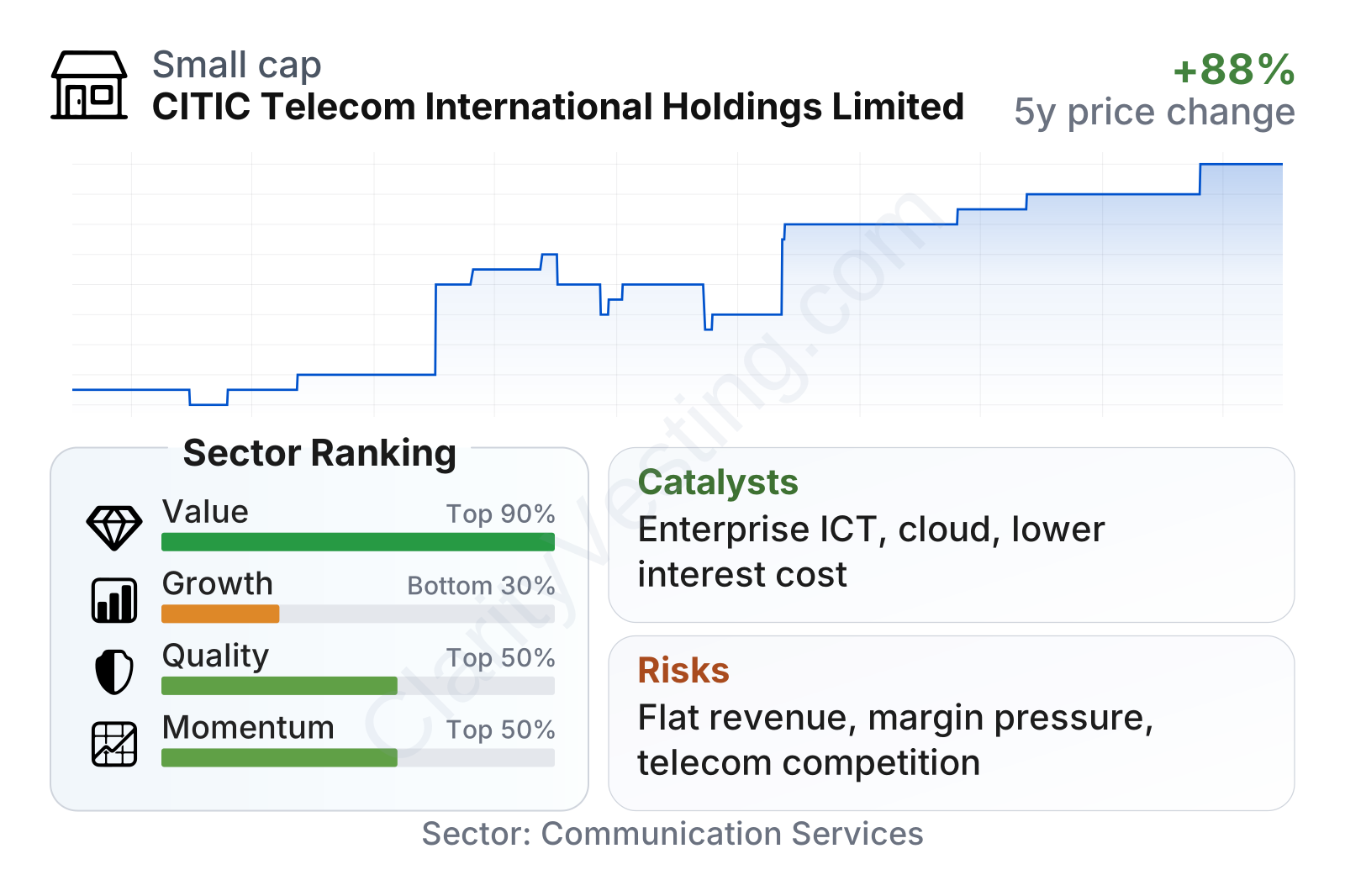
CITIC Telecom is a small-cap telecom operator with an unusually low share-price volatility profile, reflected in a beta near 0.22. The metrics point to a mixed profile: valuation looks very compressed versus the broader communication services group, quality is around the middle of the sector with relatively conservative leverage, and recent market performance has been better than the sector over the last 6 to 12 months. The weak area is growth. Revenue has been slightly negative year over year, longer-term revenue per share growth has been close to flat, earnings have contracted over five years, and margin trends have moved in the wrong direction. The dividend yield is exceptionally high on a trailing basis, but that should be read together with the slower growth profile and some decline in profit and dividend per share over time.
Growth
The company operates in areas that are structurally relevant for the long run. Demand for cloud connectivity, cybersecurity, cross-border enterprise networking, data center services, and digital transformation remains supported by ongoing data growth and tighter security requirements. Those are attractive parts of the communications market because corporate customers often need stable, recurring services rather than one-off products.
CITIC Telecom’s strategy also makes industrial sense. It sits between classic telecom infrastructure and enterprise IT services, which gives it a chance to bundle connectivity, cloud, security, and managed services for business clients. That can be more valuable than selling basic bandwidth alone. Its ownership links to the broader CITIC group and its established presence in Hong Kong, Macau, mainland China connectivity, and international carrier relationships may also help it serve customers that need cross-border communications.
That said, the company’s actual growth record has not yet matched the industry opportunity. Revenue has been mostly flat for several years, and profits have softened. This suggests the company is participating in growing digital segments, but not fast enough to offset pressure in more mature telecom activities. For long-term business development, the key question is whether enterprise services, cloud, cybersecurity, and data center products can become a larger and more profitable share of the mix.
Recent company communications have continued to emphasize enterprise digitalization, cloud computing, cybersecurity, and integrated ICT capabilities. Those areas are the clearest potential catalysts because they tend to carry stronger customer stickiness and can deepen relationships with business clients. Another potential support is lower financing cost pressure, already visible in the sharp drop in interest expense in 2025. If operating margins stabilize while newer services gain scale, earnings quality could improve even without major top-line acceleration.
Risks
This article is for informational purposes only and does not constitute financial advice. Some content is AI-generated. See Disclaimer