Stock Analysis · Century Communities Inc (CCS)
Overview
Century Communities, Inc. is a U.S. homebuilder. The company develops, builds, markets, and sells single-family homes, and it also provides related services that help buyers complete a home purchase. Its operations are spread across multiple states, with activity focused on markets where population growth, employment expansion, and housing demand have historically supported new-home sales.
The business is primarily organized around homebuilding, with mortgage, title, and insurance services attached to that core offering. Based on recent annual reporting, revenue is overwhelmingly tied to the sale of homes and homesites, while the financial services segment contributes a much smaller share.
- Home sales: approximately 97% to 99% of revenue. This includes newly built homes delivered to buyers and, in some periods, land or homesite sales tied to community development activity.
- Financial services: approximately 1% to 3% of revenue. This includes mortgage origination, title services, and insurance products used by homebuyers in Century Communities transactions.
That mix matters because it makes Century Communities highly exposed to the housing cycle: demand, affordability, mortgage rates, incentives, and construction costs all have a direct impact on results. At the same time, the attached mortgage and title operations can help capture more value per transaction and improve the customer experience.
Over the last several years, the company’s revenue base has remained large, but profitability has moved around much more than sales. Revenue recovered strongly in 2024 after a softer 2023, then eased again in 2025, while operating income and net income fell much more sharply than revenue. In simple terms, Century Communities is still selling a large volume of homes, but each dollar of sales has recently produced less profit than during the peak years of the cycle.
Key Figures
| Metric | Value | Sector ⓘ |
|---|---|---|
| Date | Nov 14, 2026 | |
| Context | ||
| Sector | Real Estate | |
| Industry | Real Estate - Development | |
| Market Cap ⓘ | $1.50B | |
| Beta ⓘ | 1.30 | |
Value (Cheapness) | ||
| P/E Ratio ⓘ | 14.15 | 18.10 |
| P/B Ratio ⓘ | 0.58 | 1.62 |
| FCF Yield ⓘ | -5.51% | 5.78% |
| Dividend Yield ⓘ | 2.31% | 4.71% |
| EBIT / EV ⓘ | 3.64% | 4.93% |
| PEG ⓘ | 0.45 | |
Growth (Business expansion) | ||
| Revenue Growth ⓘ | -11.80% | 5.70% |
| RPS Growth (5Y CAGR) ⓘ | 2.60% | 5.87% |
| EPS Growth (5Y CAGR) ⓘ | -35.10% | -3.35% |
| BVPS Growth (5Y CAGR) ⓘ | 13.62% | 0.24% |
| Margin Growth (5Y Trend) ⓘ | -10.90% | -0.69% |
| FCF Growth (5Y CAGR) ⓘ | N/A | 5.81% |
| DPS Growth (5Y CAGR) ⓘ | 26.91% | 5.00% |
Quality (Business durability) | ||
| ROIC (Latest) ⓘ | 2.15% | 5.18% |
| ROE (Latest) ⓘ | 4.24% | 7.66% |
| ROA (Latest) ⓘ | 2.36% | 3.09% |
| ROIC (5Y Median) ⓘ | 14.53% | 4.21% |
| ROE (5Y Median) ⓘ | 13.33% | 6.04% |
| ROA (5Y Median) ⓘ | 7.67% | 2.43% |
| Net Debt / EBIT (Latest) ⓘ | 14.60 | 7.49 |
| Net Debt / EBIT (5Y Median) ⓘ | 2.40 | 8.41 |
| Net Debt / EBITDA (Latest) ⓘ | 12.32 | 5.31 |
| Net Debt / Assets ⓘ | 36.29% | 38.16% |
| EBITDA / Interest ⓘ | N/A | 4.20 |
| Operating Margin (Latest) ⓘ | 3.13% | 34.29% |
| Operating Margin (5Y Median) ⓘ | 11.01% | 37.26% |
| Debt to Equity (Latest) ⓘ | 71.23% | 90.28% |
| Profit Margin (Latest) ⓘ | 2.86% | 18.55% |
| Free Cash Flow (Latest) ⓘ | -$82.66M | |
Momentum (Price trend) | ||
| 3Y Return ⓘ | -21.40% | +33.76% |
| 12M Return (excl. last month) ⓘ | -9.43% | +1.92% |
| 6M Return ⓘ | +2.06% | -1.15% |
| Price vs. 200-Day MA ⓘ | -15.98% | 0.00% |
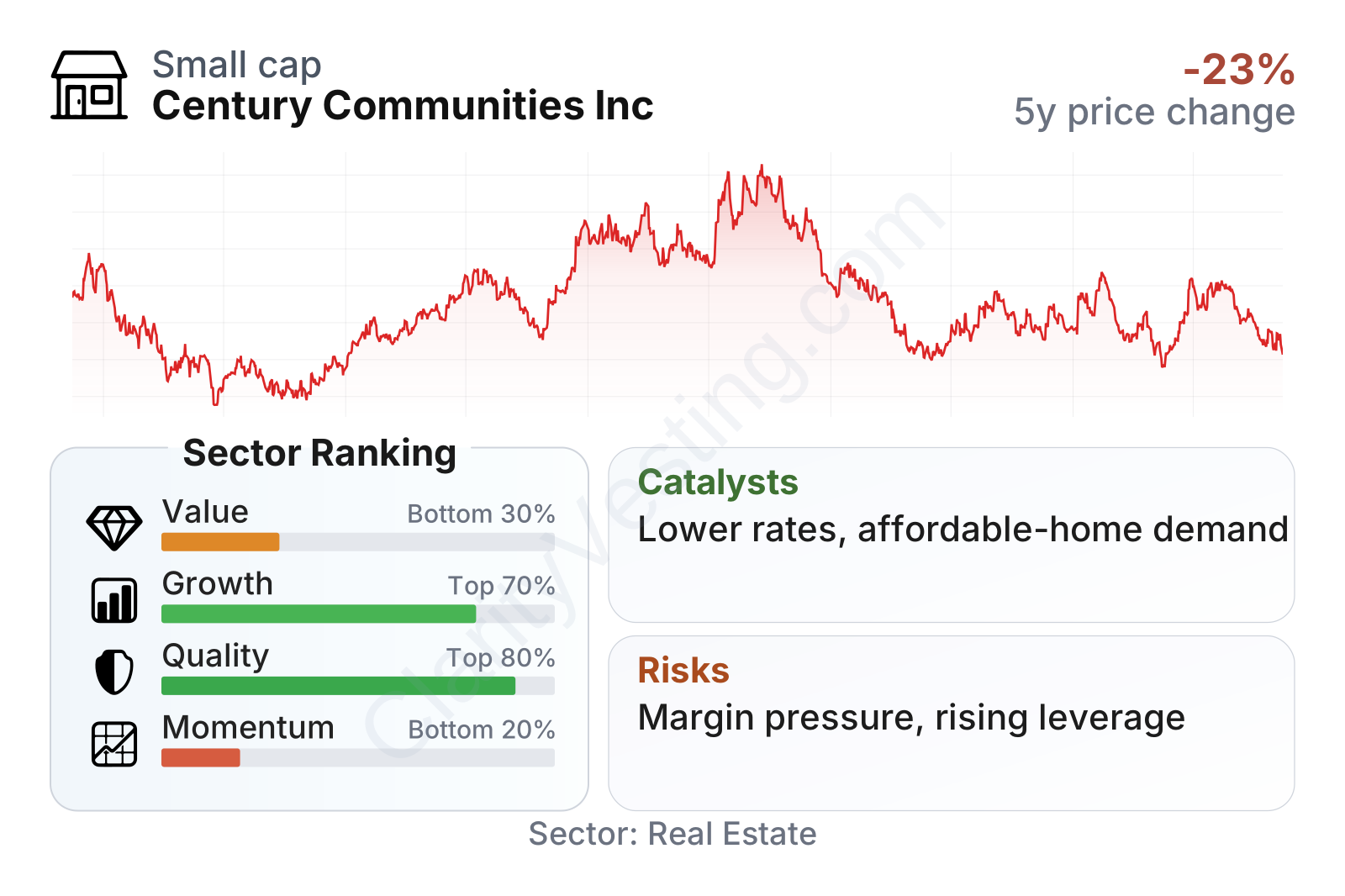
Century Communities is a mid-sized public homebuilder with stock volatility above the market average, which is common for cyclical housing names. The latest factor profile shows a mixed picture. On valuation, the shares screen below sector median levels on price-to-earnings and price-to-book, suggesting the market is assigning a cautious multiple. On quality and growth, the picture is more uneven: long-term book value growth has been solid, but recent revenue and earnings trends have weakened, and free cash flow is currently negative. Price performance has also lagged much of the sector over the last year and over a multi-year view, which fits with the market’s more conservative stance toward the company’s near-term earnings power.
Growth
Century Communities operates in a sector with durable long-term demand drivers, even though short-term conditions can be rough. U.S. housing is supported by population growth, household formation, a structural shortage of homes in many markets, and the aging of existing housing stock. Those are favorable background conditions for builders that can keep communities supplied and offer products at price points buyers can still afford.
The company’s strategy is sensible for that environment. Century Communities has emphasized a broad geographic footprint, an entry-level and move-up product mix, and an integrated offering that includes financing and title services. That is especially relevant when mortgage rates are elevated: builders with financing capabilities can use rate buydowns and other incentives more efficiently than a builder that only sells the house. The company has also used its Century Complete and online sales approach to streamline part of the purchase process, which can support volume in more standardized communities.
Revenue per share has been relatively resilient over the last five years despite a visible dip during the housing slowdown. That suggests the company has largely preserved its scale even as market conditions changed. The issue has not been demand disappearing entirely; it has been converting that demand into attractive margins while keeping incentives and financing support competitive.
The dividend trend has been one of the brighter signals. Per-share payouts have risen steadily over the past five years, indicating that management has been willing to return more cash to shareholders even while the cycle became less favorable. The yield itself is not especially high versus the broader real estate sector, but the growth rate in the payout has been strong.
A key catalyst for future growth is any improvement in housing affordability. If mortgage rates stabilize or decline, traffic, orders, and conversion rates could improve across the industry. Century Communities also has room to benefit from community expansion and lot pipeline execution if it can bring inventory to market in regions with stronger migration and employment trends. Another potential opportunity comes from the persistent shortage of affordable new homes: builders that can control costs and turn inventory efficiently may capture demand from buyers who are priced out of the resale market or discouraged by limited existing-home supply.
Recent company updates have also highlighted continued community count activity, lot investment, and the use of incentives to maintain sales pace. Those are not risk-free tools, but they show management is focused on keeping volume moving rather than waiting passively for a better market.
Risks
This article is for informational purposes only and does not constitute financial advice. Some content is AI-generated. See Disclaimer