Stock Analysis · Crown Castle (CCI)
Overview
Crown Castle is a U.S. infrastructure real estate investment trust focused on wireless communications. In simple terms, it owns the physical assets that mobile carriers and other network operators use to move wireless data: cell towers, small cells placed close to users in dense areas, and extensive fiber lines that connect those sites. Instead of selling phone service to consumers, Crown Castle rents access to this infrastructure under long-term contracts, which makes its business more utility-like than consumer-facing.
The company’s revenue comes mainly from leasing space and connectivity to large wireless carriers. Based on recent annual disclosures, the revenue mix is approximately:
- Towers: about 60% to 65% of revenue. This includes rent from tenants placing equipment on Crown Castle’s towers, amendments that add equipment, and contractual escalators.
- Fiber and small cells: about 35% to 40% of revenue. This includes small cell hosting and fiber solutions used to connect wireless sites and support enterprise or network customers.
The business model has traditionally benefited from recurring rental income, because adding an extra tenant to an existing asset usually carries high incremental margins. That helps explain why Crown Castle has historically produced strong operating profitability. At the same time, the latest years also show that portfolio changes and asset impairments can create large swings in reported earnings, so headline profit does not always reflect the underlying cash generation of the assets.
Over the last several years, revenue rose from the low-$6 billion range to nearly $7 billion, then moved lower more recently as portfolio actions and business pressure in fiber affected the top line. Gross profit stayed substantial, but interest expense increased materially, reflecting a more difficult rate environment for a capital-intensive REIT.
The broad picture is of a large infrastructure landlord with durable assets, high margins, and recurring contracts, but also one that is in the middle of reshaping parts of its portfolio after weaker performance in fiber-related operations.
Key Figures
| Metric | Value | Sector ⓘ |
|---|---|---|
| Date | Oct 24, 2026 | |
| Context | ||
| Sector | Real Estate | |
| Industry | REIT - Specialty | |
| Market Cap ⓘ | $33.46B | |
| Beta ⓘ | 0.96 | |
Value (Cheapness) | ||
| P/E Ratio ⓘ | 33.05 | 17.85 |
| P/B Ratio ⓘ | N/A | 0.87 |
| FCF Yield ⓘ | 7.19% | 7.30% |
| Dividend Yield ⓘ | 5.24% | 4.83% |
| EBIT / EV ⓘ | 3.08% | 3.78% |
| PEG ⓘ | 0.55 | |
Growth (Business expansion) | ||
| Revenue Growth ⓘ | -4.90% | 5.35% |
| RPS Growth (5Y CAGR) ⓘ | -9.59% | 6.02% |
| EPS Growth (5Y CAGR) ⓘ | -7.60% | -10.65% |
| BVPS Growth (5Y CAGR) ⓘ | N/A | 0.43% |
| Margin Growth (5Y Trend) ⓘ | 20.16% | -0.69% |
| FCF Growth (5Y CAGR) ⓘ | 17.70% | 5.40% |
| DPS Growth (5Y CAGR) ⓘ | -3.41% | 5.07% |
Quality (Business durability) | ||
| ROIC (Latest) ⓘ | 9.70% | 5.69% |
| ROE (Latest) ⓘ | N/A | 7.37% |
| ROA (Latest) ⓘ | 3.97% | 2.85% |
| ROIC (5Y Median) ⓘ | 7.90% | 4.26% |
| ROE (5Y Median) ⓘ | 16.85% | 6.04% |
| ROA (5Y Median) ⓘ | 2.82% | 2.45% |
| Net Debt / EBIT (Latest) ⓘ | 14.07 | 7.55 |
| Net Debt / EBIT (5Y Median) ⓘ | 13.16 | 8.26 |
| Net Debt / EBITDA (Latest) ⓘ | 9.83 | 5.26 |
| Net Debt / Assets ⓘ | 109.76% | 37.45% |
| EBITDA / Interest ⓘ | 2.63 | 4.11 |
| Operating Margin (Latest) ⓘ | 39.36% | 33.86% |
| Operating Margin (5Y Median) ⓘ | 33.65% | 37.49% |
| Debt to Equity (Latest) ⓘ | -669.45% | 88.76% |
| Profit Margin (Latest) ⓘ | 20.72% | 18.94% |
| Free Cash Flow (Latest) ⓘ | $2.41B | |
Momentum (Price trend) | ||
| 3Y Return ⓘ | +6.97% | +36.33% |
| 12M Return (excl. last month) ⓘ | -19.29% | +4.32% |
| 6M Return ⓘ | -5.93% | -1.74% |
| Price vs. 200-Day MA ⓘ | -1.96% | -1.42% |
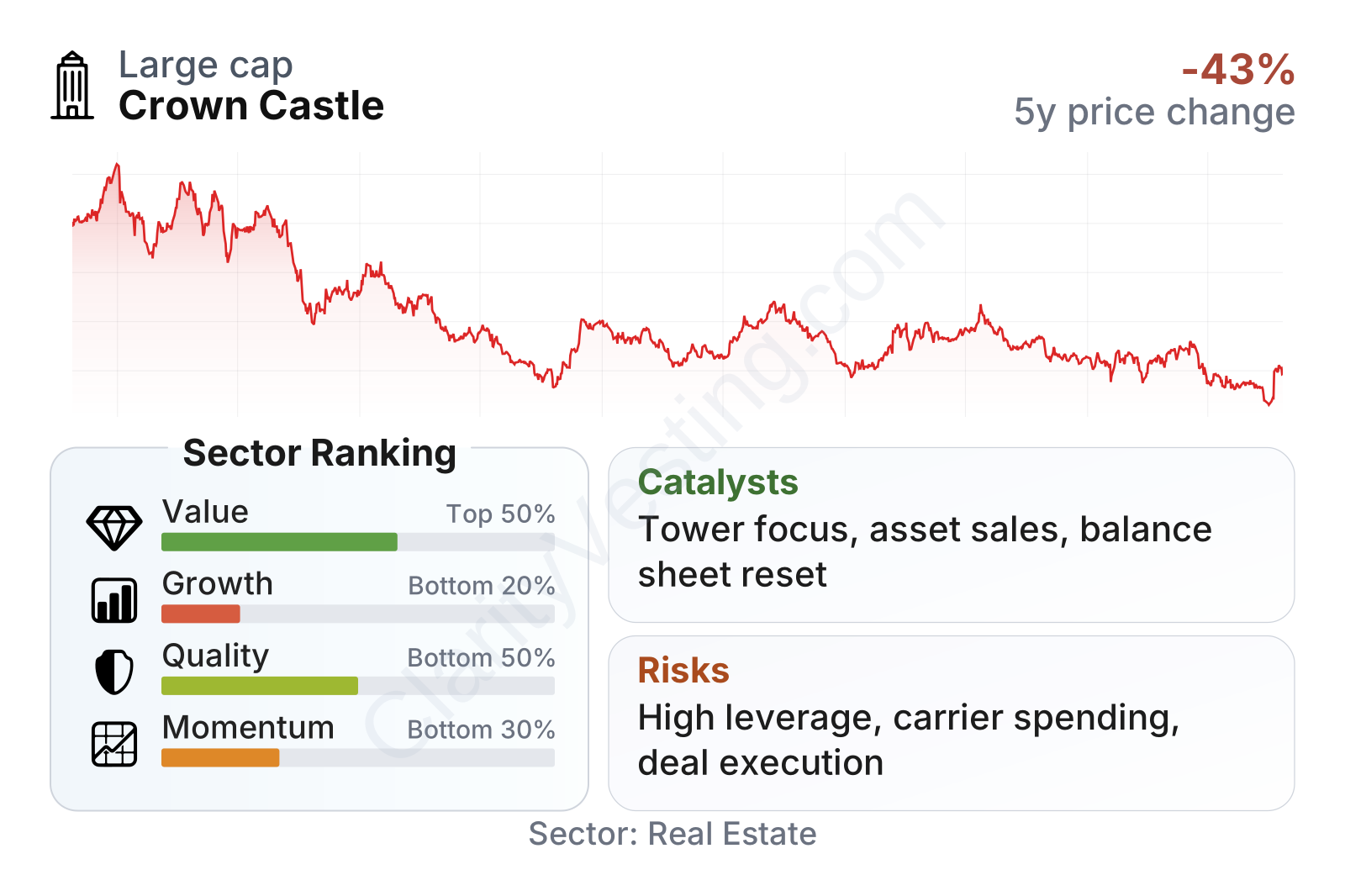
Crown Castle is a large-cap REIT with share-price behavior close to the overall market, but its recent stock performance has been notably weaker than the typical company in its sector. The latest factor snapshot is mixed: valuation signals are not stretched across every metric, free cash flow yield and dividend yield stand out positively, and profitability remains solid relative to peers. The weak area is growth, where revenue and per-share trends have lagged the sector materially, while market momentum also remains poor.
This combination matters because it shows a company that still generates meaningful cash and maintains strong margins, yet is being judged by the market as a slower-growth and higher-risk infrastructure owner rather than a straightforward expansion platform.
Growth
Crown Castle operates in a sector with favorable long-term demand drivers. Mobile data usage continues to rise, networks need more capacity, and carriers still depend on third-party infrastructure to avoid building everything themselves. Towers remain essential assets, and small cells can become more valuable as traffic density increases in urban corridors, venues, and transportation routes. In that sense, the company is tied to a structurally important part of the digital economy.
The more complicated question is whether Crown Castle is positioned to convert that industry demand into strong company-level growth. The answer is mixed. Its tower business remains attractive because tower leases are typically sticky, escalators are built into many contracts, and additional colocations can improve returns without requiring entirely new sites. That part of the strategy still makes sense for long-term infrastructure demand.
Fiber and small cells are less straightforward. Those assets can support long-duration growth if carrier spending on network densification accelerates, but deployment timing has been uneven. Carriers have recently moderated parts of their spending, which has reduced near-term growth visibility. Management’s recent strategic focus has increasingly centered on sharpening the portfolio and emphasizing returns rather than simply expanding the asset base.
The revenue-per-share trend reflects that pressure. It was relatively stable through 2022 and 2023, softened in 2024, and then fell sharply in 2025. That pattern suggests Crown Castle is not currently in a broad-based expansion phase, even though its core assets remain relevant to future wireless demand.
A notable recent catalyst is the company’s strategic shift around its fiber footprint. Crown Castle announced transactions to sell its small cells and fiber solutions businesses while retaining its tower business. If completed as expected, this would materially simplify the company and make it more of a pure-play tower REIT. That can improve comparability with tower-focused peers, reduce execution complexity, and potentially support balance-sheet repair or capital returns depending on how proceeds are used. It is one of the most important developments in the company’s recent history.
Another meaningful catalyst is the planned increase in capital allocation discipline. A more focused tower portfolio could lead to steadier cash generation and a clearer operating profile. For a company whose public market valuation has been weighed down by mixed segment performance, simplification itself can be a growth support factor, even if near-term reported revenue becomes smaller after divestitures.
The dividend-per-share chart shows the income profile has changed. After several years of gradual increases, the payout dropped sharply in 2025. That move reduces one of the traditional attractions many market participants associated with Crown Castle, but it also aligns with the company’s effort to reset its financial structure around a narrower business model. Going forward, the key issue is not past dividend growth, but whether the reshaped company can produce steadier coverage from recurring tower cash flows.
Risks
This article is for informational purposes only and does not constitute financial advice. Some content is AI-generated. See Disclaimer


