Stock Analysis · China Cinda Asset Management Co. Ltd (CCGDF)
Overview
China Cinda Asset Management Co. Ltd is a Chinese financial institution best known for dealing with distressed assets. In simple terms, it buys or manages troubled loans and other hard-to-sell financial assets, then tries to recover value through restructuring, collection, disposal, or conversion into other investments. Over time, the group has also built businesses in asset management, financial services, and selected investment activities. It is one of the large state-linked asset managers created to help clean up bad loans in China’s banking system, which gives it a special role in parts of the country’s financial system.
The company’s revenue mix can shift meaningfully from year to year because recoveries on distressed assets, fair-value changes, and disposal timing can all move results. Based on the structure described in recent annual disclosures and the way the group reports its operations, the main economic drivers are broadly the following:
- Distressed asset management: typically the largest source of earnings and capital deployment. This includes acquisition, management, restructuring, and disposal of non-performing loans and other troubled assets.
- Investment income and fair-value changes: an important contributor that can be material in some years. This includes returns from debt, equity, and other financial assets held by the group.
- Financial services and asset management fees: a smaller but recurring stream tied to subsidiaries and service platforms, including management and advisory-type activities.
- Interest-related income: income earned on certain financial assets and financing arrangements, partly offset by the group’s own borrowing costs.
Because China Cinda operates more like a balance-sheet-driven financial institution than a typical fee-based asset manager, headline revenue is less straightforward than at a standard fund manager. The key point for long-term readers is that results depend heavily on asset quality, recovery values, funding costs, and policy conditions in China’s credit markets.
The business flow also shows that revenue and profit have been volatile in recent years. Revenue fell sharply after 2021, stayed under pressure through 2024, and then rebounded in 2025. At the same time, interest expense remained very large, which is a central feature of the company’s economics: recoveries and investment gains matter, but funding costs can absorb a significant share of them.
Key Figures
| Metric | Value | Sector ⓘ |
|---|---|---|
| Date | Oct 17, 2026 | |
| Context | ||
| Sector | Financial Services | |
| Industry | Asset Management | |
| Market Cap ⓘ | $5.10B | |
| Beta ⓘ | 0.49 | |
Value (Cheapness) | ||
| P/E Ratio ⓘ | 13.37 | 12.26 |
| P/B Ratio ⓘ | 0.00 | 1.23 |
| FCF Yield ⓘ | 1673.91% | 10.40% |
| Dividend Yield ⓘ | 20.94% | 3.02% |
| EBIT / EV ⓘ | N/A | 8.14% |
| PEG ⓘ | N/A | |
Growth (Business expansion) | ||
| Revenue Growth ⓘ | -37.40% | 9.35% |
| RPS Growth (5Y CAGR) ⓘ | 59.73% | 12.19% |
| EPS Growth (5Y CAGR) ⓘ | -41.99% | -9.53% |
| BVPS Growth (5Y CAGR) ⓘ | 68.09% | 4.99% |
| Margin Growth (5Y Trend) ⓘ | 25.48% | -3.86% |
| FCF Growth (5Y CAGR) ⓘ | N/A | 4.81% |
| DPS Growth (5Y CAGR) ⓘ | 42.03% | 8.79% |
Quality (Business durability) | ||
| ROIC (Latest) ⓘ | N/A | 9.49% |
| ROE (Latest) ⓘ | 2.90% | 13.90% |
| ROA (Latest) ⓘ | 0.31% | 1.55% |
| ROIC (5Y Median) ⓘ | 0.96% | 7.86% |
| ROE (5Y Median) ⓘ | 3.46% | 12.17% |
| ROA (5Y Median) ⓘ | 0.36% | 1.30% |
| Net Debt / EBIT (Latest) ⓘ | 12.76 | 0.96 |
| Net Debt / EBIT (5Y Median) ⓘ | 46.80 | 0.73 |
| Net Debt / EBITDA (Latest) ⓘ | 10.69 | 0.92 |
| Operating Margin (Latest) ⓘ | 45.62% | 22.30% |
| Operating Margin (5Y Median) ⓘ | 36.64% | 24.63% |
| Debt to Equity (Latest) ⓘ | 215.56% | 58.56% |
| Profit Margin (Latest) ⓘ | 8.72% | 26.57% |
| Free Cash Flow (Latest) ⓘ | $85.41B | |
Momentum (Price trend) | ||
| 3Y Return ⓘ | +42.23% | +88.33% |
| 12M Return (excl. last month) ⓘ | +26.49% | +19.38% |
| 6M Return ⓘ | +26.49% | +4.75% |
| Price vs. 200-Day MA ⓘ | +15.48% | +3.50% |
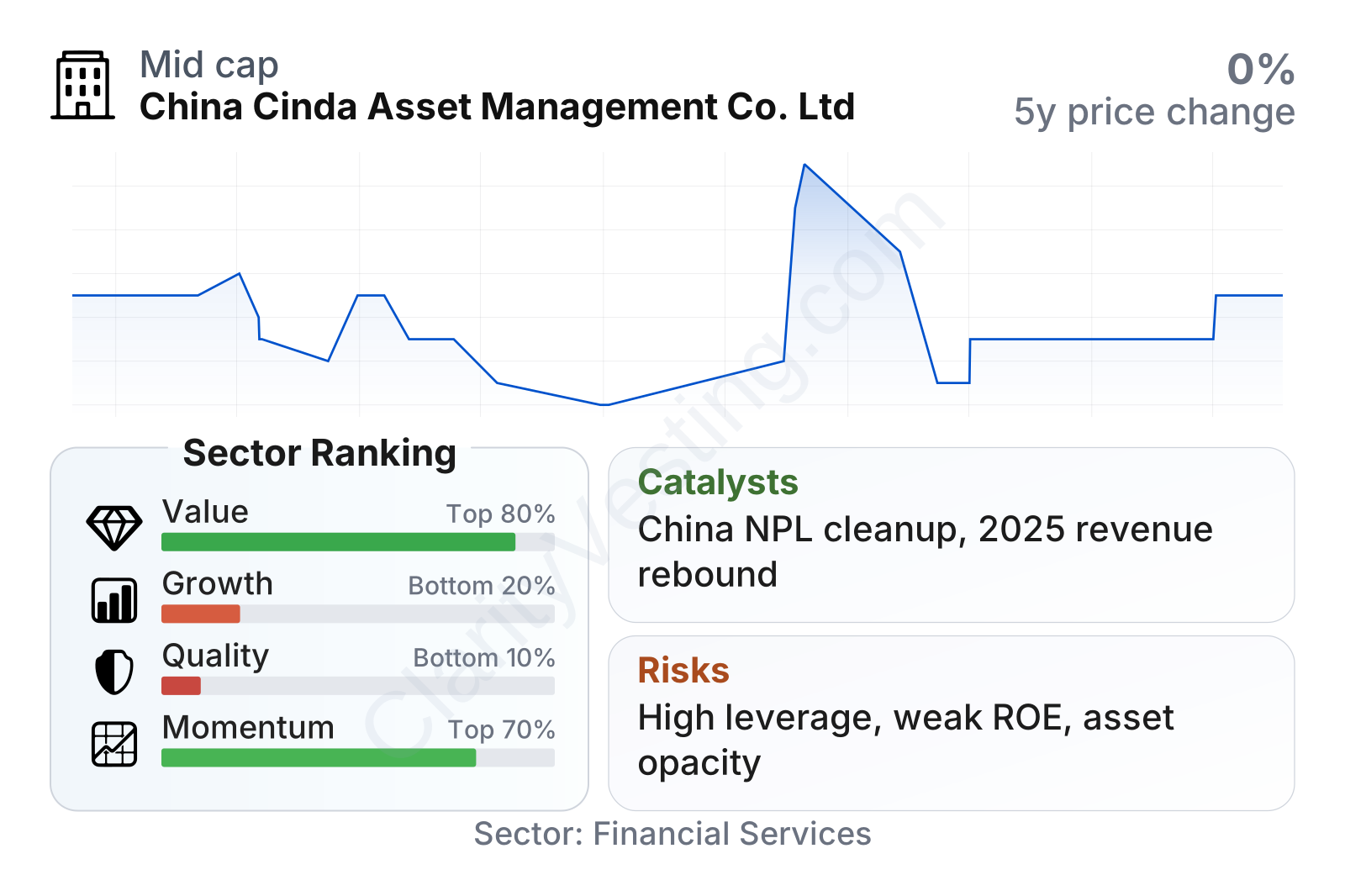
China Cinda is a mid-sized listed financial company by market value, and its share price behavior has been relatively calm compared with many financial stocks, with a beta around 0.5. Recent price momentum has improved, with gains over the last 6 to 12 months stronger than the sector median, although the longer three-year performance still trails much of the broader financial sector.
The valuation screen looks unusual at first glance. The price-to-earnings ratio is around the sector median, but the price-to-book ratio is extremely low versus peers. The dividend yield and free-cash-flow yield also appear very high. Those signals can indicate deep undervaluation, but for a company like China Cinda they can also reflect market skepticism about asset quality, earnings durability, and the reliability of book value.
On operating measures, there is a mixed picture. Operating margin is high relative to the sector, which suggests that when recoveries and investment outcomes are favorable, the business can generate solid spread economics. But return on equity is only about 3%, return on assets is near 0.3%, and leverage is far above sector norms, with debt-to-equity above 200%. That combination points to a company that looks cheap on asset-based measures but weak on profitability and balance-sheet quality.
Growth
China Cinda operates in a sector that should remain relevant as long as China has periodic stress in property, local government-related financing, and broader credit markets. Distressed debt resolution is not a passing niche; it is a recurring function in any large financial system. That gives the company a durable reason to exist, especially because it has long experience in workouts and a state-backed heritage that can matter when large restructurings become politically or financially sensitive.
Its current strategy also makes logical sense in this setting. When banks and other institutions need to reduce exposure to troubled assets, specialized managers like China Cinda can step in. If China continues to work through bad loans linked to real estate and slower growth, the company could see a larger pipeline of opportunities. That does not guarantee stronger profits, but it supports business relevance.
There are also some constructive internal trends despite weak recent year-over-year growth. Revenue growth over the last reported year was sharply negative, and earnings growth over five years has been poor. However, revenue per share over five years, operating margin trend, dividend per share growth, and especially book value per share growth over five years all stand out positively. This suggests the company has gone through a volatile reset rather than a simple linear decline.
The jump in book value per share in the latest period is especially notable. For long-term analysis, that kind of move deserves caution rather than automatic optimism, because at financial companies large changes can come from restructurings, reclassifications, capital actions, or accounting effects as well as underlying business improvement. Still, if that higher equity base proves durable, it could become an important support for the valuation case.
A visible catalyst is the rebound in total revenue and operating income in 2025 after several weaker years. Another is the company’s positioning in distressed assets at a time when China’s financial system continues to absorb pressure from property-related and credit-related stress. If policy support encourages banks to accelerate balance-sheet cleanup, China Cinda could benefit from greater transaction flow and more favorable restructuring opportunities.
Risks
This article is for informational purposes only and does not constitute financial advice. Some content is AI-generated. See Disclaimer


