Stock Analysis · Capital Clean Energy Carriers Corp (CCEC)
Overview
Capital Clean Energy Carriers Corp is a shipping company focused on transporting energy products by sea under multi-year charter contracts. Its fleet is centered on vessels that carry liquefied natural gas, or LNG, and the company has also been expanding into newer gas and carbon-related transport segments. In simple terms, it owns large ships and earns money by leasing them to energy companies and traders that need reliable transportation capacity.
The business model is relatively straightforward: the company invests in specialized ships, signs charter agreements with customers, and then collects contracted shipping revenue over the life of those agreements. That makes results less dependent on day-to-day spot shipping prices than many traditional tanker operators, although fleet utilization, vessel deliveries, financing costs, and customer quality still matter a great deal.
Based on recent company reporting, revenue is mainly generated from vessel chartering, with the largest contribution coming from LNG carriers. A simplified breakdown looks like this:
- LNG carrier charter revenue: approximately 70% to 85% of total revenue. This is the core business and includes long-term contracts for transporting liquefied natural gas.
- Legacy tanker and other gas carrier revenue: approximately 10% to 25%. This includes crude, product, or other gas-related shipping exposure depending on the period and fleet composition.
- Other revenue: typically below 5%. This may include ancillary shipping-related items and service reimbursements.
The mix can shift meaningfully from year to year because the company has been reshaping its fleet through vessel sales, acquisitions, and newbuild deliveries. The broad direction, however, has been clear: move away from conventional shipping exposure and build a larger presence in cleaner fuel and energy-transition transportation.
The income structure also shows an important feature of the model. Revenue and operating profit have generally stayed strong, while interest expense has become a much larger drain on earnings as the company finances fleet growth. That helps explain why the business can report high operating margins yet still face pressure on cash generation.
Key Figures
| Metric | Value | Sector ⓘ |
|---|---|---|
| Date | Oct 17, 2026 | |
| Context | ||
| Sector | Industrials | |
| Industry | Marine Shipping | |
| Market Cap ⓘ | $1.25B | |
| Beta ⓘ | 0.67 | |
Value (Cheapness) | ||
| P/E Ratio ⓘ | 12.54 | 22.10 |
| P/B Ratio ⓘ | 0.81 | 1.97 |
| FCF Yield ⓘ | -59.44% | 6.38% |
| Dividend Yield ⓘ | 2.91% | 1.94% |
| EBIT / EV ⓘ | 4.83% | 4.79% |
| PEG ⓘ | 4.02 | |
Growth (Business expansion) | ||
| Revenue Growth ⓘ | 8.50% | 9.30% |
| RPS Growth (5Y CAGR) ⓘ | -23.58% | 7.81% |
| EPS Growth (5Y CAGR) ⓘ | -49.45% | -13.06% |
| BVPS Growth (5Y CAGR) ⓘ | -3.19% | 6.14% |
| Margin Growth (5Y Trend) ⓘ | 14.81% | 0.88% |
| FCF Growth (5Y CAGR) ⓘ | -27.35% | 11.01% |
| DPS Growth (5Y CAGR) ⓘ | -5.84% | 9.48% |
Quality (Business durability) | ||
| ROIC (Latest) ⓘ | 4.06% | 10.84% |
| ROA (Latest) ⓘ | 2.53% | 5.41% |
| ROIC (5Y Median) ⓘ | N/A | 9.38% |
| ROA (5Y Median) ⓘ | 5.30% | 4.95% |
| Net Debt / EBIT (Latest) ⓘ | 13.90 | 2.08 |
| Net Debt / EBIT (5Y Median) ⓘ | 11.65 | 2.27 |
| Net Debt / EBITDA (Latest) ⓘ | 8.40 | 1.39 |
| Net Debt / Assets ⓘ | 57.53% | 19.28% |
| EBITDA / Interest ⓘ | 3.36 | 9.58 |
| Operating Margin (Latest) ⓘ | 49.52% | 10.50% |
| Operating Margin (5Y Median) ⓘ | 45.28% | 10.29% |
| Debt to Equity (Latest) ⓘ | 189.42% | 65.48% |
| Profit Margin (Latest) ⓘ | 28.01% | 6.67% |
| Free Cash Flow (Latest) ⓘ | -$745.11M | |
Momentum (Price trend) | ||
| 3Y Return ⓘ | +58.51% | +61.68% |
| 12M Return (excl. last month) ⓘ | +10.71% | +12.58% |
| 6M Return ⓘ | +8.61% | 0.00% |
| Price vs. 200-Day MA ⓘ | -2.81% | +0.02% |
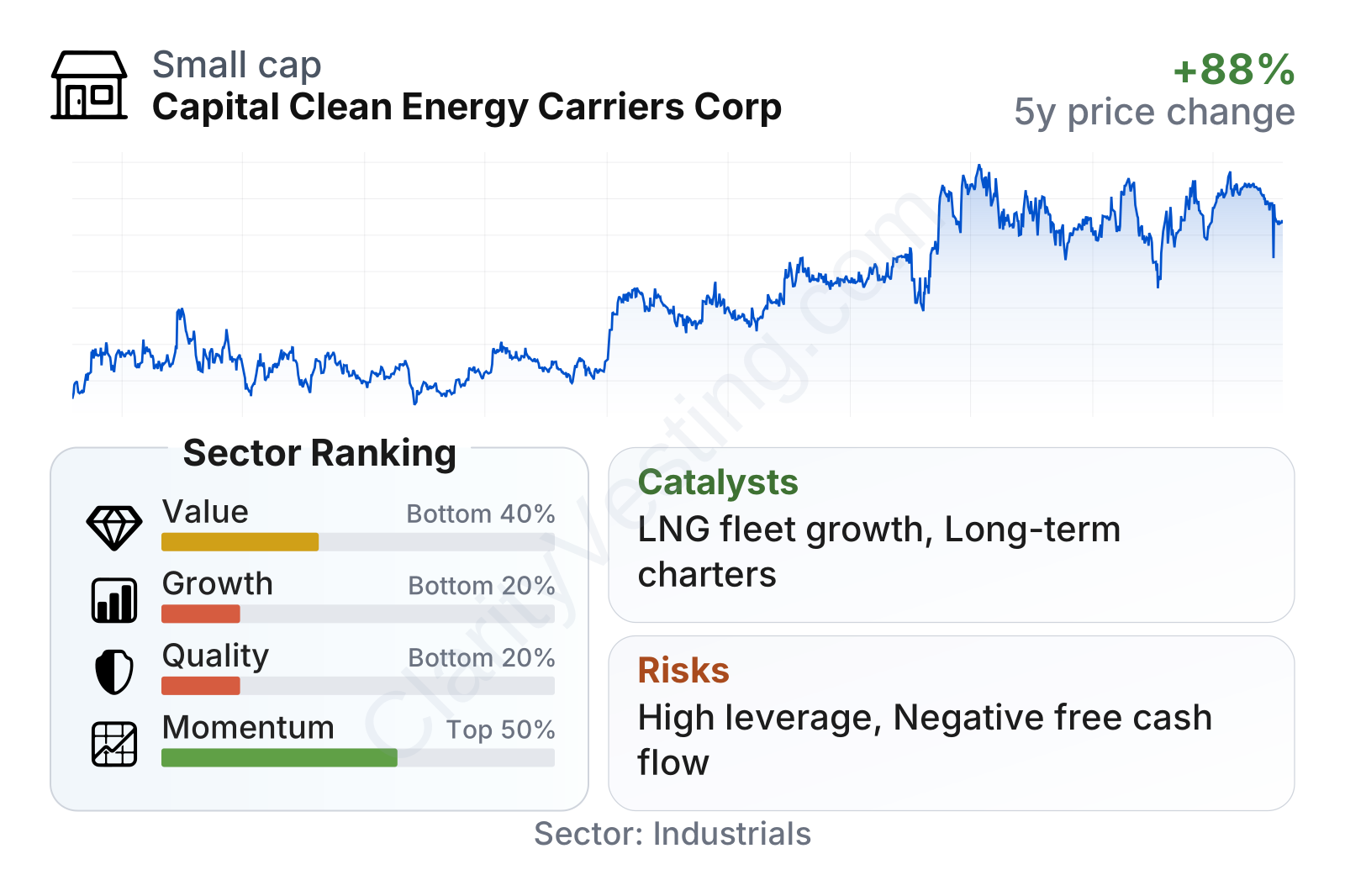
CCEC is a relatively small listed shipping company by market value, with a share price history that has been volatile but generally upward over the last several years. The metrics table points to a mixed profile. On valuation, the stock trades at lower earnings and book multiples than many industrial peers, but that comes with weak free cash flow and a modest growth ranking. Profitability on an accounting basis is unusually high for the sector, yet balance-sheet leverage is also far above typical shipping peers. In short, the company looks inexpensive on headline multiples, but not uncomplicated.
Growth
CCEC operates in a part of shipping tied to LNG, which remains one of the more structurally supported energy transport markets. Even with the long-term global push toward lower-carbon energy, natural gas continues to play a major role in power generation, industrial use, and energy security. That creates ongoing demand for LNG shipping capacity, especially on long-haul trade routes connecting the United States, Qatar, and other export hubs with Europe and Asia.
The company’s strategy is logical within that context. It has been repositioning the fleet toward modern gas carriers and away from older, less differentiated assets. For a long-term view, this matters because newer vessels usually attract better charter terms, stronger customers, and better efficiency. It also aligns the business with parts of maritime transport that can remain relevant through the energy transition rather than relying mainly on traditional oil tanker cycles.
Recent revenue growth has been uneven. Earlier periods showed very strong expansion, followed by a more volatile pattern with some quarters turning negative and the latest reading close to flat year over year. That is not unusual in shipping when vessel sales, charter rollovers, and delivery timing affect reported revenue. It does mean, however, that the growth case depends more on future fleet deployment and contract coverage than on a smooth historical trend.
Free cash flow has been deeply negative, which is one of the most important points for long-term analysis. In this case, weak free cash flow does not automatically mean the underlying business is poor. Shipping companies often post negative free cash flow when they are in heavy fleet investment phases, paying for new vessels before those ships contribute fully to earnings. The key question is whether those investments are backed by attractive long-term charters and whether the eventual cash generation can comfortably cover debt and dividends.
A meaningful catalyst is the company’s exposure to large, specialized vessels serving LNG and adjacent clean-energy transport markets. If newbuild deliveries enter service on favorable contracts, earnings visibility could improve further. Another potential catalyst is the broader need for shipping infrastructure tied to gas, carbon capture, and cleaner marine fuels, where specialized fleets can command better economics than commodity shipping segments.
Recent company updates have continued to emphasize contract-backed fleet growth and the transition toward cleaner-energy shipping assets. That does not remove cyclical risk, but it does support the idea that CCEC is trying to build a more durable earnings base than a standard spot-market shipowner.
Risks
This article is for informational purposes only and does not constitute financial advice. Some content is AI-generated. See Disclaimer


