Stock Analysis · China National Building Material Co Ltd (CBUMY)
Overview
China National Building Material Co. Ltd. is one of China’s largest building materials groups. It operates across cement, concrete, gypsum board, fiberglass, wind power blades, and other new materials and engineering-related activities. In simple terms, it supplies core materials used in construction, infrastructure, manufacturing, and parts of the energy transition. The company is controlled by a large Chinese state-owned industrial group, which gives it scale, access to major domestic markets, and a broad industrial footprint.
The business has become more diversified over time, but cement and related products still matter heavily because they are tied to China’s construction cycle. New materials such as fiberglass and gypsum board are important because they usually carry better growth potential and can reduce dependence on the more mature and cyclical cement market.
Based on the company’s recent annual reporting structure, revenue is mainly generated from the following activities:
- Cement and clinker: approximately 45% to 55% of revenue. This includes cement production and sale, clinker, and in many cases related bulk building materials used in infrastructure and real estate construction.
- Concrete: approximately 15% to 25% of revenue. This covers ready-mix concrete and related construction materials supplied to project sites.
- New materials: approximately 20% to 30% of revenue. This mainly includes gypsum board, fiberglass, composite materials, and wind turbine blade-related products, which are used in industrial applications as well as construction.
- Engineering services and other businesses: generally a smaller share. This can include equipment, technical services, and other industrial or support activities.
The broad pattern in recent years has been falling total revenue, with pressure on profitability as lower selling prices and softer construction demand weighed on the traditional building materials portfolio. At the same time, the mix has gradually shifted toward higher-value products outside basic cement.
The long-term direction visible in the business mix is clear: revenue has trended down from the 2021 peak, operating profit has compressed sharply, and interest costs remain meaningful. That combination shows why the company’s future depends not just on volume, but on improving product mix and restoring margins.
Key Figures
| Metric | Value | Sector ⓘ |
|---|---|---|
| Date | Oct 03, 2026 | |
| Context | ||
| Sector | Basic Materials | |
| Industry | Building Materials | |
| Market Cap ⓘ | $3.14B | |
| Beta ⓘ | 1.26 | |
Value (Cheapness) | ||
| P/E Ratio ⓘ | N/A | 17.61 |
| P/B Ratio ⓘ | 0.18 | 1.77 |
| FCF Yield ⓘ | 297.64% | 5.87% |
| Dividend Yield ⓘ | 5.27% | 2.06% |
| EBIT / EV ⓘ | N/A | 6.43% |
| PEG ⓘ | 0.54 | |
Growth (Business expansion) | ||
| Revenue Growth ⓘ | -2.20% | 11.30% |
| RPS Growth (5Y CAGR) ⓘ | -8.47% | 4.46% |
| EPS Growth (5Y CAGR) ⓘ | 6.75% | -13.11% |
| BVPS Growth (5Y CAGR) ⓘ | -24.79% | 5.51% |
| Margin Growth (5Y Trend) ⓘ | -11.76% | -1.57% |
| FCF Growth (5Y CAGR) ⓘ | -11.25% | 0.55% |
| DPS Growth (5Y CAGR) ⓘ | -24.25% | 6.02% |
Quality (Business durability) | ||
| ROIC (Latest) ⓘ | N/A | 9.31% |
| ROA (Latest) ⓘ | -0.90% | 4.94% |
| ROIC (5Y Median) ⓘ | 5.51% | 7.91% |
| ROA (5Y Median) ⓘ | 0.91% | 3.93% |
| Net Debt / EBIT (Latest) ⓘ | 19.64 | 1.40 |
| Net Debt / EBIT (5Y Median) ⓘ | 8.83 | 1.70 |
| Net Debt / EBITDA (Latest) ⓘ | 4.89 | 0.91 |
| Net Debt / Assets ⓘ | 36.24% | 13.69% |
| EBITDA / Interest ⓘ | N/A | 11.93 |
| Operating Margin (Latest) ⓘ | 3.13% | 13.07% |
| Operating Margin (5Y Median) ⓘ | 8.78% | 11.86% |
| Debt to Equity (Latest) ⓘ | 231.07% | 40.43% |
| Profit Margin (Latest) ⓘ | -3.17% | 6.57% |
| Free Cash Flow (Latest) ⓘ | $9.35B | |
Momentum (Price trend) | ||
| 3Y Return ⓘ | -9.29% | +65.06% |
| 12M Return (excl. last month) ⓘ | -31.52% | +36.05% |
| 6M Return ⓘ | -41.41% | +1.89% |
| Price vs. 200-Day MA ⓘ | -23.12% | +1.03% |
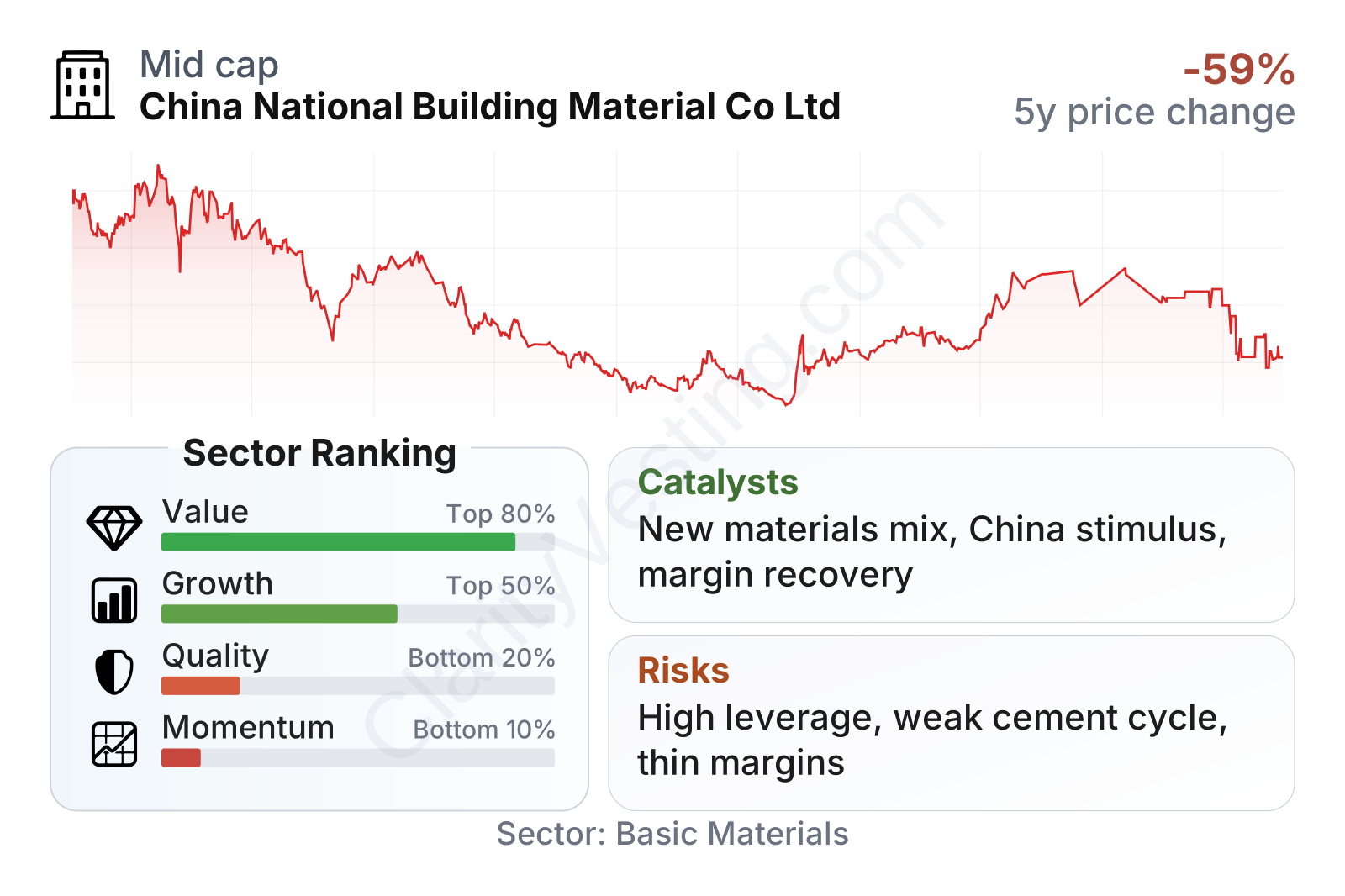
The company is large enough to matter in its industry, but the overall profile is mixed. Valuation measures look unusually low versus the sector, and the dividend yield has recently been above the industry median. However, quality and market performance are weak: profitability is below peers, leverage is high, and recent share-price momentum has been among the weakest in the sector. Growth is also uneven, with earnings over five years holding up better than many peers, but revenue, free cash flow trend, and book value trend looking much less favorable.
Growth
China National Building Material operates in sectors with very different growth speeds. Traditional cement and concrete are mature businesses in China and are closely linked to construction activity, infrastructure spending, and property development. Those markets are still enormous, but they are no longer obvious structural growth engines. That means future expansion is more likely to come from gaining share, consolidating capacity, improving efficiency, and shifting toward higher-value products rather than from rapid volume growth in basic construction materials.
That is where the company’s strategy makes the most sense. Its portfolio in fiberglass, gypsum board, composite materials, and wind power blade-related products gives it exposure to areas tied to manufacturing upgrades, lighter materials, and renewable energy equipment. These categories are generally more promising than bulk cement because they can benefit from industrial modernization and energy-transition investment, including wind power installations and advanced materials demand.
The company also has an advantage that smaller rivals often lack: scale across production, logistics, and customer relationships. In an industry where weak demand can force consolidation, a large state-backed group can sometimes withstand downturns better and reshape its portfolio more gradually.
A practical catalyst for the business is any sustained policy-driven recovery in Chinese infrastructure construction or a stabilization in property-related demand. Another is continued development of the “new materials” businesses, which could slowly lift the average profitability of the group even if cement remains sluggish. The company’s recent operating trend suggests that growth is not currently broad-based, so the most important question is not whether it can add revenue quickly, but whether it can rebuild earnings quality through mix improvement and cost control.
Risks
This article is for informational purposes only and does not constitute financial advice. Some content is AI-generated. See Disclaimer