Stock Analysis · Community Bank System Inc (CBU)
Overview
Community Bank System Inc. is a regional financial services company centered on community banking. Through Community Bank, N.A., it gathers deposits, makes loans, and provides everyday banking services to households, small businesses, municipalities, and commercial customers, mainly across the Northeastern and Midwestern United States. The group also has fee-based operations outside traditional banking, which helps diversify earnings beyond interest income.
Its revenue mix is led by banking activities, but the company is not only a plain regional bank. Based on recent company reporting, the main sources of revenue are approximately:
- Net interest income: about 57% to 62%. This is the spread between what the bank earns on loans and securities and what it pays on deposits and other funding.
- Banking noninterest income: about 14% to 18%. This includes deposit service fees, card income, wealth management, and other customer service charges tied to the banking franchise.
- Employee benefit services and insurance-related fee income: about 22% to 28%. This comes from retirement plan administration, benefits recordkeeping, consulting, insurance commissions, and related services.
This mix matters because it gives Community Bank System a more balanced profile than many smaller regional banks. Fee income can soften the impact of changes in interest rates, while the banking side still provides the scale and customer relationships that anchor the business.
Over the last several years, revenue has expanded meaningfully, and profitability recovered after the pressure many banks felt in 2023. At the same time, expenses and interest costs also moved higher, so the business remains sensitive to funding conditions and margin management.
The long-term pattern points to rising total revenue and a rebound in net income after the 2023 slowdown. It also shows how sharply interest expense increased compared with earlier years, which is one of the clearest forces shaping recent results.
Key Figures
| Metric | Value | Sector ⓘ |
|---|---|---|
| Date | Oct 24, 2026 | |
| Context | ||
| Sector | Financial Services | |
| Industry | Banks - Regional | |
| Market Cap ⓘ | $3.20B | |
| Beta ⓘ | 0.78 | |
Value (Cheapness) | ||
| P/E Ratio ⓘ | 14.09 | 12.46 |
| P/B Ratio ⓘ | 1.59 | 1.25 |
| FCF Yield ⓘ | 7.24% | 9.82% |
| Dividend Yield ⓘ | 3.09% | 2.94% |
| EBIT / EV ⓘ | 8.08% | 8.11% |
| PEG ⓘ | 2.62 | |
Growth (Business expansion) | ||
| Revenue Growth ⓘ | 12.00% | 9.10% |
| RPS Growth (5Y CAGR) ⓘ | 13.22% | 12.31% |
| EPS Growth (5Y CAGR) ⓘ | -11.76% | -6.97% |
| BVPS Growth (5Y CAGR) ⓘ | -0.42% | 5.02% |
| Margin Growth (5Y Trend) ⓘ | -10.85% | -4.00% |
| FCF Growth (5Y CAGR) ⓘ | 5.36% | 4.71% |
| DPS Growth (5Y CAGR) ⓘ | 2.49% | 8.92% |
Quality (Business durability) | ||
| ROIC (Latest) ⓘ | 9.04% | 9.18% |
| ROE (Latest) ⓘ | 11.35% | 13.93% |
| ROA (Latest) ⓘ | 1.31% | 1.57% |
| ROIC (5Y Median) ⓘ | 8.48% | 7.80% |
| ROE (5Y Median) ⓘ | 10.30% | 12.15% |
| ROA (5Y Median) ⓘ | 1.20% | 1.28% |
| Net Debt / EBIT (Latest) ⓘ | 1.68 | 1.02 |
| Net Debt / EBIT (5Y Median) ⓘ | 3.41 | 0.72 |
| Net Debt / EBITDA (Latest) ⓘ | 1.50 | 0.88 |
| Operating Margin (Latest) ⓘ | 28.71% | 22.30% |
| Operating Margin (5Y Median) ⓘ | 27.24% | 24.50% |
| Debt to Equity (Latest) ⓘ | 36.86% | 59.34% |
| Profit Margin (Latest) ⓘ | 27.21% | 26.42% |
| Free Cash Flow (Latest) ⓘ | $231.26M | |
Momentum (Price trend) | ||
| 3Y Return ⓘ | +73.35% | +95.73% |
| 12M Return (excl. last month) ⓘ | +5.08% | +17.30% |
| 6M Return ⓘ | +1.39% | +6.07% |
| Price vs. 200-Day MA ⓘ | +0.51% | +5.36% |
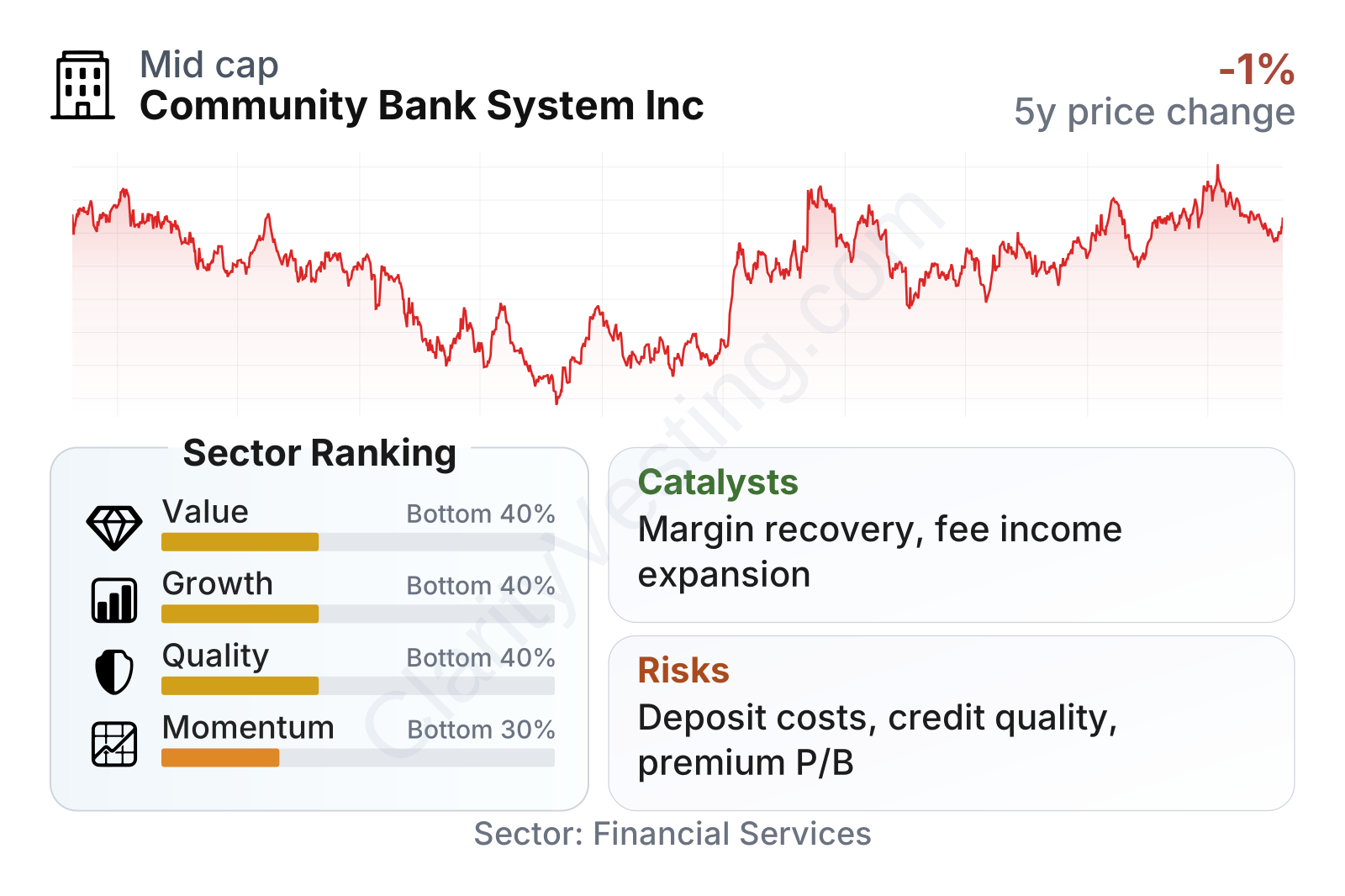
Community Bank System sits in the smaller end of listed U.S. financial companies, with a relatively low beta, meaning its stock has historically moved less than the broader market. On valuation, the shares trade somewhat above the sector median on both earnings and book value multiples, while the dividend yield is slightly above the sector median. Growth and quality metrics are more mixed: revenue expansion has been respectable, but profitability ratios and earnings growth have lagged many peers. Price performance has also been weaker than the sector over most recent comparison periods.
The stock history shows a sharp drawdown during the regional bank stress period and then a strong recovery into 2026. That rebound suggests confidence has improved, but it also means the market is no longer pricing the company as if conditions were still under acute pressure.
Growth
Community Bank System operates in a mature industry, so this is not a high-growth banking niche. However, some of its end markets remain attractive for steady expansion. Community and regional banking still benefits from local business relationships, municipal banking, consumer banking, and small-business lending. The company’s additional employee benefit and insurance-related operations also expose it to recurring service revenue, which can grow through client retention, cross-selling, and selective acquisitions.
The strategy appears coherent for long-term growth because it combines traditional deposit-and-loan banking with fee-based businesses that are less dependent on interest rates. That combination can be valuable when the banking environment becomes more difficult. It also gives the company more ways to deepen customer relationships across businesses, public-sector clients, and individuals.
A visible catalyst is margin normalization after the period of unusually high deposit competition and funding pressure across regional banking. If deposit costs stabilize while asset yields remain supportive, earnings capacity can improve even without fast balance-sheet growth. Another catalyst is the continued contribution from retirement plan and benefit-administration services, where scale and recurring client relationships can support steady fee income.
Earnings per share show that the company went through a soft patch in 2023 and then recovered through 2024 and 2025. That pattern is consistent with a bank that faced industrywide funding pressure but preserved enough franchise strength to rebuild profitability afterward.
Book value per share dropped materially in 2022, then rebuilt over the following years. For a bank, that recovery is important because it signals improving balance-sheet resilience after a period marked by market value pressure on securities and broader sector stress.
Recent company updates in 2026 have continued to emphasize core loan and deposit trends, credit discipline, and the contribution of nonbank fee businesses. None of this points to a dramatic transformation, but it does support the view of a business with several practical levers for gradual expansion rather than a single all-or-nothing growth bet.
Risks
This article is for informational purposes only and does not constitute financial advice. Some content is AI-generated. See Disclaimer


