Stock Analysis · Cabot Corporation (CBT)
Overview
Cabot Corporation is a specialty chemicals and performance materials company. It makes engineered materials that are used to improve the performance, durability, conductivity, color, and safety of products used in everyday industries such as tires, automotive parts, batteries, infrastructure, inks, coatings, and industrial manufacturing.
Its business is centered on materials that are often small in cost within the final product but important to performance. The company’s portfolio is organized around a few main product families, with earnings also supported by a global manufacturing network and long-standing customer relationships in industrial markets.
Based on Cabot’s recent annual reporting structure, the main revenue sources are approximately:
- Reinforcement Materials: about 52% of revenue — mainly carbon black used in tires and other rubber products. This is Cabot’s largest business and is closely tied to replacement tire demand, automotive production, and industrial rubber applications.
- Performance Chemicals: about 35% of revenue — includes specialty carbons, battery materials, inkjet colorants, and fumed metal oxides used in coatings, electronics, infrastructure, and energy-related applications.
- Purification Solutions: about 13% of revenue — activated carbon and related products used for water treatment, environmental applications, and industrial purification.
That mix matters for long-term analysis. Reinforcement Materials gives Cabot scale and stable industrial relevance, while Performance Chemicals and some parts of Purification Solutions offer better potential for margin expansion and exposure to structural themes such as electrification, environmental controls, and higher-performance industrial materials.
The business picture over the last several years shows a useful pattern: total revenue has moved down from the 2022 peak, but operating income has stayed comparatively resilient and even improved into 2025. That suggests pricing discipline, mix improvement, and cost control have partly offset volume and cycle pressure. In other words, Cabot has recently looked more like a company protecting profitability than simply chasing sales.
Key Figures
| Metric | Value | Sector ⓘ |
|---|---|---|
| Date | Oct 03, 2026 | |
| Context | ||
| Sector | Basic Materials | |
| Industry | Specialty Chemicals | |
| Market Cap ⓘ | $4.01B | |
| Beta ⓘ | 0.83 | |
Value (Cheapness) | ||
| P/E Ratio ⓘ | 21.97 | 17.61 |
| P/B Ratio ⓘ | 2.71 | 1.77 |
| FCF Yield ⓘ | 7.00% | 5.87% |
| Dividend Yield ⓘ | 2.32% | 2.06% |
| EBIT / EV ⓘ | 10.02% | 6.43% |
| PEG ⓘ | 1.00 | |
Growth (Business expansion) | ||
| Revenue Growth ⓘ | 6.40% | 11.30% |
| RPS Growth (5Y CAGR) ⓘ | 3.36% | 4.46% |
| EPS Growth (5Y CAGR) ⓘ | -6.37% | -13.11% |
| BVPS Growth (5Y CAGR) ⓘ | 16.12% | 5.51% |
| Margin Growth (5Y Trend) ⓘ | 3.89% | -1.57% |
| FCF Growth (5Y CAGR) ⓘ | 58.47% | 0.55% |
| DPS Growth (5Y CAGR) ⓘ | 5.90% | 6.02% |
Quality (Business durability) | ||
| ROIC (Latest) ⓘ | 9.67% | 9.31% |
| ROA (Latest) ⓘ | 4.88% | 4.94% |
| ROIC (5Y Median) ⓘ | 16.25% | 7.91% |
| ROA (5Y Median) ⓘ | 8.77% | 3.93% |
| Net Debt / EBIT (Latest) ⓘ | 2.01 | 1.40 |
| Net Debt / EBIT (5Y Median) ⓘ | 2.07 | 1.70 |
| Net Debt / EBITDA (Latest) ⓘ | 1.48 | 0.91 |
| Net Debt / Assets ⓘ | 25.74% | 13.69% |
| EBITDA / Interest ⓘ | 9.20 | 11.93 |
| Operating Margin (Latest) ⓘ | 14.03% | 13.07% |
| Operating Margin (5Y Median) ⓘ | 13.76% | 11.86% |
| Debt to Equity (Latest) ⓘ | 79.31% | 40.43% |
| Profit Margin (Latest) ⓘ | 5.23% | 6.57% |
| Free Cash Flow (Latest) ⓘ | $281.00M | |
Momentum (Price trend) | ||
| 3Y Return ⓘ | +18.25% | +65.06% |
| 12M Return (excl. last month) ⓘ | +3.88% | +36.05% |
| 6M Return ⓘ | +3.26% | +1.89% |
| Price vs. 200-Day MA ⓘ | -1.55% | +1.03% |
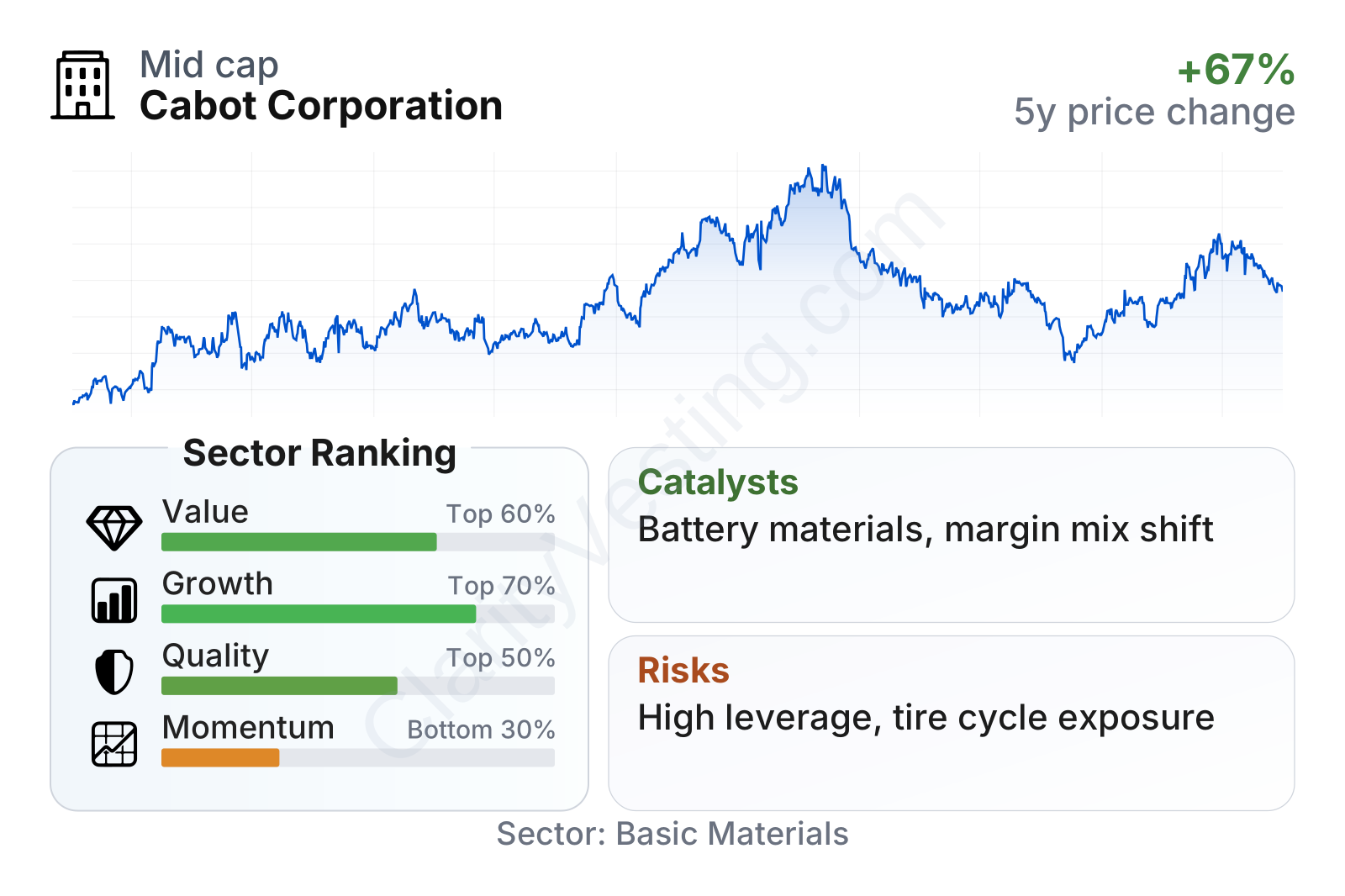
Cabot sits in the mid-cap range, with a stock that has been less volatile than the broader market based on its beta below 1. The overall factor profile is mixed but understandable for an industrial materials company: valuation metrics are better than much of the sector on cash-flow-based measures, quality is around the middle to upper half, growth is respectable but not standout, and recent share-price momentum has been weaker than many peers. The combination points to a business with solid operating characteristics, but not one currently receiving a strong market premium for near-term growth excitement.
Growth
Cabot operates in a sector that is mature in some areas and structurally attractive in others. Traditional carbon black for tires is not a fast-growth market, but it tends to benefit from recurring replacement demand because vehicles need ongoing tire maintenance regardless of the broader economic cycle. On top of that, the company has positioned parts of its portfolio toward markets with better long-term demand drivers, especially battery materials, conductive additives, specialty carbons, and environmental applications.
The strategic logic is fairly clear. Cabot is using its existing expertise in carbon-based materials to move into higher-value uses where performance matters more than commodity pricing. That does not eliminate cyclicality, but it can improve margins and make revenue less dependent on basic industrial volumes over time.
Revenue growth has been uneven. The company posted very strong expansion in 2021 and 2022, then went through a stretch of contraction as industrial demand normalized and pricing conditions became less favorable. More recently, the trend has shown signs of stabilization, with growth turning positive again in the latest period. That matters because it suggests the downcycle may be easing, even if the pace remains below the sector median.
Free cash flow is one of the more encouraging parts of Cabot’s profile. After a weak point in 2022, cash generation improved sharply and has remained healthy, reaching the high hundreds of millions on a trailing basis at recent peaks and standing at about $281 million in the latest table snapshot. Over five years, free cash flow growth has been far stronger than the sector median. For a capital-intensive materials company, that is important because cash funds debt reduction, dividends, buybacks, and growth investments without depending as heavily on external financing.
A notable long-term catalyst is the company’s battery materials effort, especially conductive carbons used in lithium-ion batteries. This is a smaller business today than tires or mainstream specialty chemicals, but it gives Cabot exposure to electric vehicles and energy storage. Another catalyst is continued optimization of product mix toward more specialized applications where pricing is more durable. Recent company communications have also emphasized disciplined capital allocation and operational efficiency, which can support earnings even if end markets remain uneven.
Risks
This article is for informational purposes only and does not constitute financial advice. Some content is AI-generated. See Disclaimer