Stock Analysis · Commerce Bancshares Inc (CBSH)
Overview
Commerce Bancshares is a regional bank holding company based in the Midwest. Through Commerce Bank, it provides traditional banking services such as deposits, commercial and consumer lending, payments, wealth management, and trust services. Its footprint is centered on states including Missouri, Kansas, Illinois, Oklahoma, and Colorado, with additional national reach in selected fee-based businesses such as payments and institutional asset servicing.
For a simple way to think about the business, Commerce Bancshares earns money from two broad engines: interest income from lending and investing, and fees from services it provides to customers. This mix matters because banks that rely only on lending can be more exposed to swings in interest rates, while Commerce has a meaningful stream of recurring fee income.
Based on the company’s recent annual reporting, the main sources of revenue are approximately:
- Net interest income: about 47% to 50% of total revenue. This is the spread between what the bank earns on loans and securities and what it pays on deposits and other funding.
- Bank card transaction fees: about 17% to 19%. This includes debit and credit card-related payment processing and merchant activity.
- Trust fees: about 14% to 16%. This comes from wealth management, private banking, estate administration, custody, and institutional trust services.
- Deposit account charges: about 7% to 9%. These are service charges and account-related banking fees.
- Capital markets and other finance fees: about 4% to 6%. This typically includes corporate finance, securities-related services, and specialized advisory activity.
- Other non-interest income: about 10% to 13%. This can include gains, brokerage-related revenue, and other service fees.
This revenue mix gives Commerce Bancshares a somewhat more diversified profile than many regional banks that depend more heavily on plain-vanilla lending. It also helps explain why the company has often delivered solid profitability even when the banking environment becomes less favorable.
Over the last several years, total revenue has moved higher, while operating costs have risen more slowly. Net income has also recovered after pressure from higher funding costs in 2023, which suggests the business has remained resilient rather than purely rate-driven.
Key Figures
| Metric | Value | Sector ⓘ |
|---|---|---|
| Date | Oct 31, 2026 | |
| Context | ||
| Sector | Financial Services | |
| Industry | Banks - Regional | |
| Market Cap ⓘ | $7.81B | |
| Beta ⓘ | 0.59 | |
Value (Cheapness) | ||
| P/E Ratio ⓘ | 13.26 | 12.20 |
| P/B Ratio ⓘ | 1.89 | 1.26 |
| FCF Yield ⓘ | 15.25% | 9.87% |
| Dividend Yield ⓘ | 1.96% | 2.87% |
| EBIT / EV ⓘ | 12.36% | 8.17% |
| PEG ⓘ | 2.06 | |
Growth (Business expansion) | ||
| Revenue Growth ⓘ | 13.90% | 8.40% |
| RPS Growth (5Y CAGR) ⓘ | 9.53% | 12.31% |
| EPS Growth (5Y CAGR) ⓘ | -0.81% | -4.03% |
| BVPS Growth (5Y CAGR) ⓘ | -43.84% | 4.96% |
| Margin Growth (5Y Trend) ⓘ | -13.50% | -4.14% |
| FCF Growth (5Y CAGR) ⓘ | 2.29% | 4.70% |
| DPS Growth (5Y CAGR) ⓘ | 4.34% | 8.85% |
Quality (Business durability) | ||
| ROIC (Latest) ⓘ | 14.51% | 9.35% |
| ROE (Latest) ⓘ | 15.01% | 13.95% |
| ROA (Latest) ⓘ | 1.76% | 1.57% |
| ROIC (5Y Median) ⓘ | 16.88% | 7.78% |
| ROE (5Y Median) ⓘ | 16.05% | 12.12% |
| ROA (5Y Median) ⓘ | 1.52% | 1.28% |
| Net Debt / EBIT (Latest) ⓘ | 2.38 | 0.99 |
| Net Debt / EBIT (5Y Median) ⓘ | -0.66 | 0.73 |
| Net Debt / EBITDA (Latest) ⓘ | 0.38 | 0.79 |
| Operating Margin (Latest) ⓘ | 35.00% | 22.61% |
| Operating Margin (5Y Median) ⓘ | 34.20% | 24.52% |
| Debt to Equity (Latest) ⓘ | 64.75% | 58.76% |
| Profit Margin (Latest) ⓘ | 31.36% | 26.18% |
| Free Cash Flow (Latest) ⓘ | $1.19B | |
Momentum (Price trend) | ||
| 3Y Return ⓘ | +55.26% | +95.34% |
| 12M Return (excl. last month) ⓘ | -0.29% | +16.22% |
| 6M Return ⓘ | +9.62% | +7.41% |
| Price vs. 200-Day MA ⓘ | +2.91% | +5.48% |
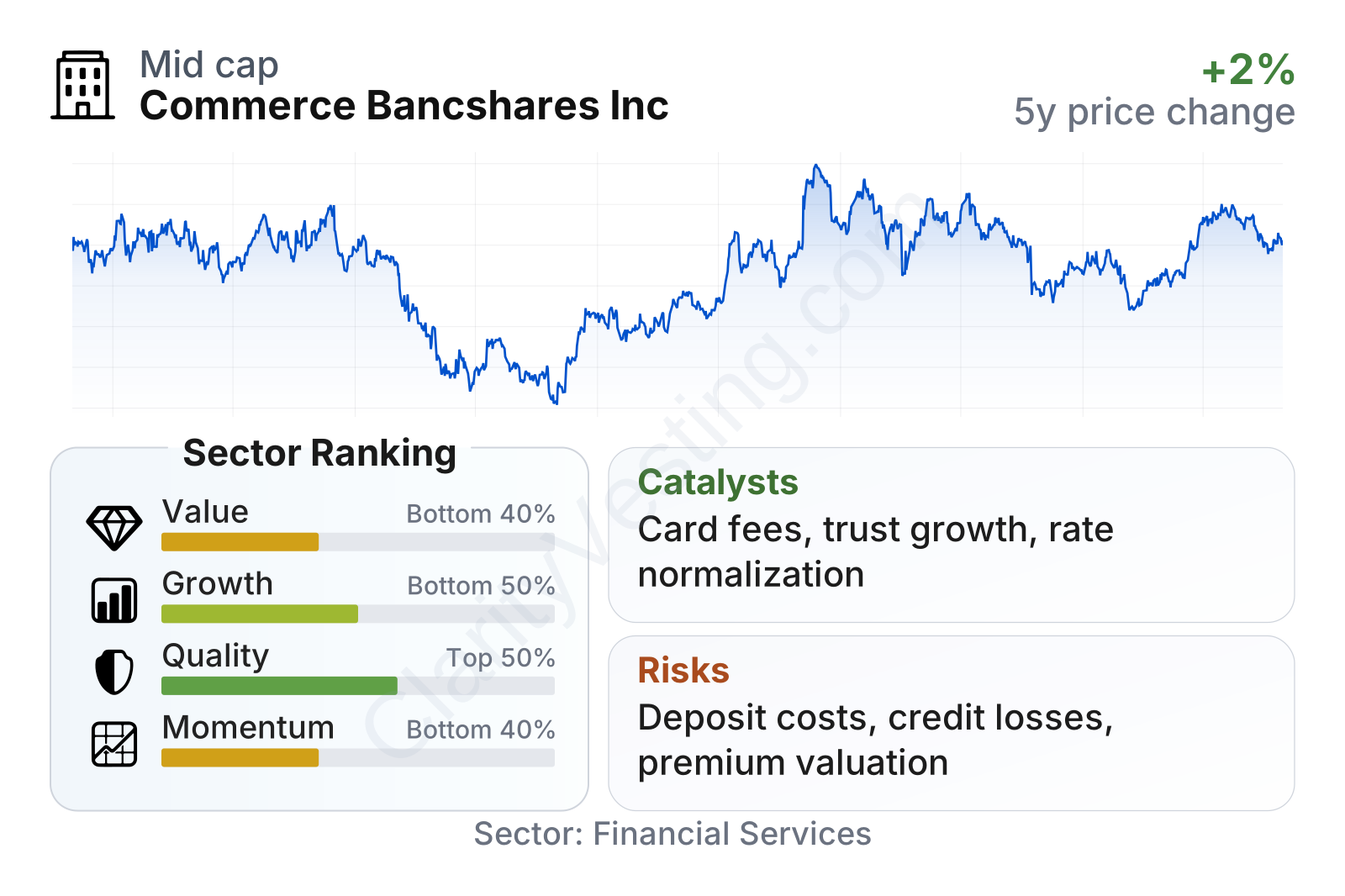
Commerce Bancshares stands out more for quality and stability than for cheapness. Profitability measures are above the regional bank median, while valuation measures are more mixed: the earnings multiple is only slightly above sector norms, but the price-to-book multiple is clearly richer. The stock has also shown relatively low volatility, which fits the profile of a conservative bank franchise rather than a fast-moving turnaround case.
The share price path over the last few years shows the same pattern. The stock fell sharply during the 2023 regional banking stress, then recovered and moved back near prior highs. That rebound suggests the market continues to view Commerce as a higher-quality operator within regional banking, even if short-term performance has not led the sector.
Growth
Commerce Bancshares operates in a mature sector, so growth is usually not driven by rapid expansion like in technology or biotech. Instead, long-term progress tends to come from gaining deposits, making disciplined loans, expanding fee-based services, and managing expenses well. In that context, Commerce’s strategy looks coherent. The company combines a conservative balance sheet culture with businesses such as card payments, treasury services, and wealth management that can grow alongside customer activity without requiring the same level of balance-sheet risk as lending.
A useful point in its favor is that payments and trust-related activities can benefit from long-duration trends. Electronic payments continue to replace cash and checks, and wealth management demand tends to rise over time as households and institutions accumulate financial assets. These are not explosive catalysts, but they can provide durable support for revenue growth.
Recent operating momentum has been respectable. Revenue growth has been stronger than the sector median on a year-over-year basis, although the longer-term picture is more moderate. Five-year revenue-per-share growth is positive, but not exceptional, and dividend growth has been steady rather than aggressive. This points to a business that compounds gradually instead of expanding at a very high rate.
Earnings per share were relatively flat from 2021 through 2023, then improved in 2024 and 2025. That pattern fits the broader industry cycle: higher funding costs pressured many banks, but Commerce has managed to rebuild earnings. The recent direction is more encouraging than the five-year average alone would suggest.
Book value per share has also been moving upward in recent years. That is important for a bank, because book value reflects the capital base supporting future lending and fee generation. One older figure in the long-term series appears distorted, but the more recent trend points to rebuilding intrinsic balance-sheet value rather than erosion.
As for more immediate catalysts, the biggest one is the path of interest rates and deposit pricing. If funding costs stabilize or ease while loan yields remain healthy, net interest income can improve. Another potential support is continued expansion in card and trust fees, which would reduce dependence on rate swings. Management has also emphasized capital strength and organic growth, which can leave room for continued dividends and selective balance-sheet deployment.
Risks
This article is for informational purposes only and does not constitute financial advice. Some content is AI-generated. See Disclaimer