Stock Analysis · Cboe Global Markets Inc (CBOE)
Overview
Cboe Global Markets operates financial marketplaces. In simple terms, it runs exchanges where investors and institutions trade options, stocks, futures, foreign exchange products, and market data services. The company is best known for its options franchise in the United States and for creating and licensing well-known volatility indexes such as the VIX. Beyond trading venues, it also sells data, analytics, and connectivity services that help customers access its markets and use its pricing information.
Cboe’s business is diversified across transaction-based revenue and more recurring revenue from data and access services. Based on the company’s recent annual reporting structure, its main revenue sources can be summarized approximately as follows:
- Options: about 39% of net revenue. This includes U.S. options trading, where Cboe has a leading position, and related fees tied to contract volume, market share, and proprietary products.
- Data Vantage: about 23%. This segment includes market data, index products, analytics, and connectivity. It is important because a meaningful part of it is subscription-like and less dependent on daily trading volumes.
- Cash and Spot Markets: about 18%. This covers U.S. and European equities trading as well as exchange-traded product listings in some markets.
- Derivatives Markets: about 11%. This includes futures and European derivatives activity, with products tied to volatility and other benchmarks.
- Global FX: about 9%. This segment provides institutional foreign exchange trading through Cboe’s FX platforms.
This mix matters for long-term analysis because Cboe is not just a simple stock exchange. It combines high-margin proprietary products, broad trading infrastructure, and a growing information business. Over the last several years, revenue and operating income have generally moved higher, and profitability improved sharply after a weaker 2022 period, showing the operating leverage that exchange businesses can have when volumes and pricing strengthen.
The financial flow over recent years points to a business with expanding revenue and improving operating efficiency. Net income recovered strongly after 2022, and by 2025 both revenue and operating profit were well above earlier levels, which supports the view that scale and product mix are lifting margins.
Key Figures
| Metric | Value | Sector ⓘ |
|---|---|---|
| Date | Oct 17, 2026 | |
| Context | ||
| Sector | Financial Services | |
| Industry | Financial Data & Stock Exchanges | |
| Market Cap ⓘ | $31.38B | |
| Beta ⓘ | 0.41 | |
Value (Cheapness) | ||
| P/E Ratio ⓘ | 22.78 | 12.26 |
| P/B Ratio ⓘ | 5.74 | 1.23 |
| FCF Yield ⓘ | 0.07% | 10.40% |
| Dividend Yield ⓘ | 0.99% | 3.02% |
| EBIT / EV ⓘ | 7.07% | 8.14% |
| PEG ⓘ | 2.38 | |
Growth (Business expansion) | ||
| Revenue Growth ⓘ | 22.90% | 9.35% |
| RPS Growth (5Y CAGR) ⓘ | 8.30% | 12.19% |
| EPS Growth (5Y CAGR) ⓘ | 1.30% | -9.53% |
| BVPS Growth (5Y CAGR) ⓘ | 9.81% | 4.99% |
| Margin Growth (5Y Trend) ⓘ | 11.33% | -3.86% |
| FCF Growth (5Y CAGR) ⓘ | 20.56% | 4.81% |
| DPS Growth (5Y CAGR) ⓘ | 10.67% | 8.79% |
Quality (Business durability) | ||
| ROIC (Latest) ⓘ | 20.57% | 9.49% |
| ROE (Latest) ⓘ | 25.75% | 13.90% |
| ROA (Latest) ⓘ | 13.75% | 1.55% |
| ROIC (5Y Median) ⓘ | 14.38% | 7.86% |
| ROE (5Y Median) ⓘ | 18.51% | 12.17% |
| ROA (5Y Median) ⓘ | 10.01% | 1.30% |
| Net Debt / EBIT (Latest) ⓘ | -0.37 | 0.96 |
| Net Debt / EBIT (5Y Median) ⓘ | 0.96 | 0.73 |
| Net Debt / EBITDA (Latest) ⓘ | -0.35 | 0.92 |
| Operating Margin (Latest) ⓘ | 38.07% | 22.30% |
| Operating Margin (5Y Median) ⓘ | 27.73% | 24.63% |
| Debt to Equity (Latest) ⓘ | 27.65% | 58.56% |
| Profit Margin (Latest) ⓘ | 26.73% | 26.57% |
| Free Cash Flow (Latest) ⓘ | $22.20M | |
Momentum (Price trend) | ||
| 3Y Return ⓘ | +95.30% | +88.33% |
| 12M Return (excl. last month) ⓘ | +16.70% | +19.38% |
| 6M Return ⓘ | +1.51% | +4.75% |
| Price vs. 200-Day MA ⓘ | +7.06% | +3.50% |
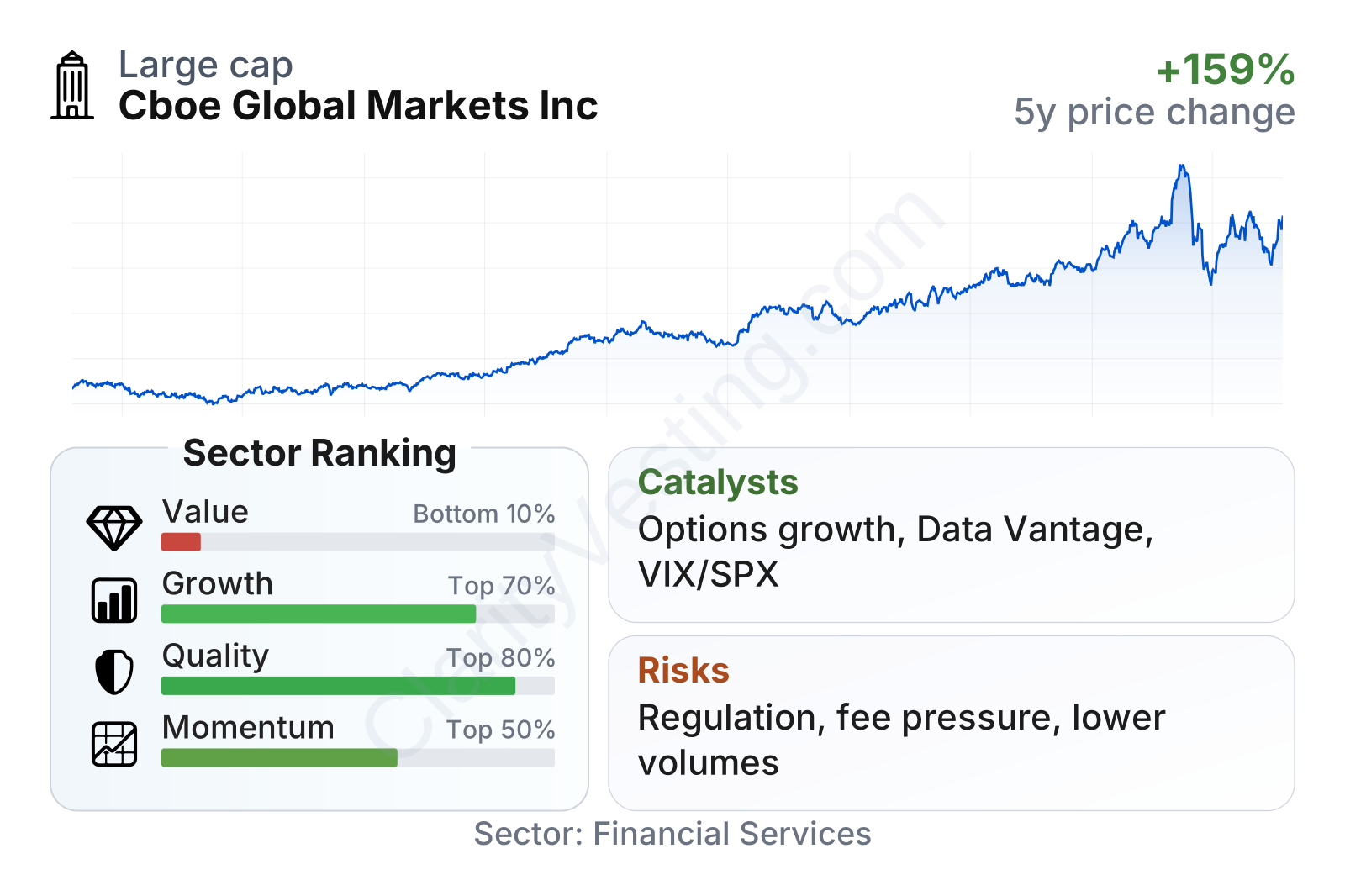
Cboe stands out more for quality and steady growth than for traditional cheapness. Profitability metrics are strong versus the broader financial sector, with returns on capital and margins clearly ahead of median levels. Growth metrics are also favorable overall, especially recent revenue growth, free cash flow expansion over five years, and rising dividends per share. By contrast, the valuation section of the table shows a premium profile: earnings and book-value multiples are well above sector medians, while dividend yield and free-cash-flow yield are comparatively low. Price momentum has cooled recently after a strong longer-term run, which suggests the market has already recognized much of the company’s operating improvement.
The stock has climbed substantially since late 2021, even with some volatility in 2026. That pattern fits the business profile: lower beta, resilient earnings, and recurring demand for market infrastructure, but not the kind of straight-line performance seen in high-growth technology names.
Growth
Cboe operates in a part of financial services that benefits from several durable trends. Trading and hedging activity tends to broaden over time as capital markets grow, electronic execution expands, and investors use more listed products for risk management. Options trading has been one of the clearest structural growth areas, and Cboe remains central to that market. At the same time, data, index, and connectivity services are becoming more valuable because customers increasingly pay for speed, analytics, and proprietary benchmarks.
The company’s strategy also makes sense for future growth because it is built on a combination of product expansion and recurring revenue. Management has emphasized broadening the Data Vantage business, growing its index and analytics capabilities, and building around proprietary franchises such as SPX and VIX-related products. Those products are difficult to replicate because they are tied to Cboe’s own marketplaces and brand recognition. The strategy is also global rather than purely domestic, with operations spanning the U.S., Europe, Asia Pacific, Canada, and foreign exchange.
Earnings per share have shown a clear upward trend from 2021 through 2025, which is a useful sign that growth has not come only from accounting adjustments or revenue without profit. The pace has not been explosive, but it has been consistent enough to support the idea of a scalable business model.
Book value per share has also increased meaningfully over the last five years. For an exchange operator, that suggests retained earnings and capital deployment have been adding to shareholder value rather than merely supporting a flat balance sheet.
A notable catalyst is the continued expansion of products linked to volatility, index options, and retail as well as institutional options trading. Cboe has also continued to develop its data and access offerings, which can deepen customer relationships and reduce reliance on pure transaction volumes. Another medium-term opportunity is the company’s product innovation pipeline, including new listings, index licensing, and broader use of its technology and data across regions.
Recent company updates have continued to highlight strong execution in derivatives and data-related activities, along with ongoing capital returns and disciplined operating management. For a business like Cboe, even without dramatic headline announcements, steady progress in market share, proprietary product usage, and recurring information services can be significant because those gains tend to compound over time.
Risks
This article is for informational purposes only and does not constitute financial advice. Some content is AI-generated. See Disclaimer


