Stock Analysis · Mersen SA (CBLNY)
Overview
Mersen is a French industrial company that makes specialized materials and electrical protection products used in demanding environments. Its businesses are centered on two large families of products: advanced materials, mainly based on graphite and related components, and electrical power solutions, such as fuses, surge protection, bus bars, and power management parts. These products are typically sold to industrial customers rather than consumers, and they are used in sectors such as semiconductors, electric vehicles, renewable energy, rail, aerospace, chemicals, and traditional process industries.
The company’s revenue mix is usually presented through its two main business segments. Based on recent annual reporting, the largest sources of revenue are approximately:
- Advanced Materials: about 54% of sales. This includes graphite specialties, anti-corrosion equipment, and process technologies used in high-temperature and corrosive industrial applications, as well as products tied to semiconductor manufacturing and certain energy uses.
- Electrical Power: about 46% of sales. This includes fuses, power transfer solutions, laminated bus bars, cooling systems for power electronics, and other equipment used to protect and distribute electrical power in industrial and transportation systems.
Geographically, Mersen is broadly international, with meaningful exposure to Europe, North America, and Asia. That diversification matters because demand can come from different industrial cycles at different times, although it also exposes the company to currency swings and regional slowdowns.
From a business model perspective, Mersen is not a simple commodity producer. Many of its products are engineered for specific customer processes, where reliability matters more than the lowest price. That tends to support repeat business and technical relationships, especially in applications where failure can be costly.
The long-term operating picture shows a business that expanded revenue materially from 2021 through 2024, while operating income also improved over that period. The notable weak point is that net income dropped sharply in 2025 even though revenue remained above pre-2023 levels, suggesting that financing costs, taxes, and other below-operating-line items became much heavier.
Key Figures
| Metric | Value | Sector ⓘ |
|---|---|---|
| Date | Oct 17, 2026 | |
| Context | ||
| Sector | Industrials | |
| Industry | Electrical Equipment & Parts | |
| Market Cap ⓘ | $1.19B | |
| Beta ⓘ | 1.58 | |
Value (Cheapness) | ||
| P/E Ratio ⓘ | 69.86 | 22.10 |
| P/B Ratio ⓘ | 1.47 | 1.97 |
| FCF Yield ⓘ | 5.04% | 6.38% |
| Dividend Yield ⓘ | 2.19% | 1.94% |
| EBIT / EV ⓘ | N/A | 4.79% |
| PEG ⓘ | N/A | |
Growth (Business expansion) | ||
| Revenue Growth ⓘ | 0.20% | 9.30% |
| RPS Growth (5Y CAGR) ⓘ | 6.32% | 7.81% |
| EPS Growth (5Y CAGR) ⓘ | -5.65% | -13.06% |
| BVPS Growth (5Y CAGR) ⓘ | 5.75% | 6.14% |
| Margin Growth (5Y Trend) ⓘ | -0.27% | 0.88% |
| FCF Growth (5Y CAGR) ⓘ | 9.22% | 11.01% |
| DPS Growth (5Y CAGR) ⓘ | 11.55% | 9.48% |
Quality (Business durability) | ||
| ROIC (Latest) ⓘ | 10.63% | 10.84% |
| ROA (Latest) ⓘ | 3.67% | 5.41% |
| ROIC (5Y Median) ⓘ | 7.77% | 9.38% |
| ROA (5Y Median) ⓘ | 4.37% | 4.95% |
| Net Debt / EBIT (Latest) ⓘ | 2.03 | 2.08 |
| Net Debt / EBIT (5Y Median) ⓘ | 3.29 | 2.27 |
| Net Debt / EBITDA (Latest) ⓘ | 1.21 | 1.39 |
| Net Debt / Assets ⓘ | 26.35% | 19.28% |
| EBITDA / Interest ⓘ | 7.49 | 9.58 |
| Operating Margin (Latest) ⓘ | 9.31% | 10.50% |
| Operating Margin (5Y Median) ⓘ | 9.54% | 10.29% |
| Debt to Equity (Latest) ⓘ | 64.64% | 65.48% |
| Profit Margin (Latest) ⓘ | 1.31% | 6.67% |
| Free Cash Flow (Latest) ⓘ | $59.81M | |
Momentum (Price trend) | ||
| 3Y Return ⓘ | +21.98% | +61.68% |
| 12M Return (excl. last month) ⓘ | +69.45% | +12.58% |
| 6M Return ⓘ | +87.80% | 0.00% |
| Price vs. 200-Day MA ⓘ | N/A | +0.02% |
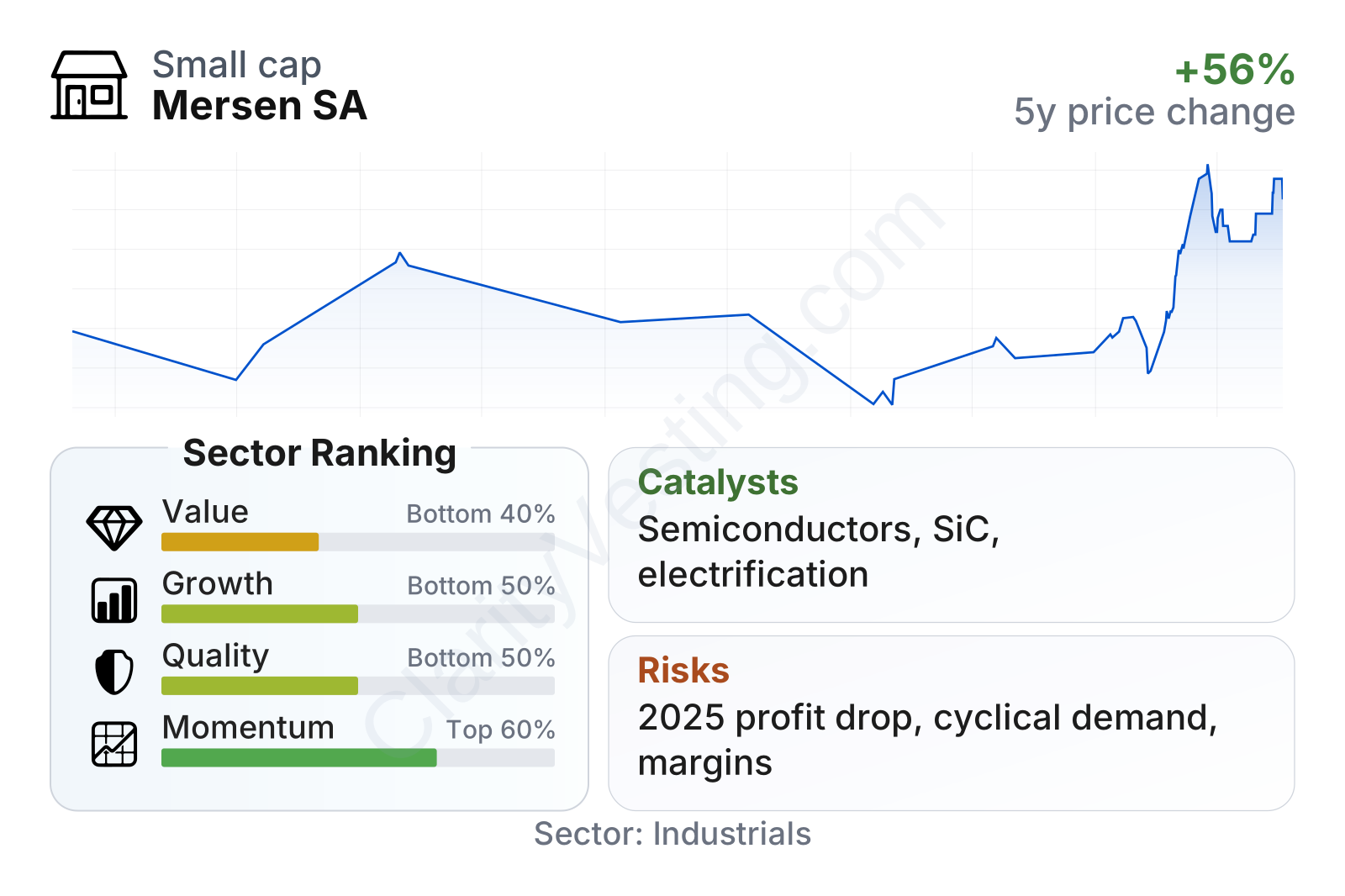
Mersen is a small-to-mid-sized industrial company with a market value around $1.2 billion, which can bring both opportunity and volatility. The recent share-price trend has been strong over the last 6 to 12 months, but its longer three-year performance still looks more moderate relative to many industrial peers. On fundamentals, the profile is mixed: leverage is not extreme, free cash flow remains positive, and returns on capital are close to sector norms, but profitability and recent sales growth sit below the industry median. The table also points to a stock that does not look especially cheap on trailing earnings, largely because reported net profit has recently been compressed.
Growth
Mersen operates in several markets that have attractive structural growth drivers. Semiconductor manufacturing requires highly specialized materials and components that can handle heat, purity, and corrosive environments. Electrification is another important theme: electric vehicles, power electronics, battery systems, and renewable energy installations all need protection, connection, and thermal management solutions. Grid modernization and energy efficiency also support demand for the company’s electrical power products.
The strategy broadly makes industrial sense because Mersen is positioned in niches where technical performance matters and where customers often need qualification, reliability, and long product life. That is particularly relevant in semiconductors and power electronics, where switching suppliers is not always easy once a component has been designed into a system. The company has also spent the last several years increasing its exposure to faster-growing applications rather than relying only on mature industrial end markets.
One of the clearest catalysts is semiconductor-related demand. Mersen has repeatedly highlighted investments linked to silicon carbide and the broader semiconductor value chain, areas that can benefit from electric vehicle adoption and higher power-efficiency requirements. A second catalyst is the expansion of electrical infrastructure for electrified transport and industrial automation, where the company’s fuses, bus bars, and cooling-related products fit naturally.
Recent company communication has also emphasized capacity expansion projects and a pipeline tied to energy transition markets. That does not guarantee smooth growth year to year, but it shows that management is aiming capital toward end markets with better long-term demand than traditional industrial replacement cycles alone.
Risks
This article is for informational purposes only and does not constitute financial advice. Some content is AI-generated. See Disclaimer


