Stock Analysis · CeriBell Inc (CBLL)
Overview
CeriBell is a medical device company focused on rapid brain monitoring in acute care settings. Its core product is an electroencephalography, or EEG, system designed to help hospitals detect seizures and other neurological problems more quickly, especially when conventional EEG access is limited. The company combines a portable headband, bedside recorder, software, and artificial intelligence-based support tools intended to simplify use in emergency rooms, intensive care units, and other hospital environments.
The business model is largely tied to its Ceribell System installed in hospitals and the recurring use of disposables and monitoring-related services. Based on the company’s recent public filings and business description, revenue is primarily generated from the following sources:
- Disposable headbands and related consumables: the largest recurring source of revenue, generated each time the system is used on a patient.
- System sales or placements: capital equipment revenue from the Ceribell recorder and related hardware provided to hospitals and health systems.
- Software, service, and support: revenue associated with platform access, maintenance, training, and related support arrangements where applicable.
CeriBell does not appear to disclose a precise percentage split for each of these streams in the provided public numerical information, but the company’s model clearly mixes upfront hardware adoption with repeat revenue from ongoing clinical use. That matters because recurring utilization is usually more valuable than one-time equipment sales: once a hospital adopts the platform, each additional patient use can expand revenue without requiring a full new system sale.
Another important point is margin structure. Revenue has expanded strongly over the last several years, and gross profit has risen with it, suggesting the core product has attractive unit economics before accounting for heavy spending on sales expansion and research. At the same time, operating expenses have climbed even faster, showing that the company is still in a scale-building phase rather than a profit-harvesting phase.
The business mix shows a company with growing gross profit and relatively low cost of revenue compared with sales, but also a sharp rise in selling, administrative, and research spending. In simple terms, the product appears commercially promising, while the income statement still reflects an aggressive expansion effort.
Key Figures
| Metric | Value | Sector ⓘ |
|---|---|---|
| Date | Oct 17, 2026 | |
| Context | ||
| Sector | Healthcare | |
| Industry | Medical Devices | |
| Market Cap ⓘ | $1.06B | |
| Beta ⓘ | 0.93 | |
Value (Cheapness) | ||
| P/E Ratio ⓘ | N/A | 24.79 |
| P/B Ratio ⓘ | 8.19 | 3.08 |
| FCF Yield ⓘ | -5.31% | 3.15% |
| Dividend Yield ⓘ | N/A | 1.94% |
| EBIT / EV ⓘ | -8.03% | 0.57% |
| PEG ⓘ | N/A | |
Growth (Business expansion) | ||
| Revenue Growth ⓘ | 32.50% | 7.45% |
| RPS Growth (5Y CAGR) ⓘ | 29.91% | 8.61% |
| EPS Growth (5Y CAGR) ⓘ | -46.12% | -17.81% |
| BVPS Growth (5Y CAGR) ⓘ | N/A | 3.72% |
| Margin Growth (5Y Trend) ⓘ | N/A | -0.62% |
| FCF Growth (5Y CAGR) ⓘ | N/A | 1.04% |
| DPS Growth (5Y CAGR) ⓘ | N/A | 6.77% |
Quality (Business durability) | ||
| ROIC (Latest) ⓘ | -29.98% | 3.24% |
| ROA (Latest) ⓘ | -36.08% | 3.01% |
| ROIC (5Y Median) ⓘ | N/A | 4.60% |
| ROA (5Y Median) ⓘ | -28.46% | 1.89% |
| Net Debt / EBIT (Latest) ⓘ | N/A | 1.34 |
| Net Debt / EBIT (5Y Median) ⓘ | N/A | 1.84 |
| Net Debt / EBITDA (Latest) ⓘ | N/A | 1.00 |
| Net Debt / Assets ⓘ | -6.46% | 5.45% |
| EBITDA / Interest ⓘ | N/A | 9.64 |
| Operating Margin (Latest) ⓘ | -62.95% | 9.27% |
| Operating Margin (5Y Median) ⓘ | -59.63% | 7.38% |
| Debt to Equity (Latest) ⓘ | 17.07% | 28.58% |
| Profit Margin (Latest) ⓘ | -64.73% | 3.59% |
| Free Cash Flow (Latest) ⓘ | -$56.33M | |
Momentum (Price trend) | ||
| 3Y Return ⓘ | N/A | +42.80% |
| 12M Return (excl. last month) ⓘ | +109.54% | +18.50% |
| 6M Return ⓘ | +34.63% | +7.57% |
| Price vs. 200-Day MA ⓘ | +34.66% | +5.12% |
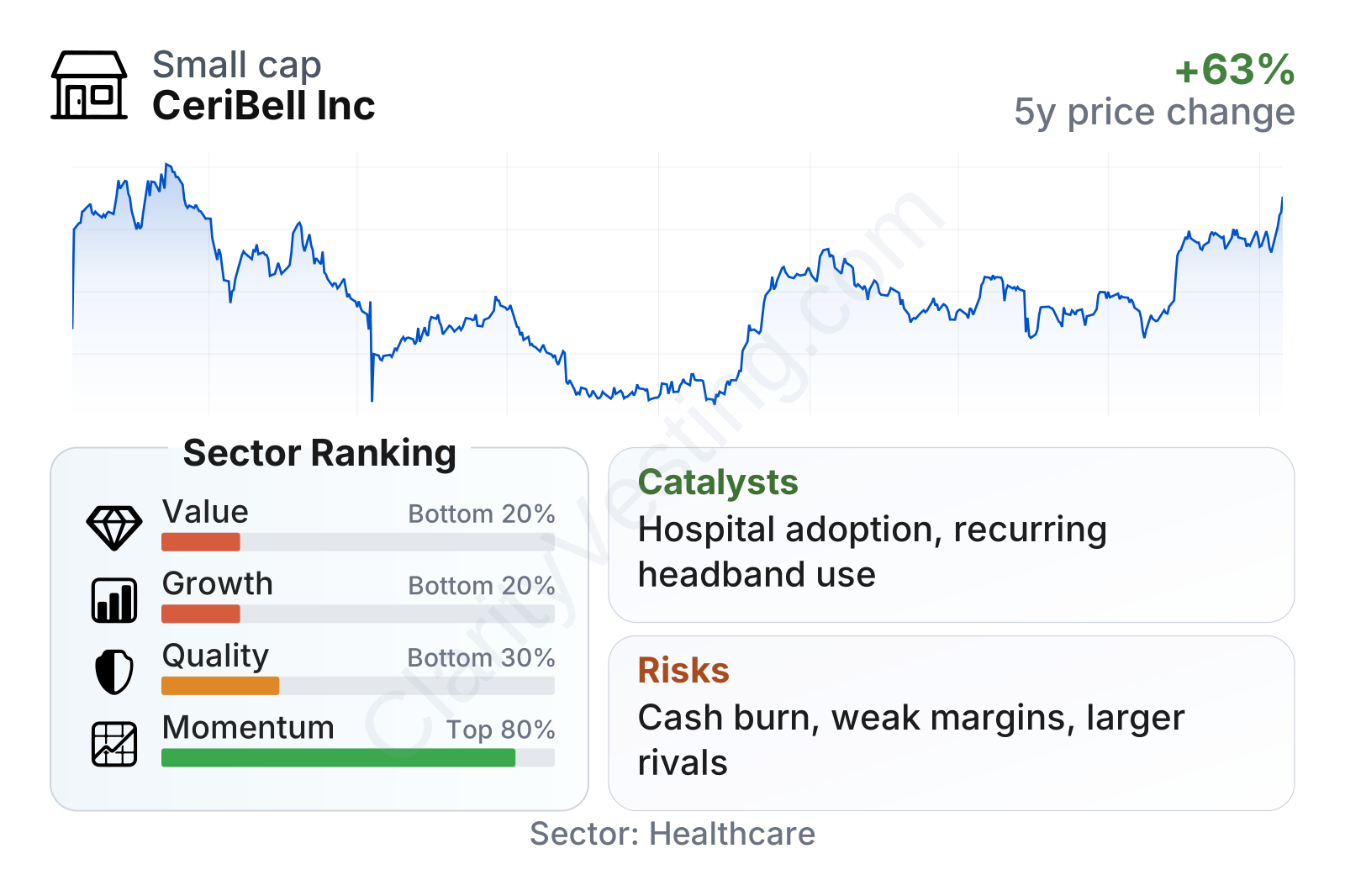
CeriBell is still a small-cap healthcare company, with share price performance that has been much stronger than the broader sector over the last 6 to 12 months. However, the underlying fundamentals remain uneven. Growth in revenue has been well above the healthcare equipment median, but profitability, returns on capital, and cash generation are still materially weaker than most peers. The valuation profile also looks demanding on book value and cash flow measures, which means the market is already assigning significant value to future expansion rather than current earnings power.
Growth
CeriBell operates in a part of healthcare that has favorable long-term drivers. Hospitals are under pressure to diagnose neurological emergencies faster, reduce delays in specialist access, and improve workflow in critical care. A simpler bedside EEG system fits directly into that need. The broader trend toward point-of-care monitoring, software-assisted interpretation, and more efficient acute-care diagnostics gives the company a relevant market backdrop.
The company’s strategy also makes sense from a scaling perspective. Instead of trying to compete head-on with every full-featured traditional EEG setup, CeriBell focuses on speed, ease of deployment, and use in settings where conventional monitoring can be slow or unavailable. That narrower positioning can support adoption because it addresses a costly hospital pain point: delayed detection of non-convulsive seizures and other neurological events.
Recent revenue growth has remained strong, running around 30% to 40% year over year in the most recent periods shown. That is far above the sector median and indicates that hospital adoption and usage are still moving upward, even if the pace has moderated from earlier peaks. For a device company at this stage, sustained growth at that level is a meaningful sign that the product is finding a place in clinical workflows.
The main limitation is that growth has not yet translated into self-funded expansion. Free cash flow remains negative and has worsened over the last reported trailing twelve-month periods. That suggests CeriBell is still spending heavily to build commercial reach and support adoption. If revenue keeps rising at a high rate while cash burn stabilizes, the path to a stronger financial profile becomes clearer. If not, scale alone may not be enough.
Potential catalysts are relatively specific. Wider hospital penetration, higher usage per installed system, additional clinical evidence, and broader acceptance of AI-assisted seizure detection could all expand the addressable opportunity. In medical devices, growth often accelerates when a product shifts from early adoption to routine protocol use, and that appears to be the transition CeriBell is trying to achieve.
Recent public company updates have continued to emphasize commercial expansion, installed base growth, and increasing utilization. Those are the right signals to watch because this is not only a question of placing devices in hospitals, but of how often staff actually use them on patients once the systems are available.
Risks
This article is for informational purposes only and does not constitute financial advice. Some content is AI-generated. See Disclaimer


