Stock Analysis · Central Bancompany Inc (CBC)
Overview
Central Bancompany Inc. is a regional banking company based in Missouri and operating through Central Bank and a network of community banking brands. Its business is straightforward: it gathers deposits from households and businesses, makes loans, earns interest on those loans and on its securities portfolio, and also collects fees from a range of banking and wealth-related services. For long-term readers, this is a traditional bank with a broad local franchise rather than a specialized financial company.
The company’s revenue mix is led by spread income, meaning the difference between what it earns on loans and investments and what it pays for funding. Based on recent annual filings, revenue appears to come mainly from the following sources:
- Net interest income: about 70% to 80% of total revenue. This includes income from commercial loans, real estate lending, consumer lending, credit card balances, and investment securities, net of interest paid on deposits and other funding.
- Trust and wealth management fees: about 5% to 10%. This typically includes fiduciary services, investment management, estate-related administration, and retirement-plan services.
- Bank card and interchange fees: about 5% to 10%. These come from debit and credit card usage, merchant processing, and related payment services.
- Deposit account and service charges: about 3% to 7%. This includes account maintenance fees, treasury management, overdraft-related charges, and commercial cash-management services.
- Mortgage banking, brokerage, and other noninterest income: about 5% to 10%. This can include gains on mortgage activity, insurance-related commissions where applicable, and other customer service fees.
This mix matters because it shows that Central Bancompany is still primarily an interest-driven bank, but not a pure one. Fee businesses provide some diversification, even if lending remains the main earnings engine.
The recent revenue path has been strong. Total revenue moved from roughly $730 million in 2021 to more than $1.2 billion in 2025, while net income also climbed materially. At the same time, interest expense increased sharply as higher rates raised the cost of deposits and funding. Even so, the company still expanded profit, which suggests a banking franchise that has managed the rate cycle relatively well.
Key Figures
| Metric | Value | Sector ⓘ |
|---|---|---|
| Date | Oct 17, 2026 | |
| Context | ||
| Sector | Financial Services | |
| Industry | Banks - Regional | |
| Market Cap ⓘ | $7.80B | |
| Beta ⓘ | 0.07 | |
Value (Cheapness) | ||
| P/E Ratio ⓘ | 17.52 | 12.26 |
| P/B Ratio ⓘ | 2.06 | 1.23 |
| FCF Yield ⓘ | 6.22% | 10.40% |
| Dividend Yield ⓘ | 1.08% | 3.02% |
| EBIT / EV ⓘ | N/A | 8.14% |
| PEG ⓘ | N/A | |
Growth (Business expansion) | ||
| Revenue Growth ⓘ | 13.70% | 9.35% |
| RPS Growth (5Y CAGR) ⓘ | -57.71% | 12.19% |
| EPS Growth (5Y CAGR) ⓘ | N/A | -9.53% |
| BVPS Growth (5Y CAGR) ⓘ | -58.75% | 4.99% |
| Margin Growth (5Y Trend) ⓘ | N/A | -3.86% |
| FCF Growth (5Y CAGR) ⓘ | -1.86% | 4.81% |
| DPS Growth (5Y CAGR) ⓘ | -43.53% | 8.79% |
Quality (Business durability) | ||
| ROIC (Latest) ⓘ | N/A | 9.49% |
| ROE (Latest) ⓘ | 12.02% | 13.90% |
| ROA (Latest) ⓘ | 2.18% | 1.55% |
| ROIC (5Y Median) ⓘ | N/A | 7.86% |
| ROE (5Y Median) ⓘ | 10.61% | 12.17% |
| ROA (5Y Median) ⓘ | 1.51% | 1.30% |
| Net Debt / EBIT (Latest) ⓘ | N/A | 0.96 |
| Net Debt / EBIT (5Y Median) ⓘ | N/A | 0.73 |
| Net Debt / EBITDA (Latest) ⓘ | 1.08 | 0.92 |
| Operating Margin (Latest) ⓘ | N/A | 22.30% |
| Operating Margin (5Y Median) ⓘ | N/A | 24.63% |
| Debt to Equity (Latest) ⓘ | 23.62% | 58.56% |
| Profit Margin (Latest) ⓘ | 40.10% | 26.57% |
| Free Cash Flow (Latest) ⓘ | $485.68M | |
Momentum (Price trend) | ||
| 3Y Return ⓘ | +169.75% | +88.33% |
| 12M Return (excl. last month) ⓘ | +70.45% | +19.38% |
| 6M Return ⓘ | +34.39% | +4.75% |
| Price vs. 200-Day MA ⓘ | +18.98% | +3.50% |
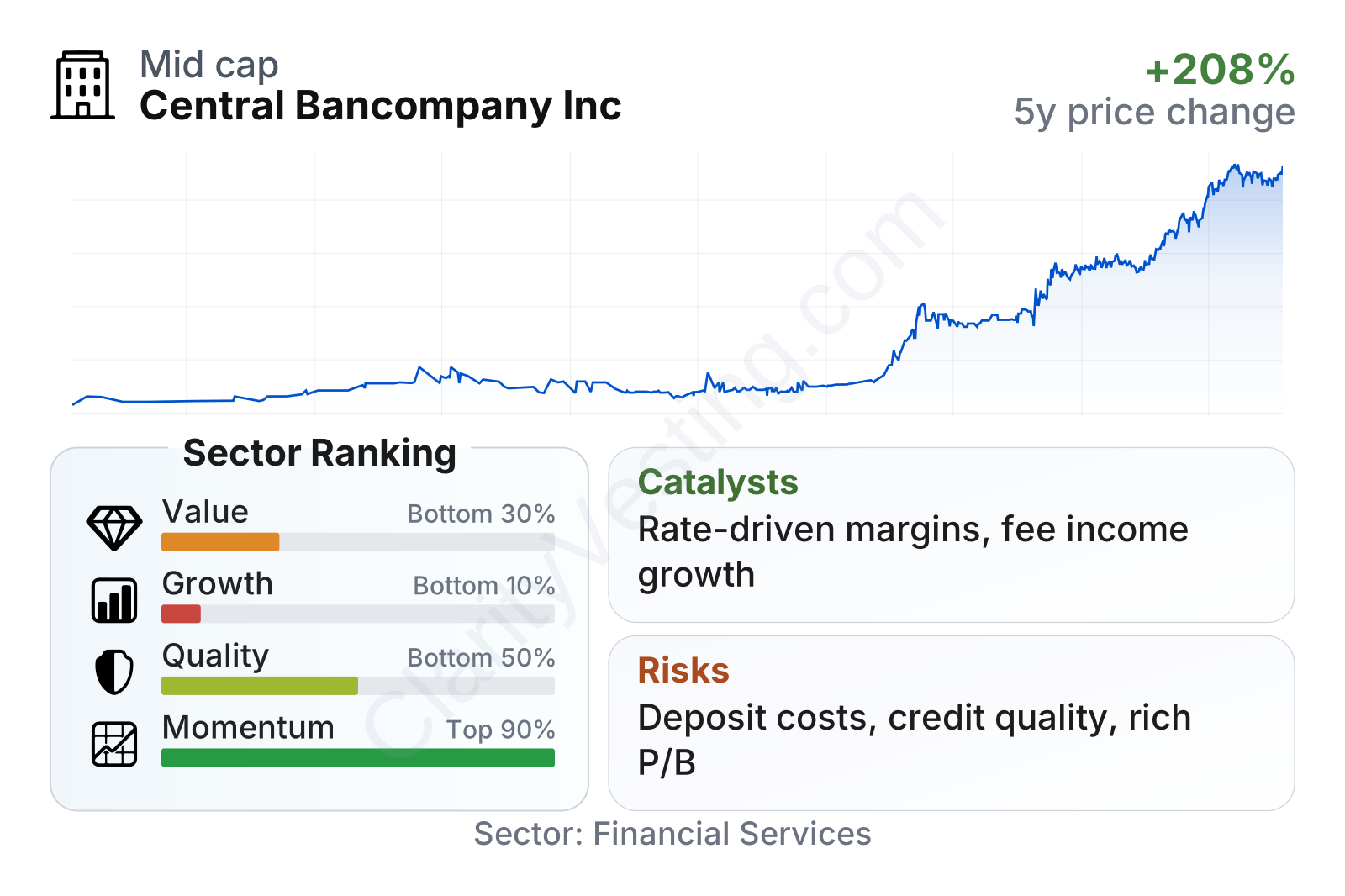
Central Bancompany sits in the mid-sized range among U.S. regional banks. The share price performance has been notably strong over the last one to three years, and recent momentum is well above the sector median. Profitability also shows some attractive features, especially a profit margin around 40% and return on assets above the industry median. On the other hand, the valuation profile looks less cheap than many regional-bank peers: both earnings and book-value multiples are above sector medians, while dividend yield and free-cash-flow yield are lower. The summary is a bank with strong recent market performance and solid operating results, but not one currently screened as an obvious bargain by conventional banking metrics.
Growth
Central Bancompany operates in regional banking, a mature industry rather than a high-growth one. That said, mature does not mean stagnant. Banks can still grow through local market share gains, loan expansion, acquisitions, treasury and payment services, and better use of customer relationships across business lines. In that context, the company’s strategy makes sense: it combines community banking with broader service capabilities, which can deepen customer ties and support steady expansion over time.
A major external factor is the interest-rate environment. When rates rise, banks can often earn more on loans and securities, although funding costs also rise. Central Bancompany’s recent results suggest that asset yields have increased enough to more than offset some of that pressure. That has been a meaningful earnings catalyst in the last two years.
There are also signs of operating momentum. Revenue growth has recently been ahead of the sector median, and earnings per share have continued to move up into 2026. That does not automatically mean a straight-line trend from here, but it does show that recent business conditions have supported higher profitability.
Book value per share is an important measure for banks because it reflects the equity base supporting the franchise. The longer-term series shown here is distorted by what appears to be a share-count or reporting comparability issue, so the direction should be read carefully rather than literally. Even with that caveat, capital generation remains an important area to watch because banks that consistently grow book value tend to have more room for balance-sheet expansion and shareholder returns over time.
As for recent developments, the strongest opportunity likely remains continued balance-sheet growth in its regional footprint combined with cross-selling of wealth, card, and treasury services. If the bank maintains loan growth discipline while preserving credit quality, that combination could keep earnings supported even if the broader banking sector becomes more competitive.
Risks
This article is for informational purposes only and does not constitute financial advice. Some content is AI-generated. See Disclaimer


