Stock Analysis · Meta Financial Group Inc (CASH)
Overview
Meta Financial Group Inc, which operates as Pathward Financial, is a regional bank with a national specialty-finance platform. Instead of relying mainly on a traditional branch network, the company combines insured deposits with fee-based payment services and selected lending businesses. Its model is built around serving businesses, program managers, fintech partners, and consumers through embedded banking, payments infrastructure, tax-related financial services, and specialized commercial lending.
The company’s revenue mix is more diversified than that of many regional banks. Based on recent annual filings, the largest sources of revenue are spread across net interest income and non-interest income from payments and servicing activities. Exact percentages can move from year to year, but the broad mix is reasonably described as follows:
- Net interest income: about 45% to 55% of total revenue. This is the spread between what the company earns on loans and securities and what it pays on deposits and other funding.
- Card and deposit-related fees: about 20% to 30%. This includes fees tied to prepaid cards, debit programs, sponsor bank relationships, and related payment processing activities.
- Tax services and refund-related fees: about 10% to 20%. This business is seasonal and linked to tax refund transfers and other tax-related financial products.
- Lending-related and other fee income: about 10% to 15%. This includes servicing, commercial finance activities, and other banking fees.
What stands out is that Pathward is not just a plain-vanilla lender. It earns meaningful income from payments and program-management activities, which can reduce dependence on any single revenue stream. Over the last several years, total revenue has trended upward, while operating profitability has remained solid even as expenses rose with business expansion.
The revenue path has generally moved higher since 2022, with net income also improving over time. Operating costs have increased, but the business has still maintained healthy earnings, suggesting the company has been able to scale without losing overall profitability.
Key Figures
| Metric | Value | Sector ⓘ |
|---|---|---|
| Date | Oct 24, 2026 | |
| Context | ||
| Sector | Financial Services | |
| Industry | Banks - Regional | |
| Market Cap ⓘ | $1.54B | |
| Beta ⓘ | 0.66 | |
Value (Cheapness) | ||
| P/E Ratio ⓘ | 9.29 | 12.46 |
| P/B Ratio ⓘ | 1.95 | 1.25 |
| FCF Yield ⓘ | 38.55% | 9.82% |
| Dividend Yield ⓘ | 0.27% | 2.94% |
| EBIT / EV ⓘ | 13.63% | 8.11% |
| PEG ⓘ | 0.20 | |
Growth (Business expansion) | ||
| Revenue Growth ⓘ | -13.50% | 9.10% |
| RPS Growth (5Y CAGR) ⓘ | -28.95% | 12.31% |
| EPS Growth (5Y CAGR) ⓘ | 16.10% | -6.97% |
| BVPS Growth (5Y CAGR) ⓘ | 15.54% | 5.02% |
| Margin Growth (5Y Trend) ⓘ | 172.26% | -4.00% |
| FCF Growth (5Y CAGR) ⓘ | -17.78% | 4.71% |
| DPS Growth (5Y CAGR) ⓘ | -0.29% | 8.92% |
Quality (Business durability) | ||
| ROIC (Latest) ⓘ | 18.85% | 9.18% |
| ROE (Latest) ⓘ | 20.95% | 13.93% |
| ROA (Latest) ⓘ | 2.37% | 1.57% |
| ROIC (5Y Median) ⓘ | 18.74% | 7.80% |
| ROE (5Y Median) ⓘ | 21.88% | 12.15% |
| ROA (5Y Median) ⓘ | 2.43% | 1.28% |
| Net Debt / EBIT (Latest) ⓘ | 0.25 | 1.02 |
| Net Debt / EBIT (5Y Median) ⓘ | -0.35 | 0.72 |
| Net Debt / EBITDA (Latest) ⓘ | 0.20 | 0.88 |
| Operating Margin (Latest) ⓘ | 26.21% | 22.30% |
| Operating Margin (5Y Median) ⓘ | 32.68% | 24.50% |
| Debt to Equity (Latest) ⓘ | 40.78% | 59.34% |
| Profit Margin (Latest) ⓘ | 23.38% | 26.42% |
| Free Cash Flow (Latest) ⓘ | $594.28M | |
Momentum (Price trend) | ||
| 3Y Return ⓘ | +77.57% | +95.73% |
| 12M Return (excl. last month) ⓘ | -3.32% | +17.30% |
| 6M Return ⓘ | -21.99% | +6.07% |
| Price vs. 200-Day MA ⓘ | -9.58% | +5.36% |
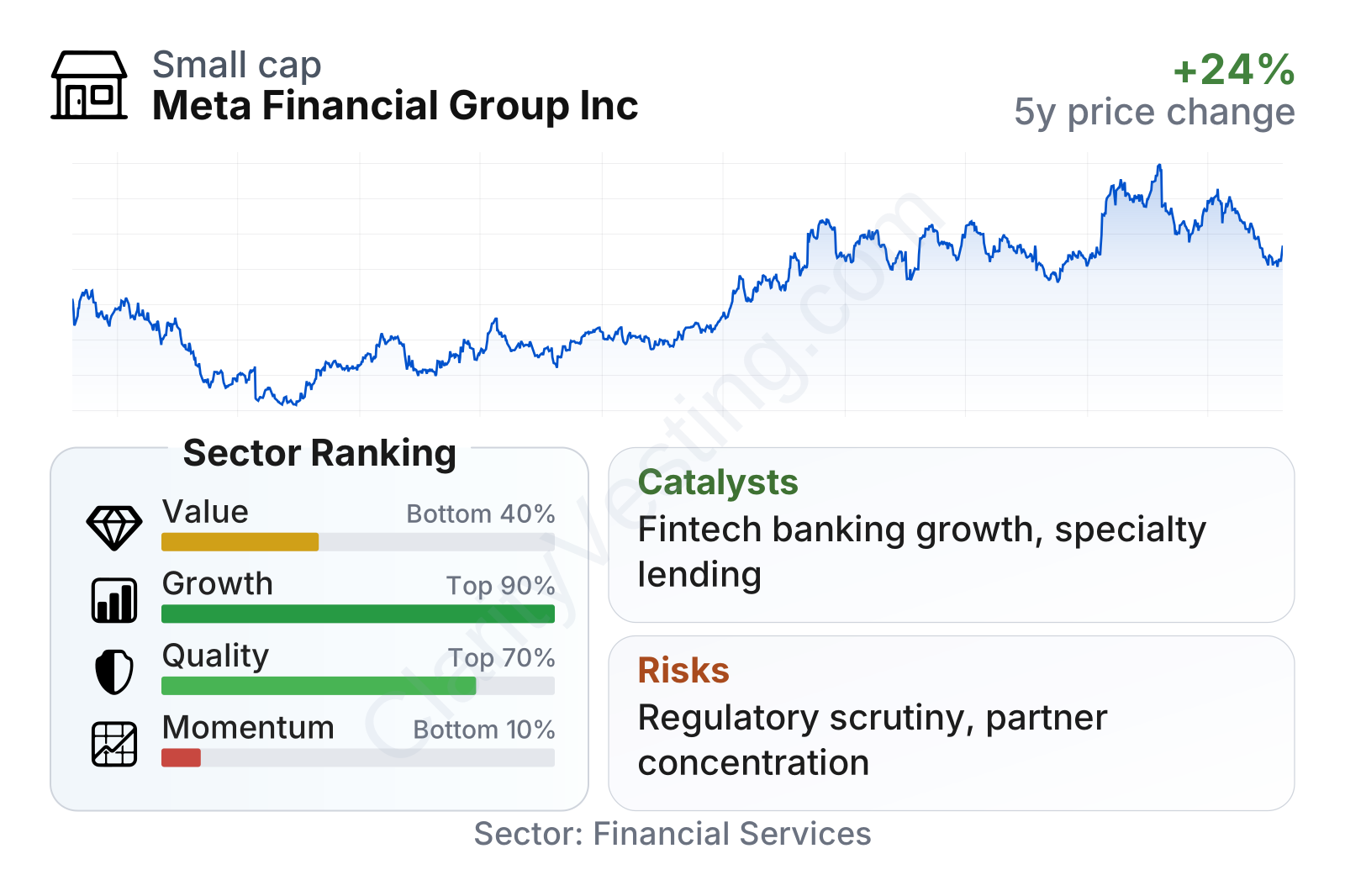
Pathward sits in the smaller end of the public banking universe by market value, but it has generated profitability metrics that compare well with many peers. The stock’s recent trading pattern has been uneven, with weaker momentum over the last six to twelve months despite a strong multi-year rise. In the factor breakdown, quality and long-term growth look stronger than near-term market sentiment. Valuation is mixed: the earnings multiple is below the sector median, while the price-to-book ratio is above it, reflecting that the market is paying up for a bank that has produced better-than-average returns on capital and equity.
Growth
Pathward operates in parts of financial services that still have room to expand, especially embedded banking, prepaid and debit program management, sponsor banking for fintechs, and specialized commercial finance. These are attractive niches because many non-bank financial brands need a regulated bank partner to issue cards, hold deposits, move money, and support customer accounts. That structural demand can create steady opportunities for banks with compliance systems, technology connections, and established partner relationships.
The company’s strategy appears coherent for long-term growth. It combines stable deposit gathering with fee-generating payments activity and higher-yield specialty lending. That mix can help offset pressure in any one line of business. It also means growth does not need to come only from opening more branches or taking outsized credit risk. Over a five-year period, revenue per share, earnings per share, and book value per share have all grown faster than the sector median, which points to real operating progress rather than just balance-sheet expansion.
The earnings trend shows a strong climb from 2022 through 2025, followed by a pullback in 2026 from a high base. That pattern suggests the business has improved meaningfully over time, even if results are not perfectly smooth from year to year.
Book value per share has advanced steadily, which is important for a bank because it reflects the accumulation of capital over time. A rising book value usually supports resilience, lending capacity, and future earnings power.
One notable catalyst is the continued buildout of bank-partner infrastructure for fintech and payments programs. As more financial products are distributed digitally, regulated banking partners with established compliance and processing capabilities can become more valuable. Pathward has also emphasized commercial payment solutions and specialty finance niches where large national banks are not always as focused. If management continues to deepen those relationships while keeping credit quality and compliance in line, the company could keep expanding faster than a typical regional bank.
Recent corporate updates have also pointed to continued emphasis on partner-driven payments and commercial finance, rather than a major strategic reset. That matters because consistency is often valuable in financial services: execution, underwriting, and compliance infrastructure take years to build, and Pathward already has operating scale in those areas.
Risks
This article is for informational purposes only and does not constitute financial advice. Some content is AI-generated. See Disclaimer


