Stock Analysis · Carrier Global Corp (CARR)
Overview
Carrier Global Corp is a large building systems company focused on heating, ventilation, air conditioning, refrigeration, and fire and security solutions. In simple terms, it sells equipment that helps keep buildings comfortable, food and medicines cold, and facilities safer. Its customers include homeowners, commercial building owners, industrial clients, contractors, and distributors across many countries.
Carrier has reshaped its portfolio over the last few years to concentrate more heavily on climate and energy-related building technologies. That matters because these markets are tied to long-term needs such as replacing aging equipment, improving energy efficiency, adapting to stricter environmental rules, and expanding cooling demand in hotter climates and more digital buildings.
Based on the company’s latest reporting structure and recent portfolio changes, revenue is mainly generated from the following activities:
- HVAC: approximately 70% of revenue. This includes residential and commercial heating and cooling systems, aftermarket parts, service, and controls.
- Refrigeration: approximately 20% of revenue. This includes transport refrigeration and cold-chain solutions used for trucks, trailers, containers, and food distribution.
- Fire & Security and other remaining activities: approximately 10% of revenue or less, depending on timing of divestitures and portfolio exits. This area has been reduced as Carrier has focused more on core climate solutions.
Profitability has been uneven in recent years because reported earnings were influenced by portfolio actions, tax effects, and deal-related changes. At the operating level, the business still shows the profile of a large installed-base company: a high proportion of manufacturing costs, meaningful selling expenses, and steady investment in engineering and product development. Revenue has remained above $20 billion in recent years, while operating income and net income have moved more sharply from year to year than sales.
The business mix points to a company with strong exposure to replacement demand and service revenue, but also one still in the middle of a strategic transition toward a more focused building and climate platform.
Key Figures
| Metric | Value | Sector ⓘ |
|---|---|---|
| Date | Oct 24, 2026 | |
| Context | ||
| Sector | Industrials | |
| Industry | Building Products & Equipment | |
| Market Cap ⓘ | $46.30B | |
| Beta ⓘ | 1.29 | |
Value (Cheapness) | ||
| P/E Ratio ⓘ | 40.70 | 22.29 |
| P/B Ratio ⓘ | 3.70 | 1.98 |
| FCF Yield ⓘ | 4.11% | 6.26% |
| Dividend Yield ⓘ | 1.71% | 1.92% |
| EBIT / EV ⓘ | 3.15% | 4.83% |
| PEG ⓘ | 1.07 | |
Growth (Business expansion) | ||
| Revenue Growth ⓘ | 3.90% | 9.30% |
| RPS Growth (5Y CAGR) ⓘ | 2.63% | 7.76% |
| EPS Growth (5Y CAGR) ⓘ | -12.21% | -13.17% |
| BVPS Growth (5Y CAGR) ⓘ | 21.80% | 6.13% |
| Margin Growth (5Y Trend) ⓘ | -1.06% | 0.74% |
| FCF Growth (5Y CAGR) ⓘ | -2.70% | 10.79% |
| DPS Growth (5Y CAGR) ⓘ | 18.12% | 9.41% |
Quality (Business durability) | ||
| ROIC (Latest) ⓘ | 9.72% | 10.75% |
| ROA (Latest) ⓘ | 3.23% | 5.41% |
| ROIC (5Y Median) ⓘ | 10.14% | 9.37% |
| ROA (5Y Median) ⓘ | 6.49% | 4.95% |
| Net Debt / EBIT (Latest) ⓘ | 6.22 | 2.04 |
| Net Debt / EBIT (5Y Median) ⓘ | 3.06 | 2.27 |
| Net Debt / EBITDA (Latest) ⓘ | 3.61 | 1.39 |
| Net Debt / Assets ⓘ | 29.57% | 19.27% |
| EBITDA / Interest ⓘ | 9.16 | 9.58 |
| Operating Margin (Latest) ⓘ | 8.03% | 10.49% |
| Operating Margin (5Y Median) ⓘ | 11.43% | 10.30% |
| Debt to Equity (Latest) ⓘ | 94.27% | 64.82% |
| Profit Margin (Latest) ⓘ | 5.52% | 6.67% |
| Free Cash Flow (Latest) ⓘ | $1.90B | |
Momentum (Price trend) | ||
| 3Y Return ⓘ | +21.83% | +67.77% |
| 12M Return (excl. last month) ⓘ | -8.16% | +12.05% |
| 6M Return ⓘ | -7.84% | 0.00% |
| Price vs. 200-Day MA ⓘ | -8.20% | +0.67% |
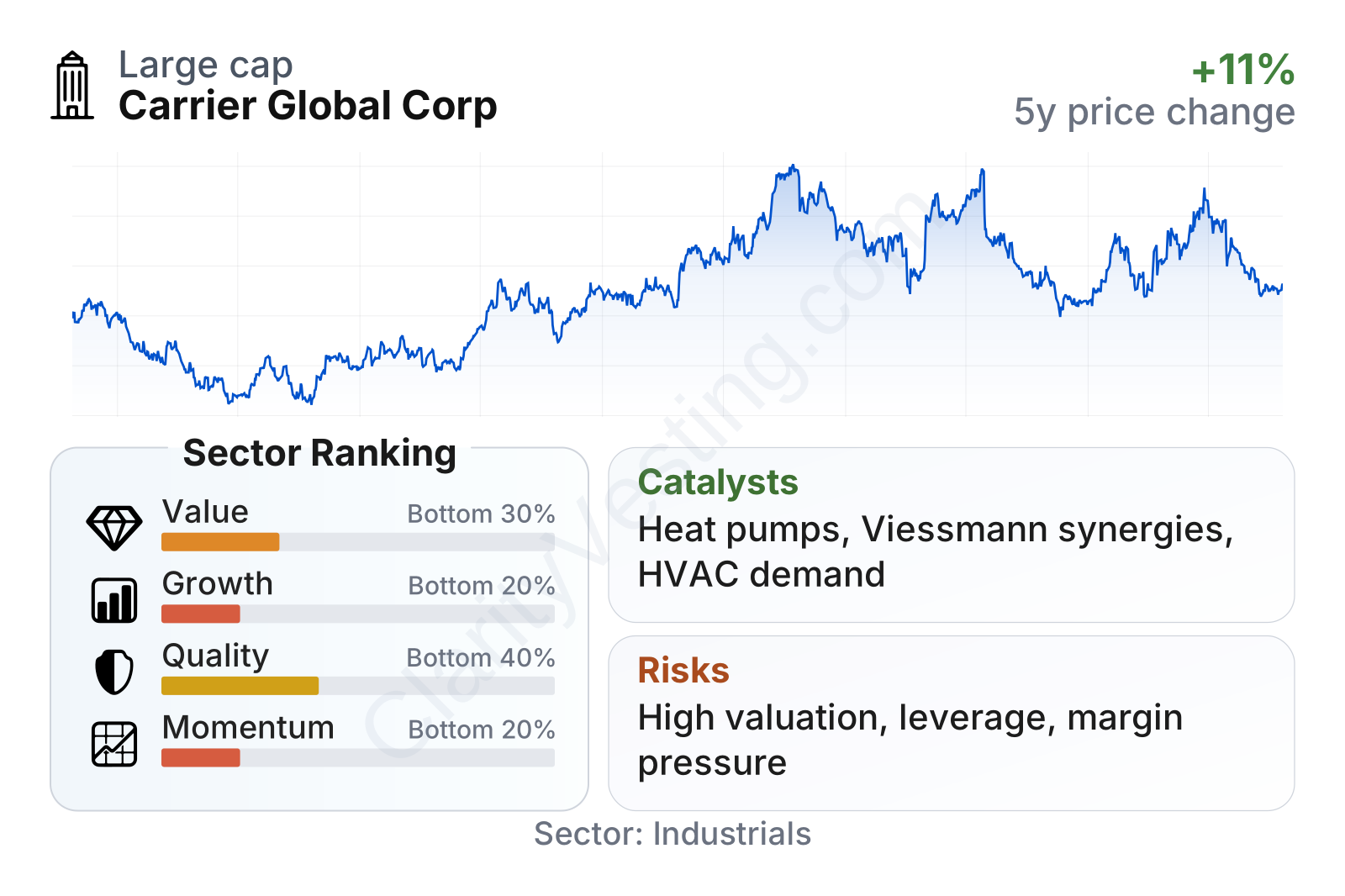
Carrier is a large industrial company with above-average share price volatility, as shown by a beta around 1.3. Relative to its sector, the current profile looks mixed: valuation appears demanding, growth ranks weakly, quality is around the middle to lower half, and recent stock momentum has lagged. Free cash flow remains meaningful in absolute dollars, but the yield is below the sector median, which suggests the market is placing a premium on the business despite moderate recent operating trends.
The stock chart also shows that sentiment has been changeable. After a strong run through 2024, the shares experienced a notable reset and then recovered again into 2026. That kind of movement often reflects a company where expectations can swing quickly based on margin outlook, portfolio simplification, and integration progress rather than just headline revenue growth.
Growth
Carrier operates in a sector with durable long-term demand drivers. Cooling and heating equipment are essential products, and much of the market is based on replacement rather than purely discretionary spending. On top of that, efficiency regulations, electrification trends, data center cooling needs, tighter environmental standards, and rising demand for healthier indoor environments all support continued investment in modern HVAC systems.
The company’s strategy broadly makes sense for future growth. Management has been simplifying the portfolio to focus more on areas where Carrier can combine equipment, controls, software, and service. That approach can strengthen margins over time because service and aftermarket activities are usually steadier than new equipment sales alone. The acquisition of Viessmann Climate Solutions added more exposure to Europe, heat pumps, and residential energy transition products, which gives Carrier a larger role in decarbonization-related building upgrades.
That said, recent top-line growth has not been especially strong compared with the wider industrial sector. Year-over-year sales growth returned to low-single-digit positive territory in the latest periods after several uneven quarters. This suggests the business is still growing, but not at a pace that clearly stands out within its peer group.
Cash generation gives a somewhat better picture than short-term revenue swings. Free cash flow dropped sharply in 2025 and then recovered meaningfully by 2026, indicating that the company still has solid earnings-to-cash conversion capacity even when reported results are noisy. For a long-term view, that is important because industrial companies often create value through cash generation, debt reduction, bolt-on deals, and shareholder distributions more than through fast annual revenue expansion.
A notable catalyst is Carrier’s positioning in more efficient climate solutions. Heat pumps, building decarbonization, refrigerant transitions, and intelligent controls are all areas where regulation and customer economics can work in the same direction. If the company executes well, those themes can support both volume and pricing over time. Recent company communications have also emphasized continued integration work and portfolio optimization, which could create additional margin improvement opportunities if delivered cleanly.
Risks
This article is for informational purposes only and does not constitute financial advice. Some content is AI-generated. See Disclaimer


