Stock Analysis · Avis Budget Group Inc (CAR)
Overview
Avis Budget Group is one of the world’s largest vehicle rental companies. It operates well-known brands including Avis, Budget, and Zipcar, and provides short-term vehicle rentals, related mobility services, and fleet management support across North America, Europe, Australia, New Zealand, and parts of Asia and Latin America. In simple terms, the company makes money by renting cars to leisure travelers, business travelers, and commercial customers, then managing a very large fleet efficiently enough to earn a profit after vehicle, financing, maintenance, and operating costs.
The business is primarily organized into two reporting segments: Americas and International. Based on recent annual filings, revenue is heavily concentrated in the Americas, with International as the second-largest contributor.
- Americas vehicle rental and related services: approximately 75% to 80% of total revenue. This includes airport rentals, off-airport rentals, commercial fleet customers, ancillary items such as insurance-related products, and other mobility-related fees.
- International vehicle rental and related services: approximately 20% to 25% of total revenue. This covers similar activities outside the Americas, including company-operated rental operations and related services.
- Other activities: a small share of revenue, generally linked to fleet management, licensing, car-sharing through Zipcar, and miscellaneous service lines.
Avis Budget’s economics are unusual compared with many industrial businesses because vehicle costs, depreciation, fleet financing, and used-car resale values can have a very large effect on results. That means revenue alone does not tell the full story: earnings can swing sharply depending on pricing, utilization, vehicle supply, and the value of cars when they are sold out of the fleet.
The multi-year profit flow shows that revenue stayed relatively high after the post-pandemic rebound, but profitability dropped much faster than sales. Gross profit and operating income peaked in 2022, then weakened materially in 2023 and especially 2024 as fleet-related costs and vehicle values turned less favorable.
Key Figures
| Metric | Value | Sector ⓘ |
|---|---|---|
| Date | Oct 24, 2026 | |
| Context | ||
| Sector | Industrials | |
| Industry | Rental & Leasing Services | |
| Market Cap ⓘ | $3.62B | |
| Beta ⓘ | 2.11 | |
Value (Cheapness) | ||
| P/E Ratio ⓘ | N/A | 22.29 |
| P/B Ratio ⓘ | N/A | 1.98 |
| FCF Yield ⓘ | -314.99% | 6.26% |
| Dividend Yield ⓘ | N/A | 1.92% |
| EBIT / EV ⓘ | 4.94% | 4.83% |
| PEG ⓘ | 0.17 | |
Growth (Business expansion) | ||
| Revenue Growth ⓘ | -1.30% | 9.30% |
| RPS Growth (5Y CAGR) ⓘ | 23.81% | 7.76% |
| EPS Growth (5Y CAGR) ⓘ | N/A | -13.17% |
| BVPS Growth (5Y CAGR) ⓘ | N/A | 6.13% |
| Margin Growth (5Y Trend) ⓘ | -20.16% | 0.74% |
| FCF Growth (5Y CAGR) ⓘ | N/A | 10.79% |
| DPS Growth (5Y CAGR) ⓘ | N/A | 9.41% |
Quality (Business durability) | ||
| ROIC (Latest) ⓘ | 5.97% | 10.75% |
| ROA (Latest) ⓘ | -1.96% | 5.41% |
| ROIC (5Y Median) ⓘ | 12.08% | 9.37% |
| ROA (5Y Median) ⓘ | 5.50% | 4.95% |
| Net Debt / EBIT (Latest) ⓘ | 17.91 | 2.04 |
| Net Debt / EBIT (5Y Median) ⓘ | 8.17 | 2.27 |
| Net Debt / EBITDA (Latest) ⓘ | 5.16 | 1.39 |
| Net Debt / Assets ⓘ | 88.37% | 19.27% |
| EBITDA / Interest ⓘ | 4.24 | 9.58 |
| Operating Margin (Latest) ⓘ | 13.62% | 10.49% |
| Operating Margin (5Y Median) ⓘ | 24.21% | 10.30% |
| Debt to Equity (Latest) ⓘ | -859.65% | 64.82% |
| Profit Margin (Latest) ⓘ | -5.43% | 6.67% |
| Free Cash Flow (Latest) ⓘ | -$11.40B | |
Momentum (Price trend) | ||
| 3Y Return ⓘ | -40.46% | +67.77% |
| 12M Return (excl. last month) ⓘ | -25.62% | +12.05% |
| 6M Return ⓘ | -86.22% | 0.00% |
| Price vs. 200-Day MA ⓘ | -36.31% | +0.67% |
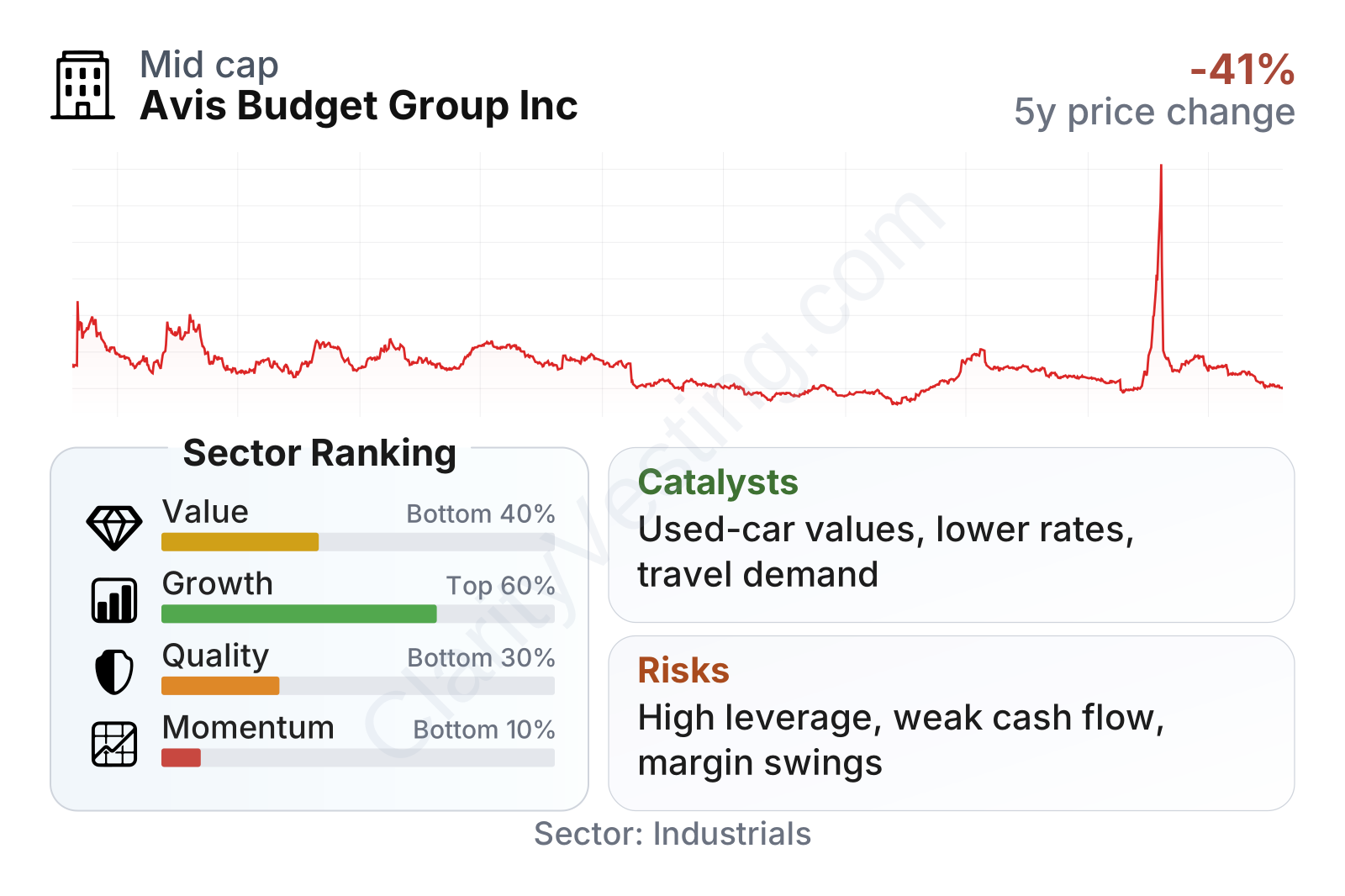
Avis Budget sits in the mid-cap range and carries a high beta, which means the stock has tended to move more sharply than the broader market. The overall factor picture is mixed: growth ranks around the middle of the sector, but quality, momentum, and value are weaker. That combination reflects a company with a strong long-term rebound record from the last cycle, but with current balance-sheet strain, negative recent cash generation, and a share price that has remained highly volatile.
The stock-price history also underlines how cyclical this business can be. The shares have experienced very large up-and-down moves over the last several years, which is consistent with a company whose earnings are strongly influenced by travel demand, used-car prices, financing costs, and residual vehicle values.
Growth
The broader sector has some durable support. Air travel, tourism, and outsourced mobility needs continue to create demand for rental vehicles, and large operators such as Avis Budget benefit from scale, airport presence, brand recognition, and purchasing relationships with automakers. Over the long run, car rental remains tied to steady economic activities rather than a short-lived niche trend.
That said, current growth is not especially strong. Recent year-over-year revenue changes have been flat to slightly negative after the exceptional rebound period that followed pandemic disruptions. This suggests the company is now operating in a more mature part of the cycle, where pricing and fleet economics matter more than simple volume expansion.
Strategically, management has continued to focus on fleet optimization, technology, and operational efficiency. For a rental company, this makes practical sense: stronger utilization, better pricing discipline, and more efficient fleet turnover can improve returns even when revenue growth is limited. Avis Budget also still has exposure to business travel normalization, international travel demand, and off-airport and commercial rental activity, which can help support utilization across the fleet.
There is also a longer-term opportunity in how mobility habits are evolving. Many consumers and businesses want access to transportation without committing to ownership, especially in urban and travel-heavy use cases. Zipcar adds a smaller but relevant presence in car-sharing, while the core rental platform provides flexibility across leisure, insurance replacement, and corporate channels.
Cash generation, however, is the main pressure point. Free cash flow has remained deeply negative in recent periods, which indicates that fleet investment and working-capital needs have outweighed operating cash creation. For this business, that does not automatically signal structural weakness, because fleet purchases and dispositions can distort cash flow, but the scale of the negative figures still shows that the recovery in underlying economics is incomplete.
A near-term catalyst is any improvement in used-car residual values and fleet depreciation trends. Because vehicle resale values feed directly into rental economics, a more stable or improving used-vehicle market could have an outsized effect on earnings. Another catalyst is lower financing pressure if interest costs ease over time, since fleet-heavy operators are especially sensitive to borrowing costs.
Risks
This article is for informational purposes only and does not constitute financial advice. Some content is AI-generated. See Disclaimer


