Stock Analysis · China Overseas Land & Investment Limited (CAOVF)
Overview
China Overseas Land & Investment Limited is a large Chinese real estate developer focused mainly on residential and mixed-use projects. The company develops and sells properties, but it also owns investment properties that generate recurring rental income and it provides other real-estate-related services. It is part of the wider China State Construction group, which matters because backing from a major state-linked parent can improve financing access and execution credibility in a sector that has gone through a prolonged downturn.
Based on the company’s recent annual disclosures, revenue is still dominated by property development and sales, with smaller contributions from recurring and service activities.
- Property development and sales: approximately 85% to 90% of revenue. This includes the sale and delivery of residential projects and some commercial units.
- Property investment: approximately 5% to 10% of revenue. This mainly covers rental income from office buildings, shopping centers, and other investment properties.
- Other operations: approximately 3% to 7% of revenue. This generally includes hotel operations, property management-related activities, and other ancillary services depending on the reporting period.
The business mix shows a classic Chinese developer profile: sales of completed projects remain the main earnings engine, while rental and service income provide a smaller but steadier base. The broader earnings flow also highlights a key trend over the last several years: revenue and profits have remained sizable, but margins have narrowed materially as the Chinese property market weakened and pricing power fell.
The operating picture suggests a company that is still generating large amounts of business volume, but with much thinner profit conversion than a few years ago. Cost control has helped somewhat, and interest expense has remained relatively contained, yet the decline in net income since 2021 shows how strongly the sector downturn has affected even the stronger developers.
Key Figures
| Metric | Value | Sector ⓘ |
|---|---|---|
| Date | Oct 24, 2026 | |
| Context | ||
| Sector | Real Estate | |
| Industry | Real Estate - Development | |
| Market Cap ⓘ | $18.17B | |
| Beta ⓘ | 0.56 | |
Value (Cheapness) | ||
| P/E Ratio ⓘ | 11.86 | 17.85 |
| P/B Ratio ⓘ | 0.01 | 0.87 |
| FCF Yield ⓘ | 267.98% | 7.30% |
| Dividend Yield ⓘ | 25.30% | 4.83% |
| EBIT / EV ⓘ | N/A | 3.78% |
| PEG ⓘ | 0.60 | |
Growth (Business expansion) | ||
| Revenue Growth ⓘ | 17.30% | 5.35% |
| RPS Growth (5Y CAGR) ⓘ | 44.19% | 6.02% |
| EPS Growth (5Y CAGR) ⓘ | -30.76% | -10.65% |
| BVPS Growth (5Y CAGR) ⓘ | 60.27% | 0.43% |
| Margin Growth (5Y Trend) ⓘ | -8.19% | -0.69% |
| FCF Growth (5Y CAGR) ⓘ | -18.77% | 5.40% |
| DPS Growth (5Y CAGR) ⓘ | 41.36% | 5.07% |
Quality (Business durability) | ||
| ROIC (Latest) ⓘ | N/A | 5.69% |
| ROE (Latest) ⓘ | 6.57% | 7.37% |
| ROA (Latest) ⓘ | 2.76% | 2.85% |
| ROIC (5Y Median) ⓘ | 4.18% | 4.26% |
| ROE (5Y Median) ⓘ | 5.82% | 6.04% |
| ROA (5Y Median) ⓘ | 2.23% | 2.45% |
| Net Debt / EBIT (Latest) ⓘ | 2.70 | 7.55 |
| Net Debt / EBIT (5Y Median) ⓘ | 3.98 | 8.26 |
| Net Debt / EBITDA (Latest) ⓘ | 2.65 | 5.26 |
| Net Debt / Assets ⓘ | 13.19% | 37.45% |
| EBITDA / Interest ⓘ | 22.04 | 4.11 |
| Operating Margin (Latest) ⓘ | 11.90% | 33.86% |
| Operating Margin (5Y Median) ⓘ | 19.84% | 37.49% |
| Debt to Equity (Latest) ⓘ | 60.48% | 88.76% |
| Profit Margin (Latest) ⓘ | 6.10% | 18.94% |
| Free Cash Flow (Latest) ⓘ | $48.69B | |
Momentum (Price trend) | ||
| 3Y Return ⓘ | -0.98% | +36.33% |
| 12M Return (excl. last month) ⓘ | -1.04% | +4.32% |
| 6M Return ⓘ | +7.48% | -1.74% |
| Price vs. 200-Day MA ⓘ | -3.28% | -1.42% |
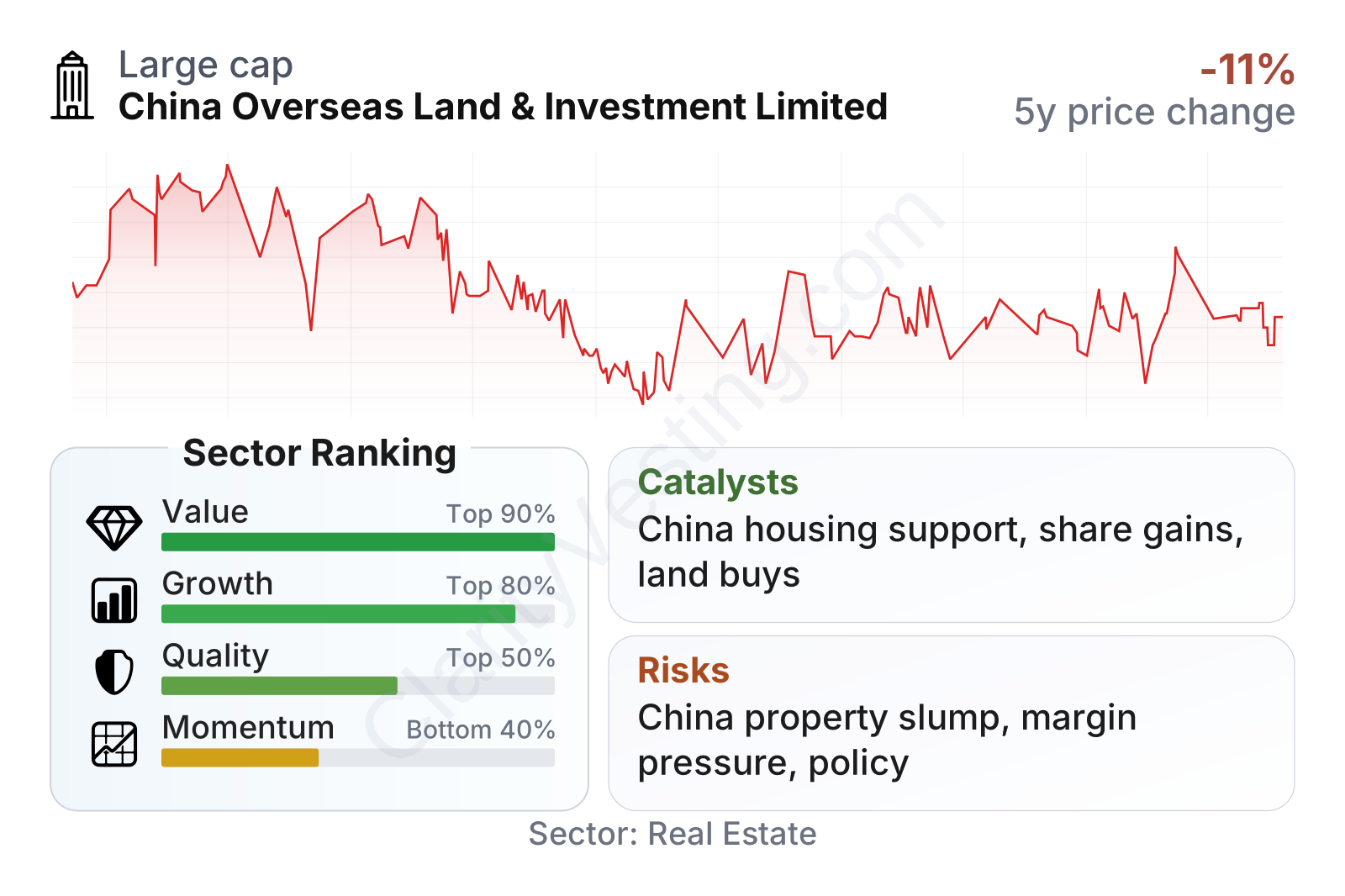
The stock has moved sideways to weaker over several years, reflecting broad caution toward Chinese property names rather than a collapse unique to this company. The metrics table, however, paints a more nuanced picture. On valuation, the shares screen as very cheap versus much of the real estate sector, with a low earnings multiple, an unusually low price-to-book ratio, and a dividend yield far above the sector median. Growth indicators also rank strongly, especially on recent revenue growth and long-term book value expansion. Quality is more mixed: leverage looks better than many peers and interest coverage is strong, but profitability ratios and margins are not especially high. Momentum remains the weakest area, which fits the market’s continued skepticism toward the sector.
Growth
China Overseas Land & Investment operates in a sector that is strategically important to China but still under pressure. That creates an unusual setup for long-term analysis. The Chinese residential property market is no longer in its old high-growth phase, so the sector itself is not a straightforward growth market. However, stronger developers can still gain share when weaker competitors retreat, restructure, or lose access to funding. In that environment, scale, land discipline, and financing access matter more than aggressive expansion.
The company’s strategy appears aligned with that reality. It has maintained a relatively stronger balance sheet than many private-sector developers, and that gives it room to continue acquiring land selectively, completing projects, and benefiting from industry consolidation. Its connection to a major state-backed construction ecosystem also supports execution and funding resilience, which can become a competitive advantage when homebuyers and lenders prefer safer counterparties.
Revenue per share has been volatile rather than steadily rising, which is normal for a developer because revenue depends heavily on project completion timing and market conditions. Even so, the broader picture suggests the company has preserved scale better than many distressed peers. If the Chinese housing market stabilizes, project deliveries and land replenishment at favorable prices could become meaningful drivers of future growth.
Dividend distributions have also been uneven over time, which is another sign of the sector’s cyclical pressure. Still, the company has remained a cash-generative business on a trailing basis and continues to stand out in yield terms relative to many real estate peers. That does not remove cyclicality, but it does suggest management has retained more financial flexibility than many competitors.
A major catalyst for the company is any sustained policy support aimed at stabilizing China’s housing market, including easier mortgage conditions, support for project completion, or measures that improve buyer confidence in top-tier and core urban markets. Another potential opportunity is market-share transfer: when weaker developers cut activity, better-capitalized groups can secure land, financing, and customer trust on better terms.
Risks
This article is for informational purposes only and does not constitute financial advice. Some content is AI-generated. See Disclaimer


