Stock Analysis · Cal-Maine Foods Inc (CALM)
Overview
Cal-Maine Foods is the largest producer and distributor of fresh shell eggs in the United States. The company sells conventional eggs, cage-free eggs, organic eggs, brown eggs, free-range eggs, pasture-raised eggs, and a range of specialty egg products. Its customers include grocery chains, mass merchandisers, club stores, foodservice distributors, and food manufacturers. In simple terms, Cal-Maine is a large-scale egg business whose results depend mainly on how many eggs it sells, what mix of eggs it sells, and the market price of eggs.
The business is more concentrated than many packaged food companies because eggs dominate revenue. Based on company reporting, the main sources of revenue are approximately:
- Conventional shell eggs: roughly 60% to 70% of sales in recent years. This is the core business and includes standard white eggs sold through retail and foodservice channels.
- Specialty shell eggs: roughly 30% to 40% of sales. This category includes cage-free, organic, brown, free-range, and pasture-raised eggs, which usually carry higher selling prices.
- Other products: typically a small share of sales, including egg products and incidental items tied to distribution and processing activities.
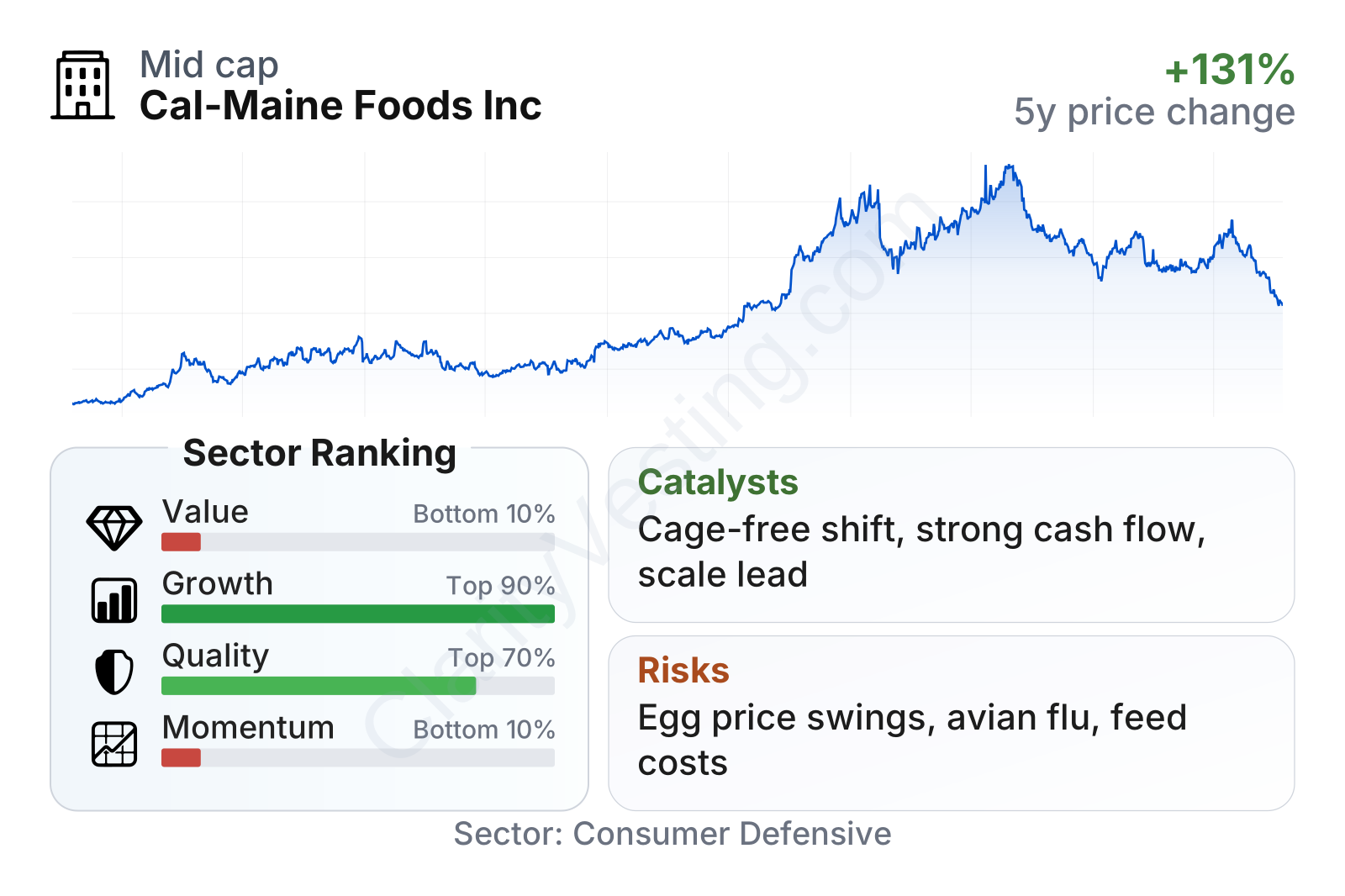
What stands out is how strongly profits can swing from year to year. Revenue climbed sharply in fiscal 2025 and then fell back in fiscal 2026 as egg prices normalized from unusually high levels, yet the business remained profitable. Over a five-year view, Cal-Maine still shows meaningful expansion in sales, cash generation, and book value, which suggests that the company has used favorable market periods to strengthen its balance sheet rather than stretch it.
The operating picture shows an unusually wide gap between strong years and more normal years. Fiscal 2025 was exceptionally profitable, while fiscal 2026 moved closer to a more moderate level. Even after that reset, the company still produced solid earnings with very low interest expense, highlighting how little financial leverage it uses.
Key Figures
| Metric | Value | Sector ⓘ |
|---|---|---|
| Date | Oct 17, 2026 | |
| Context | ||
| Sector | Consumer Defensive | |
| Industry | Farm Products | |
| Market Cap ⓘ | $2.96B | |
| Beta ⓘ | 0.23 | |
Value (Cheapness) | ||
| P/E Ratio ⓘ | 51.58 | 17.88 |
| P/B Ratio ⓘ | 1.14 | 1.29 |
| FCF Yield ⓘ | -1.00% | 12.39% |
| Dividend Yield ⓘ | 1.68% | 2.85% |
| EBIT / EV ⓘ | 0.71% | 6.43% |
| PEG ⓘ | 2.20 | |
Growth (Business expansion) | ||
| Revenue Growth ⓘ | -41.50% | 4.10% |
| RPS Growth (5Y CAGR) ⓘ | 13.70% | 6.18% |
| EPS Growth (5Y CAGR) ⓘ | N/A | -13.59% |
| BVPS Growth (5Y CAGR) ⓘ | 24.77% | 3.20% |
| Margin Growth (5Y Trend) ⓘ | 2.41% | -0.15% |
| FCF Growth (5Y CAGR) ⓘ | 57.58% | 4.10% |
| DPS Growth (5Y CAGR) ⓘ | 149.29% | 6.79% |
Quality (Business durability) | ||
| ROIC (Latest) ⓘ | 9.99% | 12.34% |
| ROA (Latest) ⓘ | 1.91% | 6.30% |
| ROIC (5Y Median) ⓘ | 16.22% | 10.49% |
| ROA (5Y Median) ⓘ | 13.35% | 5.44% |
| Net Debt / EBIT (Latest) ⓘ | -6.60 | 1.96 |
| Net Debt / EBIT (5Y Median) ⓘ | -0.31 | 2.35 |
| Net Debt / EBITDA (Latest) ⓘ | -0.78 | 1.38 |
| Net Debt / Assets ⓘ | -3.77% | 21.51% |
| EBITDA / Interest ⓘ | N/A | 9.46 |
| Operating Margin (Latest) ⓘ | 0.68% | 8.87% |
| Operating Margin (5Y Median) ⓘ | 15.50% | 9.53% |
| Debt to Equity (Latest) ⓘ | N/A | 72.35% |
| Profit Margin (Latest) ⓘ | 2.32% | 5.40% |
| Free Cash Flow (Latest) ⓘ | -$29.52M | |
Momentum (Price trend) | ||
| 3Y Return ⓘ | +45.95% | +20.92% |
| 12M Return (excl. last month) ⓘ | -31.17% | +2.13% |
| 6M Return ⓘ | -17.07% | +1.26% |
| Price vs. 200-Day MA ⓘ | -20.81% | +1.39% |
Cal-Maine is a mid-sized public company with a market value a little above $3 billion and a very low beta, which means its trading pattern has historically been less sensitive than the broader market. The current profile is mixed: valuation and quality measures look relatively solid, growth looks excellent on a multi-year basis but weak on the most recent year, and momentum is clearly soft after a strong multi-year run.
The most notable point in the table is the company’s financial strength. Profitability remains above the sector median, while net debt metrics are better than many peers because Cal-Maine effectively operates with net cash rather than heavy borrowing. That balance sheet flexibility matters in a business where earnings can move sharply with egg price cycles.
Growth
The egg market is not a high-growth technology sector, but it is part of a large and resilient food category with long-term demand support. Eggs remain one of the lower-cost animal proteins, which helps demand during periods when consumers trade down from more expensive foods. On top of that, the industry is being reshaped by the shift toward cage-free and other specialty eggs, where pricing is usually higher and where large operators with capital, distribution reach, and retail relationships can gain share.
Cal-Maine’s strategy is logical for that environment. The company has continued investing in specialty capacity, acquisitions, and processing capabilities while keeping a very conservative balance sheet. That combination gives it room to expand when smaller producers face pressure. Its scale also helps with national retail relationships, logistics, and the ability to serve large customers consistently.
The recent revenue trend is volatile rather than linear. Year-over-year sales growth has swung from very large increases to a sharp decline most recently, which is normal for this business because egg pricing can change quickly. That makes short-term growth hard to read in isolation. The more useful signal is that over five years, revenue per share has compounded well above the sector median, showing that Cal-Maine has still built a larger earnings base over time despite the ups and downs.
Cash generation is another encouraging element. Free cash flow has been positive and substantial in recent periods, even after the peak earnings year faded. This matters because it gives the company options: expansion projects, acquisitions, dividends under its variable policy, and a buffer against weaker pricing periods. A recent opportunity worth watching is the continued conversion of U.S. egg demand toward cage-free supply, especially as retailers, restaurants, and state rules push the market in that direction. That shift tends to favor operators with scale, capital, and existing customer access.
Risks
This article is for informational purposes only and does not constitute financial advice. Some content is AI-generated. See Disclaimer


