Stock Analysis · Conagra Brands Inc (CAG)
Overview
Conagra Brands is a large U.S. packaged food company that owns a wide collection of grocery and frozen-food brands sold through supermarkets, club stores, mass retailers, convenience channels, foodservice customers, and e-commerce. Its portfolio includes familiar names such as Healthy Choice, Marie Callender’s, Birds Eye, Banquet, Duncan Hines, Reddi-wip, Slim Jim, and Angie’s BOOMCHICKAPOP. In simple terms, Conagra makes branded food products that consumers buy for everyday meals, snacks, and pantry use.
The company’s revenue comes mainly from three operating segments. Based on recent annual reporting, the mix is approximately:
- Grocery & Snacks: about 40% — shelf-stable meals, condiments, peanut butter, popcorn, snack nuts, jerky, baking products, and other pantry staples.
- Refrigerated & Frozen: about 40% — frozen meals, vegetables, plant-based and refrigerated products, whipped toppings, and frozen single-serve and family meal offerings.
- International: about 20% — branded food sold outside the United States, with an important presence in Canada and selected other markets.
That revenue mix matters because it shows Conagra is not dependent on a single product line. It has meaningful exposure to frozen food, snacks, and center-store grocery categories, which can help balance demand patterns. At the same time, most of its business is still tied to mature North American packaged-food markets, so growth tends to depend more on pricing, brand management, innovation, and efficiency than on rapid market expansion.
Over the last several years, sales have stayed in a fairly narrow range around the low tens of billions of dollars, while profitability has been more volatile. The latest annual figures show that revenue declined modestly again, and the sharp drop in operating income in fiscal 2026 was driven largely by sizable non-cash impairment charges rather than by a collapse in the underlying cash generation of the business.
The overall flow of revenue and costs shows a business with relatively steady sales but fluctuating earnings. Gross profit has narrowed from recent highs, while the latest year’s operating result was heavily distorted by large charges. Interest expense remains material, which is important for a company with above-sector leverage.
Key Figures
| Metric | Value | Sector ⓘ |
|---|---|---|
| Date | Oct 17, 2026 | |
| Context | ||
| Sector | Consumer Defensive | |
| Industry | Packaged Foods | |
| Market Cap ⓘ | $6.53B | |
| Beta ⓘ | N/A | |
Value (Cheapness) | ||
| P/E Ratio ⓘ | N/A | 17.88 |
| P/B Ratio ⓘ | 1.03 | 1.29 |
| FCF Yield ⓘ | 13.43% | 12.39% |
| Dividend Yield ⓘ | 9.08% | 2.85% |
| EBIT / EV ⓘ | -11.93% | 6.43% |
| PEG ⓘ | 12.07 | |
Growth (Business expansion) | ||
| Revenue Growth ⓘ | -1.40% | 4.10% |
| RPS Growth (5Y CAGR) ⓘ | -0.39% | 6.18% |
| EPS Growth (5Y CAGR) ⓘ | -44.36% | -13.59% |
| BVPS Growth (5Y CAGR) ⓘ | -7.42% | 3.20% |
| Margin Growth (5Y Trend) ⓘ | -27.96% | -0.15% |
| FCF Growth (5Y CAGR) ⓘ | 8.24% | 4.10% |
| DPS Growth (5Y CAGR) ⓘ | 3.75% | 6.79% |
Quality (Business durability) | ||
| ROIC (Latest) ⓘ | -8.53% | 12.34% |
| ROA (Latest) ⓘ | -10.24% | 6.30% |
| ROIC (5Y Median) ⓘ | 9.27% | 10.49% |
| ROA (5Y Median) ⓘ | 3.07% | 5.44% |
| Net Debt / EBIT (Latest) ⓘ | N/A | 1.96 |
| Net Debt / EBIT (5Y Median) ⓘ | 6.46 | 2.35 |
| Net Debt / EBITDA (Latest) ⓘ | N/A | 1.38 |
| Net Debt / Assets ⓘ | 41.74% | 21.51% |
| EBITDA / Interest ⓘ | N/A | 9.46 |
| Operating Margin (Latest) ⓘ | -15.01% | 8.87% |
| Operating Margin (5Y Median) ⓘ | 10.71% | 9.53% |
| Debt to Equity (Latest) ⓘ | 121.16% | 72.35% |
| Profit Margin (Latest) ⓘ | -16.95% | 5.40% |
| Free Cash Flow (Latest) ⓘ | $877.00M | |
Momentum (Price trend) | ||
| 3Y Return ⓘ | -40.38% | +20.92% |
| 12M Return (excl. last month) ⓘ | -17.81% | +2.13% |
| 6M Return ⓘ | -2.10% | +1.26% |
| Price vs. 200-Day MA ⓘ | -9.41% | +1.39% |
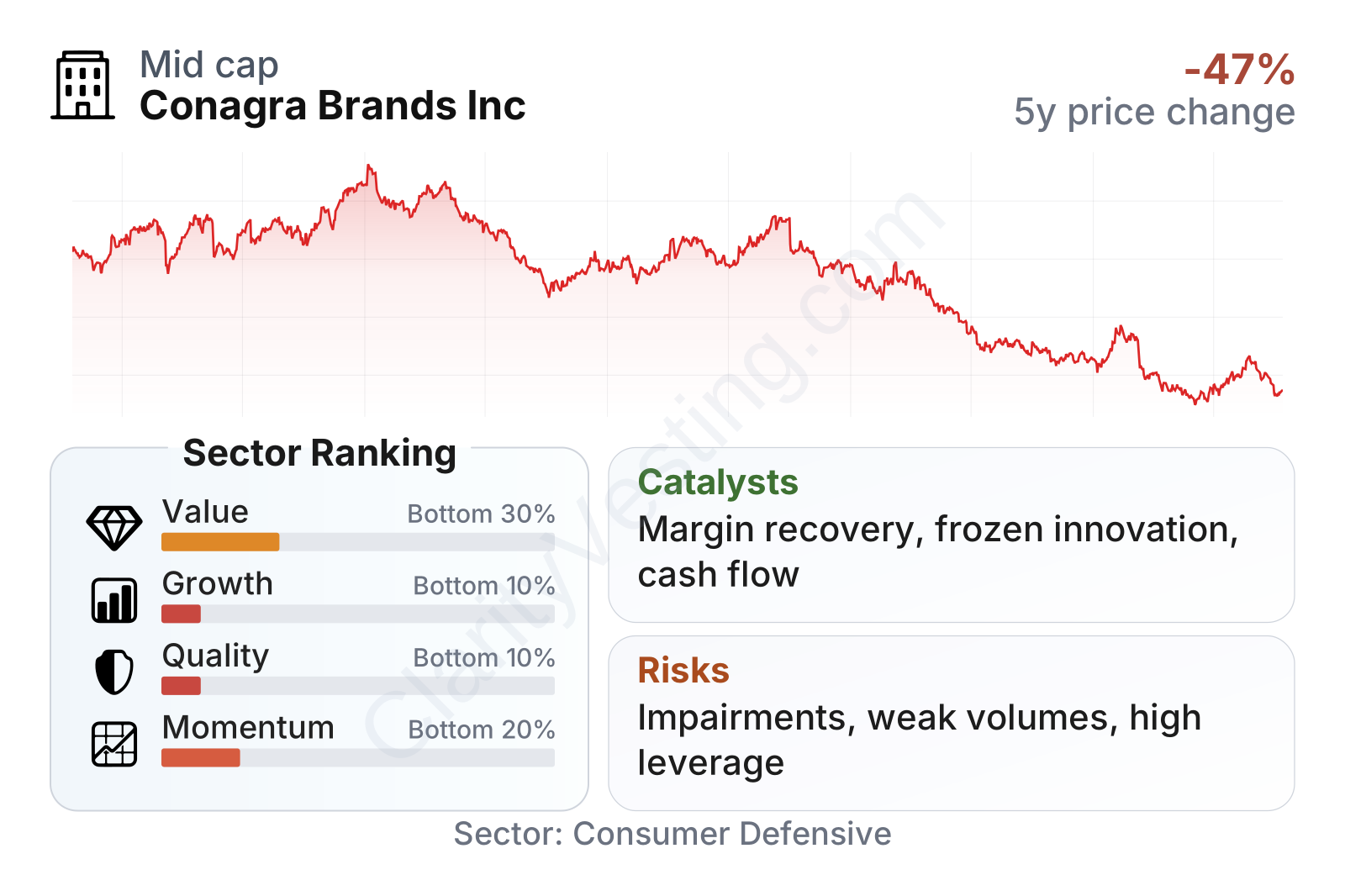
Conagra looks like a mid-sized defensive food company whose market value has fallen meaningfully over the last few years. On factor rankings, it scores weakly on growth and quality versus the broader consumer defensive group, while value signals are mixed: the dividend yield and free cash flow yield stand out, but those are being offset by concerns around earnings quality, leverage, and sluggish long-term expansion.
The stock’s recent trading pattern has also been weak. That does not say much about the business by itself, but it does show that the market has been repricing the company downward as operational pressures and write-downs weighed on confidence.
Growth
Packaged foods is a stable sector, not usually a fast-growing one. Demand is supported by recurring household food purchases, but volume growth is often modest because categories are mature and highly competitive. For Conagra, that means future expansion is likely to come from a combination of product innovation, mix improvement, operational productivity, and selective price realization rather than from rapid market growth.
Management’s strategy has generally centered on strengthening brands, focusing on frozen meals and snacks, improving supply chain execution, and using productivity savings to protect margins. That approach is sensible for this industry. Frozen food remains one of the more attractive packaged-food niches because it benefits from convenience, portion control, and better product quality than consumers often associate with older frozen categories. Snacks also remain an important area because it tends to offer better innovation opportunities and stronger brand loyalty than some slower pantry categories.
Revenue growth has been uneven. Conagra posted stronger year-over-year gains during the inflation-heavy period when pricing was a major support, then moved into several quarters of declines as volumes softened. More recently, growth has turned positive again, but the longer pattern still points to a company fighting for stabilization rather than delivering a clear multi-year acceleration.
Free cash flow is one of the more constructive parts of the picture. Even with earnings volatility, Conagra has continued to generate substantial cash over time, and that matters because cash helps fund dividends, debt reduction, and internal investment. The recent level is below the peak reached in earlier periods, but the business still appears capable of producing meaningful annual cash flow when working capital and restructuring swings normalize.
A key near-term catalyst is portfolio repair after the large fiscal 2026 impairment charges. Those write-downs often reflect weaker expectations for certain brands or categories, but they can also reset the balance sheet and create pressure for sharper execution going forward. Another potential catalyst is margin recovery if input costs, manufacturing productivity, and promotional intensity become more favorable. Conagra has also continued to launch and refresh products across frozen meals, snacks, and staples, which is important in a slow-growth industry where shelf relevance matters.
There is opportunity in the company’s broad brand base, especially if it can improve volume trends without sacrificing too much on pricing. In a consumer environment where affordability remains important, mainstream meal and snack brands can stay relevant, particularly when compared with more premium offerings.
Risks
This article is for informational purposes only and does not constitute financial advice. Some content is AI-generated. See Disclaimer


