Stock Analysis · Corporacion America Airports (CAAP)
Overview
Corporacion America Airports is one of the largest private airport operators in the world. The company manages and develops airports, mainly under long-term concessions granted by governments. Its business is straightforward: it earns money from aircraft movements and passenger traffic, and it also captures spending that happens inside the airport ecosystem, such as retail, duty-free, cargo handling, parking, and other commercial services.
As of the latest company disclosures available in 2026, the group operates airports across Latin America and Europe, with Argentina as its most important market. This geographic mix matters because airport operators usually benefit from local monopoly characteristics at each airport, but they are also exposed to country-specific regulation, currencies, and economic cycles.
The company’s revenue base is usually split between aeronautical income and non-aeronautical income. Based on recent annual reporting, the largest sources of revenue are approximately:
- Aeronautical revenue: about 55% to 65% — passenger fees, landing and parking charges, jet bridge use, and other airline-related airport services.
- Commercial revenue: about 20% to 30% — retail, duty-free, food and beverage, parking, car rentals, VIP lounges, and other terminal concessions.
- Cargo revenue: about 8% to 12% — cargo terminal services, warehousing, and logistics-related activities.
- Construction services and other revenue: about 5% to 10% — infrastructure works, reimbursement items, and miscellaneous airport-related services.
This combination is important for long-term analysis. Aeronautical revenue gives scale and traffic linkage, while commercial revenue tends to carry attractive economics because passenger growth can increase spending without requiring the same level of incremental infrastructure as a new runway or terminal expansion.
The broader financial flow has improved sharply since the pandemic recovery. Revenue has risen from roughly $0.7 billion in 2021 to nearly $2.0 billion in 2025, while profitability has moved from a loss to solid positive earnings. Interest expense has also become easier to absorb as operating income expanded.
Key Figures
| Metric | Value | Sector ⓘ |
|---|---|---|
| Date | Oct 24, 2026 | |
| Context | ||
| Sector | Industrials | |
| Industry | Airports & Air Services | |
| Market Cap ⓘ | $4.11B | |
| Beta ⓘ | 0.68 | |
Value (Cheapness) | ||
| P/E Ratio ⓘ | 14.06 | 22.29 |
| P/B Ratio ⓘ | 2.24 | 1.98 |
| FCF Yield ⓘ | 11.07% | 6.26% |
| Dividend Yield ⓘ | N/A | 1.92% |
| EBIT / EV ⓘ | 10.78% | 4.83% |
| PEG ⓘ | N/A | |
Growth (Business expansion) | ||
| Revenue Growth ⓘ | 12.00% | 9.30% |
| RPS Growth (5Y CAGR) ⓘ | 28.69% | 7.76% |
| EPS Growth (5Y CAGR) ⓘ | -6.83% | -13.17% |
| BVPS Growth (5Y CAGR) ⓘ | 33.55% | 6.13% |
| Margin Growth (5Y Trend) ⓘ | 16.65% | 0.74% |
| FCF Growth (5Y CAGR) ⓘ | 46.18% | 10.79% |
| DPS Growth (5Y CAGR) ⓘ | N/A | 9.41% |
Quality (Business durability) | ||
| ROIC (Latest) ⓘ | N/A | 10.75% |
| ROA (Latest) ⓘ | 6.08% | 5.41% |
| ROIC (5Y Median) ⓘ | 15.08% | 9.37% |
| ROA (5Y Median) ⓘ | 5.74% | 4.95% |
| Net Debt / EBIT (Latest) ⓘ | 0.87 | 2.04 |
| Net Debt / EBIT (5Y Median) ⓘ | 3.07 | 2.27 |
| Net Debt / EBITDA (Latest) ⓘ | 0.57 | 1.39 |
| Net Debt / Assets ⓘ | 8.17% | 19.27% |
| EBITDA / Interest ⓘ | 8.43 | 9.58 |
| Operating Margin (Latest) ⓘ | 22.84% | 10.49% |
| Operating Margin (5Y Median) ⓘ | 21.58% | 10.30% |
| Debt to Equity (Latest) ⓘ | 58.47% | 64.82% |
| Profit Margin (Latest) ⓘ | 13.60% | 6.67% |
| Free Cash Flow (Latest) ⓘ | $455.19M | |
Momentum (Price trend) | ||
| 3Y Return ⓘ | +137.85% | +67.77% |
| 12M Return (excl. last month) ⓘ | +39.65% | +12.05% |
| 6M Return ⓘ | +4.95% | 0.00% |
| Price vs. 200-Day MA ⓘ | +1.99% | +0.67% |
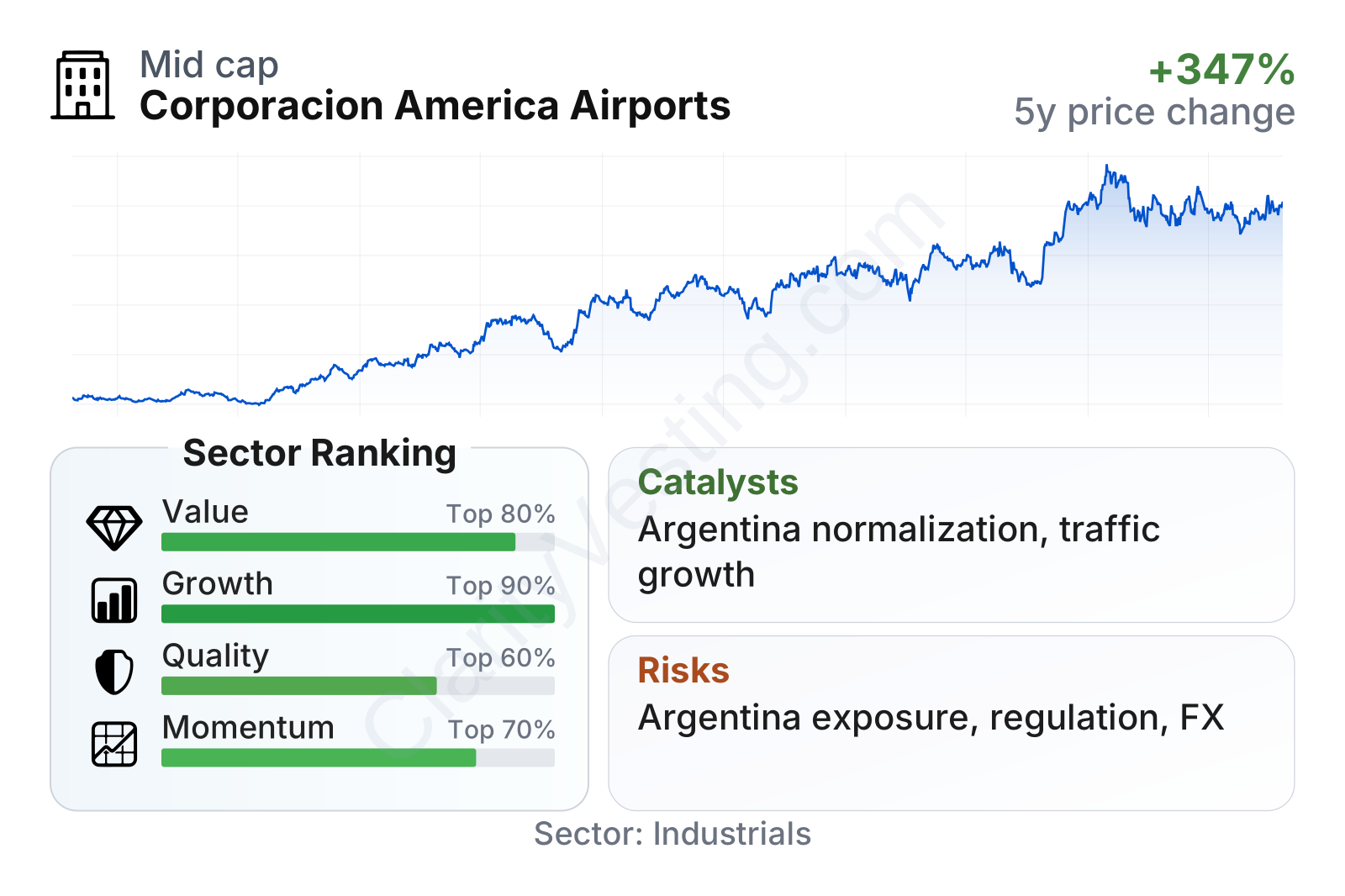
Corporacion America Airports is now a mid-sized listed airport operator with a market value in the low single-digit billions of dollars and a stock that has been less volatile than the broader market, as reflected by a beta below 1. The overall factor profile is favorable: growth ranks near the top of its sector, quality is above average, and value metrics remain relatively appealing despite the strong share price recovery since 2022. The combination of a lower-than-sector P/E, stronger free cash flow yield, and materially higher operating margin than the sector median suggests the market is recognizing the recovery, but not assigning the kind of premium often seen in larger infrastructure franchises.
Growth
The airport sector is structurally tied to long-term growth in air travel, tourism, and trade. Over many years, passenger traffic has tended to rise faster than GDP in many emerging markets, especially where incomes, regional connectivity, and international travel penetration are still developing. That backdrop generally supports airport operators, particularly those with concession assets in countries where aviation infrastructure remains strategically important.
Corporacion America Airports has several growth levers that make sense. First, passenger traffic normalization after the pandemic has already rebuilt the earnings base. Second, airports can grow revenue from both volume and pricing: more passengers and flights lift aeronautical fees, while higher foot traffic supports retail, parking, cargo, and other commercial income. Third, non-aeronautical income still offers room for expansion because airport operators can improve mix and spending per passenger through better tenant selection, terminal redesign, digital tools, and service upgrades.
Recent growth has become less explosive than in the post-pandemic rebound period, which is normal, but the longer pattern remains strong. Revenue per share growth over five years has been far above the sector median, and the latest year-over-year revenue growth still sits above the sector median as well. There has been some quarterly volatility, including a weaker reading in the most recent period, but that does not erase the larger multi-year uptrend in the business.
Cash generation is one of the more encouraging parts of the picture. Free cash flow has stayed substantial, with trailing twelve-month levels around the mid-$400 million range. Over five years, free cash flow growth has outpaced most peers by a wide margin. For an airport operator, this matters because the business is capital intensive: strong cash generation creates flexibility for debt reduction, concession commitments, capital projects, and shareholder distributions if management chooses.
A notable catalyst in recent years has been Argentina’s macroeconomic adjustment and the gradual normalization of rules affecting pricing, currencies, and capital markets. Because Argentina is a major exposure for the company, any improvement in the operating and regulatory environment can have an outsized effect on reported results and market perception. In parallel, continued traffic growth in key markets, tariff updates, concession extensions, and commercial optimization across terminals remain visible drivers for future expansion.
Risks
This article is for informational purposes only and does not constitute financial advice. Some content is AI-generated. See Disclaimer


