Stock Analysis · Bodycote plc (BYPLF)
Overview
Bodycote plc is a specialized industrial services company. Instead of mainly manufacturing finished parts, it improves the performance, durability, and reliability of metal and alloy components for customers in industries where failure is costly or dangerous. Its services include heat treatment, hot isostatic pressing, surface technology, and specialist thermal processing. These processes are used on parts that go into aircraft, cars, energy systems, medical devices, industrial machinery, and defense applications.
The business model is built around processing customer-owned components in a global network of facilities. That gives Bodycote exposure to many end markets without carrying the same product design risk as a component maker. It also means revenue is closely linked to industrial production volumes, maintenance cycles, and demand for higher-specification engineered parts.
Based on recent company reporting, Bodycote’s revenue is mainly split between its two operating divisions.
- Specialist Technologies: about 53% of revenue. This division includes hot isostatic pressing, surface technology, and other highly engineered services used in aerospace, defense, medical, and energy applications. These activities generally involve more technical requirements and can carry stronger margins.
- Classical Heat Treatment: about 47% of revenue. This is the larger-volume heat treatment work used across automotive, general industrial, aerospace, and other manufacturing markets.
From an end-market perspective, Bodycote has meaningful exposure to aerospace and defense, automotive, general industrial, and energy. The exact mix moves over time, but aerospace and defense has become an increasingly important source of demand, especially within the more specialized services portfolio.
The broad financial picture over the last several years shows a business that expanded strongly after the pandemic recovery, then faced a weaker period more recently. Revenue climbed from a little above £600 million equivalent in 2021 to above £800 million in 2023, before softening afterward. Profitability also became more volatile, which matters because Bodycote is usually valued as a quality industrial service provider rather than a deep-cyclical low-multiple name.
The long-term pattern is still recognizable: Bodycote converts industrial demand into recurring processing revenue, but earnings can swing when utilization rates change. That makes capacity use and end-market mix especially important for understanding the business.
Key Figures
| Metric | Value | Sector ⓘ |
|---|---|---|
| Date | Oct 17, 2026 | |
| Context | ||
| Sector | Industrials | |
| Industry | Specialty Industrial Machinery | |
| Market Cap ⓘ | $2.08B | |
| Beta ⓘ | 1.34 | |
Value (Cheapness) | ||
| P/E Ratio ⓘ | 27.33 | 22.10 |
| P/B Ratio ⓘ | 3.48 | 1.97 |
| FCF Yield ⓘ | 5.94% | 6.38% |
| Dividend Yield ⓘ | 1.89% | 1.94% |
| EBIT / EV ⓘ | N/A | 4.79% |
| PEG ⓘ | 1.00 | |
Growth (Business expansion) | ||
| Revenue Growth ⓘ | 3.30% | 9.30% |
| RPS Growth (5Y CAGR) ⓘ | 6.19% | 7.81% |
| EPS Growth (5Y CAGR) ⓘ | -43.25% | -13.06% |
| BVPS Growth (5Y CAGR) ⓘ | 0.11% | 6.14% |
| Margin Growth (5Y Trend) ⓘ | 0.52% | 0.88% |
| FCF Growth (5Y CAGR) ⓘ | -10.63% | 11.01% |
| DPS Growth (5Y CAGR) ⓘ | -2.63% | 9.48% |
Quality (Business durability) | ||
| ROIC (Latest) ⓘ | N/A | 10.84% |
| ROA (Latest) ⓘ | 8.10% | 5.41% |
| ROIC (5Y Median) ⓘ | 9.53% | 9.38% |
| ROA (5Y Median) ⓘ | 5.46% | 4.95% |
| Net Debt / EBIT (Latest) ⓘ | 1.37 | 2.08 |
| Net Debt / EBIT (5Y Median) ⓘ | 1.44 | 2.27 |
| Net Debt / EBITDA (Latest) ⓘ | 0.63 | 1.39 |
| Net Debt / Assets ⓘ | 17.79% | 19.28% |
| EBITDA / Interest ⓘ | 23.03 | 9.58 |
| Operating Margin (Latest) ⓘ | 9.44% | 10.50% |
| Operating Margin (5Y Median) ⓘ | 13.38% | 10.29% |
| Debt to Equity (Latest) ⓘ | 35.03% | 65.48% |
| Profit Margin (Latest) ⓘ | 7.87% | 6.67% |
| Free Cash Flow (Latest) ⓘ | $123.83M | |
Momentum (Price trend) | ||
| 3Y Return ⓘ | +65.42% | +61.68% |
| 12M Return (excl. last month) ⓘ | +47.90% | +12.58% |
| 6M Return ⓘ | +25.22% | 0.00% |
| Price vs. 200-Day MA ⓘ | +51.54% | +0.02% |
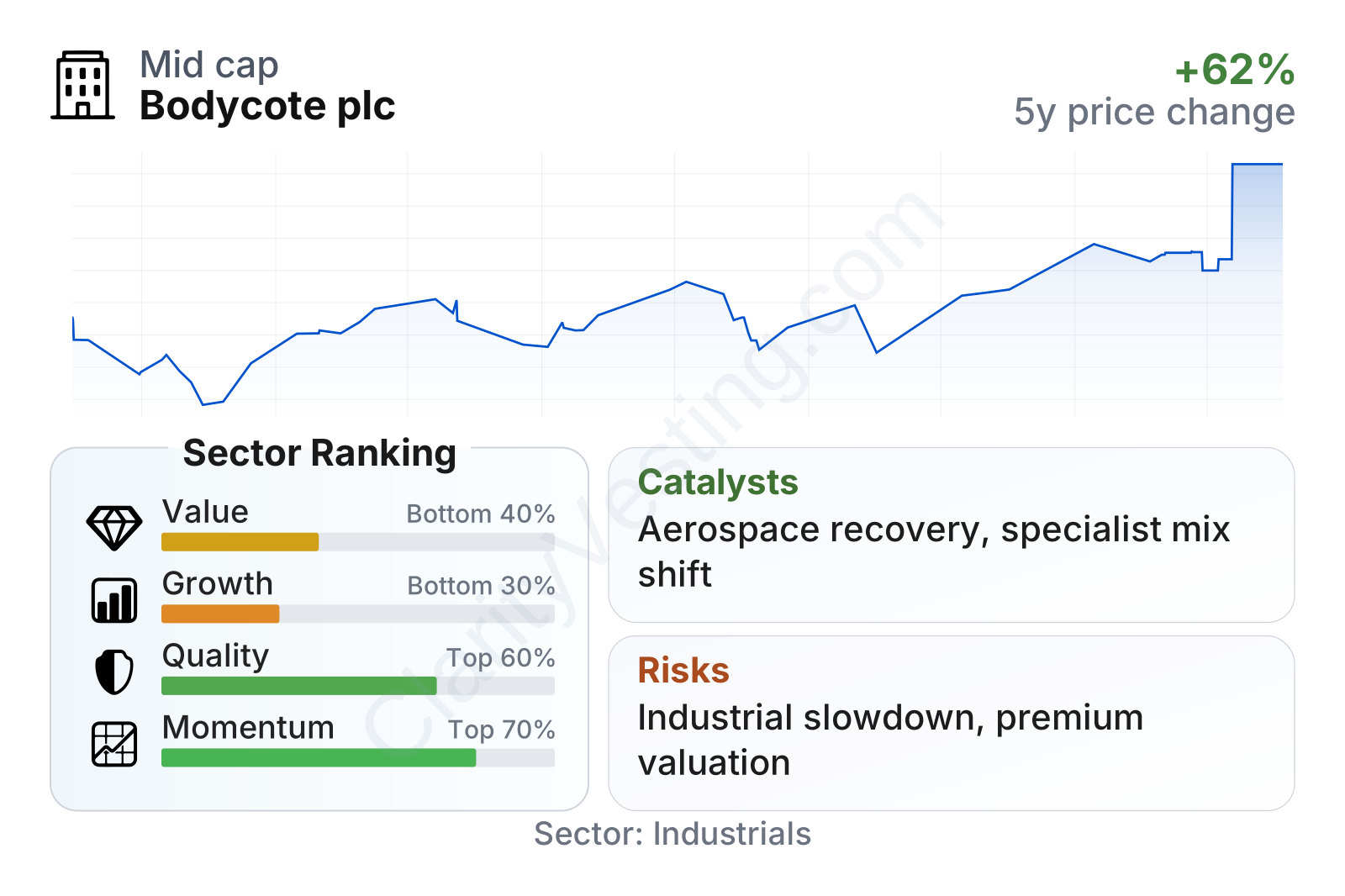
Bodycote sits in the mid-cap range and has shown strong recent share price momentum, clearly ahead of the broader industrial sector over the last 6 to 12 months. Financial quality looks solid: leverage is modest, debt is lower than many peers, and interest coverage is very strong. Profitability is mixed. Return on assets and medium-term operating margins compare well with the sector, but more recent operating margins are closer to average.
Growth is the weaker area in the current profile. Recent revenue growth has been positive but slower than the sector median, while longer-term earnings and free cash flow trends have been uneven. On valuation, the stock screens more expensive than the sector on both earnings and book value multiples, while the cash flow yield and dividend yield are roughly in line with peers rather than clearly superior.
Growth
Bodycote operates in parts of manufacturing that should remain relevant for a long time. Heat treatment and related metallurgical services are not fashionable technologies, but they are deeply embedded in modern industry. As aerospace platforms age, as engine makers require more advanced materials, and as medical and defense components need tighter performance standards, specialist thermal processing remains necessary. That gives the company exposure to structural demand rather than only short-cycle factory activity.
The most attractive part of Bodycote’s growth case is the shift toward more specialized technologies. Services such as hot isostatic pressing and advanced surface treatment are harder to replicate than standard heat treatment, and they are used in applications where certification, process control, and customer trust matter a great deal. This strategy makes sense because it can improve pricing power, deepen customer relationships, and reduce direct exposure to commoditized industrial work.
Aerospace and defense is an important catalyst. Commercial aerospace production is still recovering over a multiyear period, while defense spending in many Western countries has been rising. Both trends support demand for mission-critical metal components that need specialist processing. Bodycote is positioned to benefit because it already has approved processes and long-standing customer relationships in these markets.
Another supportive factor is the growing use of complex alloys and higher-performance engineered parts. As manufacturers push for lighter, stronger, and more heat-resistant components, outsourced processing expertise becomes more valuable. Bodycote’s role can become more difficult to replace when customers need certified treatment for advanced materials rather than basic furnace capacity.
Recent company communications have also emphasized operational improvement, disciplined capital allocation, and capacity alignment. That matters because the company does not need a radical reinvention to grow; it mainly needs better mix, stronger utilization, and steady execution in the higher-value parts of the portfolio.
Risks
This article is for informational purposes only and does not constitute financial advice. Some content is AI-generated. See Disclaimer


