Stock Analysis · Big Yellow Group Plc (BYLOF)
Overview
Big Yellow Group Plc is a U.K.-based self-storage real estate company. It develops, owns, and operates storage facilities mainly under the Big Yellow brand, serving both personal and business customers. In simple terms, it rents storage rooms of different sizes to people who need extra space and to companies that need flexible room for inventory, records, equipment, or distribution support.
The business model is relatively straightforward for a real estate company: Big Yellow invests in well-located storage sites, fills them with customers, raises rent over time when demand allows, and benefits from the operating leverage of a property platform where many costs are fixed once a store is open. The company also has a smaller pipeline element through development and occasional joint ventures, which can add future capacity and property value growth.
Based on the latest annual reporting, revenue is heavily concentrated in self-storage activities, with a small contribution from ancillary services and other property-related income.
- Self-storage rental income: approximately 90% to 95% of revenue. This is the core activity and includes rent from storage units used by households and businesses.
- Other storage-related income: approximately 5% to 10% of revenue. This typically includes insurance commissions, merchandise sales such as packing materials, and other customer service income linked to storage use.
- Non-core or property-related items: a very small share, when present, linked to joint venture activity or other real estate items rather than recurring operating revenue.
What stands out is that this is not a diversified conglomerate. Big Yellow is a focused specialist in one niche: urban self-storage. That makes the company easy to understand, but it also means performance depends heavily on occupancy, rental rates, development execution, and the health of the U.K. storage market.
The operating profile remains attractive. Revenue has risen gradually over the last several years, while operating costs have stayed relatively controlled. Profitability can look unusually high or volatile in some years because property companies often record non-cash valuation movements, so the cleanest underlying signal is the steady growth in top-line revenue and gross profit rather than swings in reported net income.
Key Figures
| Metric | Value | Sector ⓘ |
|---|---|---|
| Date | Oct 17, 2026 | |
| Context | ||
| Sector | Real Estate | |
| Industry | REIT - Industrial | |
| Market Cap ⓘ | $2.15B | |
| Beta ⓘ | 0.91 | |
Value (Cheapness) | ||
| P/E Ratio ⓘ | 12.93 | 17.38 |
| P/B Ratio ⓘ | 0.89 | 0.85 |
| FCF Yield ⓘ | 5.69% | 7.38% |
| Dividend Yield ⓘ | 4.39% | 4.85% |
| EBIT / EV ⓘ | N/A | 3.78% |
| PEG ⓘ | 2.38 | |
Growth (Business expansion) | ||
| Revenue Growth ⓘ | 2.50% | 5.30% |
| RPS Growth (5Y CAGR) ⓘ | 3.05% | 6.02% |
| EPS Growth (5Y CAGR) ⓘ | -1.30% | -11.37% |
| BVPS Growth (5Y CAGR) ⓘ | 2.40% | 0.45% |
| Margin Growth (5Y Trend) ⓘ | -349.56% | -0.22% |
| FCF Growth (5Y CAGR) ⓘ | -47.62% | 5.40% |
| DPS Growth (5Y CAGR) ⓘ | 5.83% | 5.02% |
Quality (Business durability) | ||
| ROIC (Latest) ⓘ | 8.97% | 5.69% |
| ROE (Latest) ⓘ | 12.68% | 7.56% |
| ROA (Latest) ⓘ | 10.63% | 2.85% |
| ROIC (5Y Median) ⓘ | 7.51% | 4.22% |
| ROE (5Y Median) ⓘ | 8.05% | 6.03% |
| ROA (5Y Median) ⓘ | 6.80% | 2.44% |
| Net Debt / EBIT (Latest) ⓘ | 1.81 | 7.59 |
| Net Debt / EBIT (5Y Median) ⓘ | 1.83 | 8.40 |
| Net Debt / EBITDA (Latest) ⓘ | 1.78 | 5.27 |
| Net Debt / Assets ⓘ | 15.62% | 37.76% |
| EBITDA / Interest ⓘ | 9.41 | 4.10 |
| Operating Margin (Latest) ⓘ | 65.87% | 35.29% |
| Operating Margin (5Y Median) ⓘ | 107.48% | 37.31% |
| Debt to Equity (Latest) ⓘ | 19.31% | 88.87% |
| Profit Margin (Latest) ⓘ | 59.70% | 19.61% |
| Free Cash Flow (Latest) ⓘ | $122.65M | |
Momentum (Price trend) | ||
| 3Y Return ⓘ | +15.77% | +30.75% |
| 12M Return (excl. last month) ⓘ | -5.96% | +4.36% |
| 6M Return ⓘ | -1.90% | -2.52% |
| Price vs. 200-Day MA ⓘ | -3.16% | -2.34% |
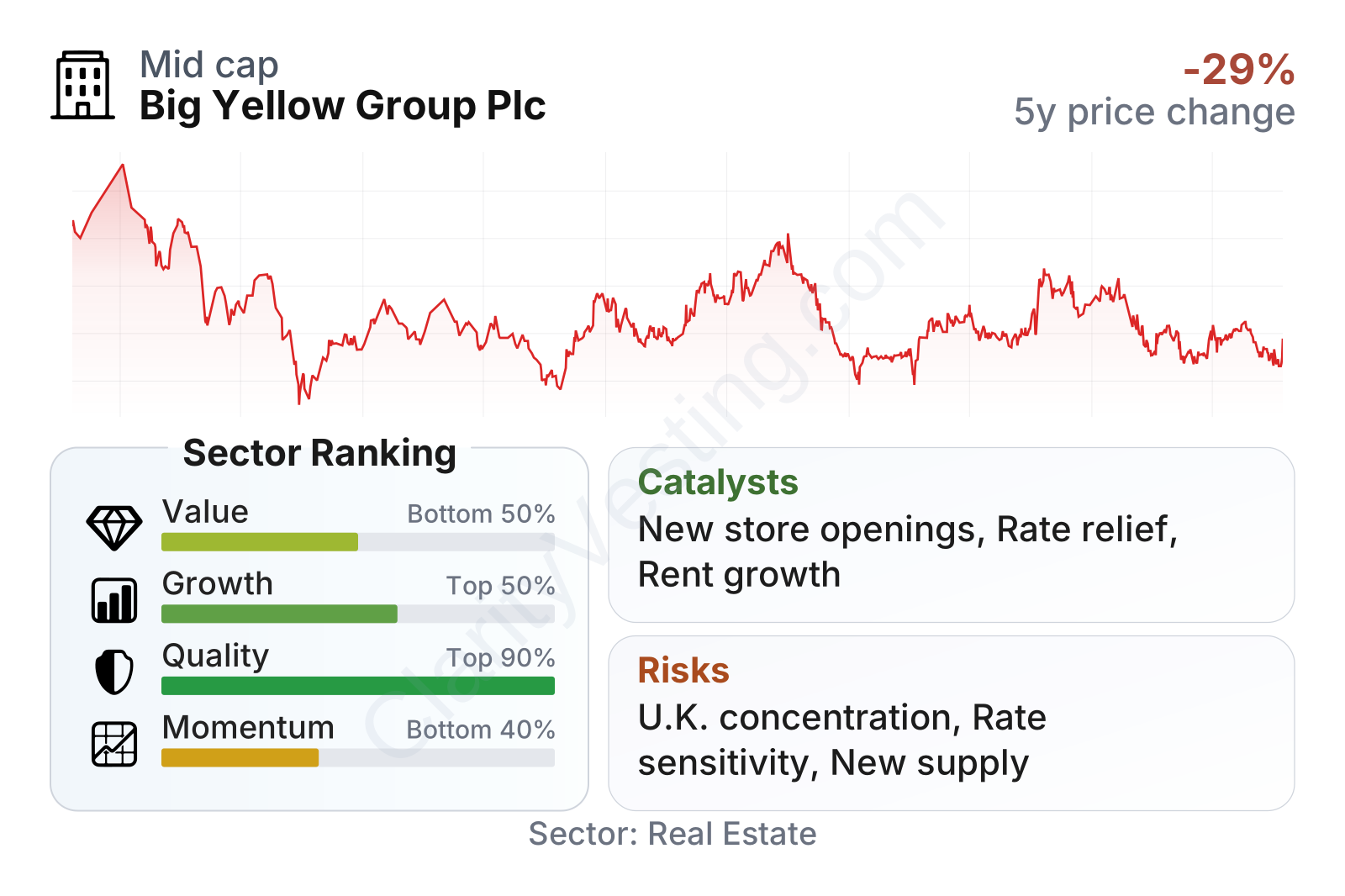
Big Yellow is a mid-sized real estate company with a share price history that has been much steadier than many cyclical property names, although it is still clearly sensitive to interest rates and property sentiment. The quality profile is the most notable feature in the current metrics: returns on capital, returns on assets, operating margins, and interest coverage all compare favorably with much of the sector. Balance-sheet leverage also looks conservative relative to many peers, which is important in real estate.
The weaker areas are growth and share-price momentum. Revenue growth has been positive but modest, and recent market performance has lagged the broader real estate group. On value, the picture is mixed rather than extreme: traditional multiples are not demanding on earnings and book value, but free cash flow yield and growth-adjusted valuation do not point to a clear bargain.
Growth
Self-storage is generally considered an attractive real estate niche because demand can come from several recurring life events: moving home, downsizing, renovation, business inventory needs, document storage, and e-commerce support. In densely populated cities, limited living space can make storage structurally useful rather than purely discretionary. The U.K. market also remains less mature than the U.S. market, which suggests there is still room for long-term industry expansion if supply is added carefully.
Big Yellow’s strategy is logically aligned with that backdrop. The company focuses on major urban areas, especially London and the South East, where land is constrained and storage economics can be stronger. Its development pipeline matters because new stores take time to mature, but once stabilized they can become valuable long-duration assets. This combination of existing cash-generating sites and future openings gives the company a visible route to gradual expansion.
Revenue per share has trended upward over the last five years, but the pace has been measured rather than rapid. That fits the nature of the business: this is a steady compounding real estate platform, not a fast-scaling technology company. The key question for future growth is whether occupancy, rental rate progression, and new store openings can keep offsetting cost inflation and a potentially softer consumer environment.
Dividend per share has also moved higher over time, which supports the idea of a business with recurring cash generation. Even so, recent free cash flow trends have been less impressive than the dividend trend, so future distribution growth will still depend on disciplined capital allocation and continued operating stability.
One meaningful catalyst is the company’s ability to bring new sites into operation in supply-constrained locations. Another is the gradual normalization of financing conditions if interest rates become less restrictive. Lower financing pressure can improve property values, support development economics, and help market sentiment toward real estate stocks. Recent annual reporting also showed continued revenue growth into fiscal 2026, indicating that demand has remained resilient enough to keep the business moving forward despite a tougher macro backdrop.
Risks
This article is for informational purposes only and does not constitute financial advice. Some content is AI-generated. See Disclaimer


