Stock Analysis · Barry Callebaut AG (BYCBF)
Overview
Barry Callebaut AG is one of the world’s largest cocoa and chocolate manufacturers. Unlike a consumer candy brand that mainly sells directly to shoppers, Barry Callebaut mostly operates business-to-business. It supplies chocolate, cocoa ingredients, fillings, decorations, and related products to food manufacturers, artisanal users such as chocolatiers and bakers, and large foodservice customers. The group also provides outsourcing and product development support, which makes it an important behind-the-scenes supplier for many global chocolate and confectionery products.
The business is mainly built around two large revenue engines: chocolate products and cocoa products. Based on company reporting, chocolate is the larger activity and cocoa is the second pillar, while a much smaller share comes from adjacent ingredients, gourmet specialties, and service-related activities embedded in those divisions.
- Chocolate products: approximately 70% to 80% of revenue. This includes industrial chocolate sold to large food companies, specialty chocolate, compounds, fillings, decorations, and products for artisans and chefs.
- Cocoa products: approximately 20% to 30% of revenue. This includes cocoa powder, cocoa butter, cocoa liquor, and other cocoa ingredients sold to food manufacturers.
- Other and support activities: a low single-digit share or embedded within the two main divisions. This can include services, sourcing-related activities, and innovation support tied to customer relationships.
One important point for long-term analysis is that Barry Callebaut’s reported revenue can swing sharply when cocoa prices move. That means sales growth does not always reflect real business volume growth. In recent years, the company’s revenue increased strongly in currency terms, but the cost structure also rose significantly because cocoa beans and financing costs became much more expensive. The result is a business that is large and strategically important in the food chain, but currently under pressure from commodity volatility.
The operating flow shows a business with very high raw-material intensity. Revenue has climbed strongly over the last few years, but most of that increase has been absorbed by the cost of revenue. Gross profit has improved far more slowly, while interest expense has risen sharply, which helps explain why net income has stayed under pressure despite a much larger top line.
Key Figures
| Metric | Value | Sector ⓘ |
|---|---|---|
| Date | Oct 03, 2026 | |
| Context | ||
| Sector | Consumer Defensive | |
| Industry | Confectioners | |
| Market Cap ⓘ | $7.35B | |
| Beta ⓘ | 0.12 | |
Value (Cheapness) | ||
| P/E Ratio ⓘ | 25.12 | 18.16 |
| P/B Ratio ⓘ | 2.95 | 1.27 |
| FCF Yield ⓘ | -9.87% | 12.39% |
| Dividend Yield ⓘ | 2.04% | 2.83% |
| EBIT / EV ⓘ | N/A | 6.45% |
| PEG ⓘ | 0.48 | |
Growth (Business expansion) | ||
| Revenue Growth ⓘ | -7.30% | 3.80% |
| RPS Growth (5Y CAGR) ⓘ | 19.70% | 6.20% |
| EPS Growth (5Y CAGR) ⓘ | 0.29% | -14.64% |
| BVPS Growth (5Y CAGR) ⓘ | -0.60% | 3.26% |
| Margin Growth (5Y Trend) ⓘ | -2.12% | -0.25% |
| FCF Growth (5Y CAGR) ⓘ | N/A | 4.65% |
| DPS Growth (5Y CAGR) ⓘ | 13.27% | 6.86% |
Quality (Business durability) | ||
| ROIC (Latest) ⓘ | 11.16% | 12.58% |
| ROA (Latest) ⓘ | 2.85% | 6.35% |
| ROIC (5Y Median) ⓘ | 9.41% | 10.36% |
| ROA (5Y Median) ⓘ | 4.81% | 5.44% |
| Net Debt / EBIT (Latest) ⓘ | 2.91 | 1.91 |
| Net Debt / EBIT (5Y Median) ⓘ | 2.30 | 2.32 |
| Net Debt / EBITDA (Latest) ⓘ | 2.02 | 1.36 |
| Net Debt / Assets ⓘ | 30.05% | 21.25% |
| EBITDA / Interest ⓘ | 2.09 | 9.61 |
| Operating Margin (Latest) ⓘ | 4.55% | 8.96% |
| Operating Margin (5Y Median) ⓘ | 6.61% | 9.53% |
| Debt to Equity (Latest) ⓘ | 208.18% | 71.66% |
| Profit Margin (Latest) ⓘ | 1.71% | 5.40% |
| Free Cash Flow (Latest) ⓘ | -$725.72M | |
Momentum (Price trend) | ||
| 3Y Return ⓘ | -7.84% | +15.25% |
| 12M Return (excl. last month) ⓘ | -2.78% | +2.63% |
| 6M Return ⓘ | -16.25% | +2.43% |
| Price vs. 200-Day MA ⓘ | -12.01% | +0.43% |
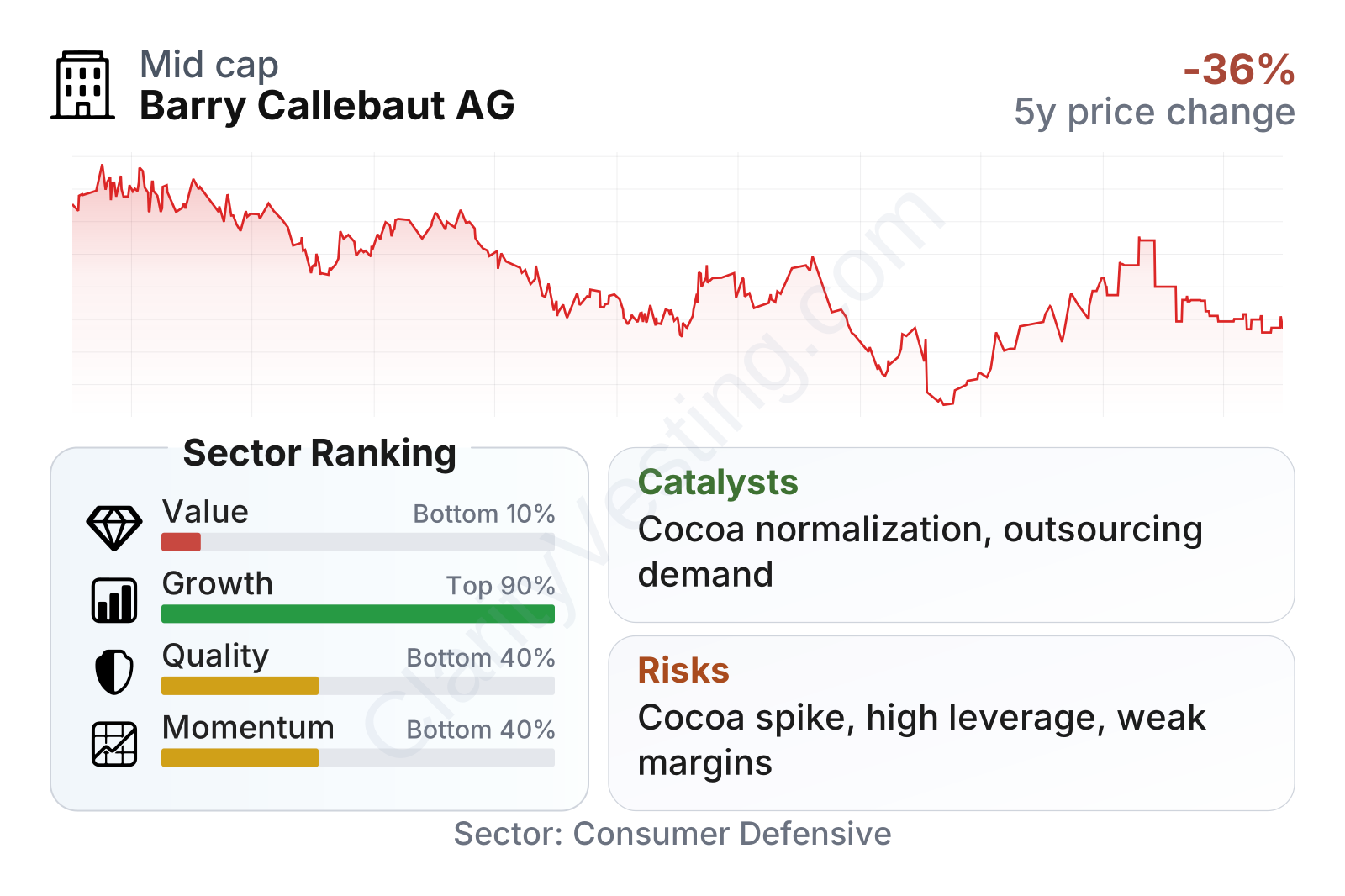
Barry Callebaut is a mid-to-large consumer staples company with unusually low share-price volatility, reflected in a beta close to 0.1. That defensive trading profile fits the food ingredients sector, but the operating picture is less defensive than the stock’s beta suggests. The company ranks weakly on value metrics versus the sector, with a higher earnings multiple and price-to-book ratio, while free cash flow is currently negative. Growth signals are mixed: the latest year shows declining revenue, yet the five-year revenue-per-share trend remains much stronger than the sector median. Quality metrics are more concerning, especially leverage, interest coverage, and profitability, which all sit below many sector peers.
The share price history also shows that the market has materially reset expectations since the 2021-2023 period. Even after that decline, the stock is not obviously cheap on current earnings because margins and cash generation remain pressured.
Growth
The long-term sector backdrop is still supportive. Chocolate consumption has historically benefited from population growth, rising incomes in emerging markets, premiumization, and continued demand from food manufacturers for outsourced production. Barry Callebaut is well positioned for that trend because it serves a broad customer base across industrial clients, gourmet users, and foodservice. Scale matters in sourcing, formulation, logistics, and global manufacturing, and the company already has those capabilities.
Its strategy also makes sense in principle for future growth. Barry Callebaut has emphasized outsourcing partnerships, specialty and gourmet offerings, innovation, and expansion in high-growth regions. That approach can be attractive because large food companies often prefer reliable global suppliers rather than building every capability in-house. The company also has exposure to trends such as premium chocolate, customized formulations, and sustainability-linked sourcing, all of which can deepen customer relationships.
The growth picture is currently complicated. Over five years, revenue per share has grown at roughly 20% annually, far ahead of the sector median near 6%. However, the latest year-over-year revenue change is negative, around -7%, versus a positive sector median. That contrast suggests the business has had meaningful long-term expansion, but the near-term environment is much tougher. Management commentary and recent company communications have pointed to exceptional cocoa market conditions, customer timing effects, and pressure on volumes. In other words, the addressable market still looks attractive, but short-term execution is being tested by an unusual cost environment.
A significant catalyst is normalization. If cocoa markets become less distorted, Barry Callebaut could benefit from better customer ordering patterns, more stable hedging and working capital needs, and stronger conversion of revenue into profit and cash flow. Another catalyst is the company’s global manufacturing footprint and customer integration: when major food producers outsource more chocolate production, large suppliers tend to gain share. Sustainability and traceability programs may also strengthen its relevance with multinational customers that face tighter sourcing requirements.
Risks
This article is for informational purposes only and does not constitute financial advice. Some content is AI-generated. See Disclaimer