Stock Analysis · Byline Bancorp Inc (BY)
Overview
Byline Bancorp is a regional bank based in Chicago. Through Byline Bank, it provides traditional banking services to businesses and consumers, with a strong emphasis on commercial banking. In simple terms, the company gathers deposits from customers, lends that money out at higher rates, and also earns fees from services such as treasury management, payments, wealth-related activities, and government-guaranteed lending programs.
The business is centered on the Chicago and Milwaukee markets, where Byline serves small and mid-sized businesses, commercial real estate clients, and local consumers. For a bank like Byline, the most important engine is usually net interest income, which is the spread between what it earns on loans and securities and what it pays on deposits and borrowings. The rest comes from non-interest income, which includes fee-based activities.
Based on recent annual reporting, Byline’s revenue mix is broadly organized as follows:
- Net interest income after provision expense: approximately 75% to 85% of total revenue in recent years. This is the core banking spread business, mainly from commercial loans, commercial real estate loans, consumer loans, and investment securities, offset by deposit and funding costs and credit loss provisions.
- Non-interest income: approximately 15% to 25%. This includes loan servicing and sale gains, especially from SBA lending activity, plus deposit service charges, treasury and card fees, and other banking service income.
- SBA and specialty finance-related fee income: a meaningful subset of non-interest income. Byline has historically highlighted small business lending and government-guaranteed loan production as an area of expertise, which can produce recurring servicing income and occasional gain-on-sale income.
What stands out is that Byline is not a broad national bank trying to do everything. It is a smaller institution focused on relationship banking in selected Midwestern markets, with an added niche in SBA lending. That combination matters because it can support better customer retention and more fee diversity than a plain-vanilla community bank.
The long-term financial path has been constructive: total revenue has risen materially since 2021, and net income has also improved, although higher funding costs have become a more important factor as interest rates moved up. Expenses have remained meaningful, but profitability has held up better than many smaller banks thanks to steady loan generation and solid margins.
The broad picture is one of a bank that has expanded revenue and earnings over the last several years, with funding costs taking a larger share of the income stream as rates reset higher. Even so, the business has continued to produce healthy profits rather than showing a broken earnings model.
Key Figures
| Metric | Value | Sector ⓘ |
|---|---|---|
| Date | Oct 24, 2026 | |
| Context | ||
| Sector | Financial Services | |
| Industry | Banks - Regional | |
| Market Cap ⓘ | $1.69B | |
| Beta ⓘ | 0.72 | |
Value (Cheapness) | ||
| P/E Ratio ⓘ | 11.26 | 12.46 |
| P/B Ratio ⓘ | 1.32 | 1.25 |
| FCF Yield ⓘ | 9.67% | 9.82% |
| Dividend Yield ⓘ | 1.17% | 2.94% |
| EBIT / EV ⓘ | 10.01% | 8.11% |
| PEG ⓘ | N/A | |
Growth (Business expansion) | ||
| Revenue Growth ⓘ | 11.70% | 9.10% |
| RPS Growth (5Y CAGR) ⓘ | 13.88% | 12.31% |
| EPS Growth (5Y CAGR) ⓘ | -8.22% | -6.97% |
| BVPS Growth (5Y CAGR) ⓘ | 6.71% | 5.02% |
| Margin Growth (5Y Trend) ⓘ | -10.23% | -4.00% |
| FCF Growth (5Y CAGR) ⓘ | 17.23% | 4.71% |
| DPS Growth (5Y CAGR) ⓘ | 6.22% | 8.92% |
Quality (Business durability) | ||
| ROIC (Latest) ⓘ | 8.68% | 9.18% |
| ROE (Latest) ⓘ | 11.76% | 13.93% |
| ROA (Latest) ⓘ | 1.51% | 1.57% |
| ROIC (5Y Median) ⓘ | 7.18% | 7.80% |
| ROE (5Y Median) ⓘ | 11.35% | 12.15% |
| ROA (5Y Median) ⓘ | 1.33% | 1.28% |
| Net Debt / EBIT (Latest) ⓘ | 2.52 | 1.02 |
| Net Debt / EBIT (5Y Median) ⓘ | 2.76 | 0.72 |
| Net Debt / EBITDA (Latest) ⓘ | 2.46 | 0.88 |
| Operating Margin (Latest) ⓘ | 33.07% | 22.30% |
| Operating Margin (5Y Median) ⓘ | 30.38% | 24.50% |
| Debt to Equity (Latest) ⓘ | 46.48% | 59.34% |
| Profit Margin (Latest) ⓘ | 34.41% | 26.42% |
| Free Cash Flow (Latest) ⓘ | $163.35M | |
Momentum (Price trend) | ||
| 3Y Return ⓘ | +111.36% | +95.73% |
| 12M Return (excl. last month) ⓘ | +32.86% | +17.30% |
| 6M Return ⓘ | +15.65% | +6.07% |
| Price vs. 200-Day MA ⓘ | +9.82% | +5.36% |
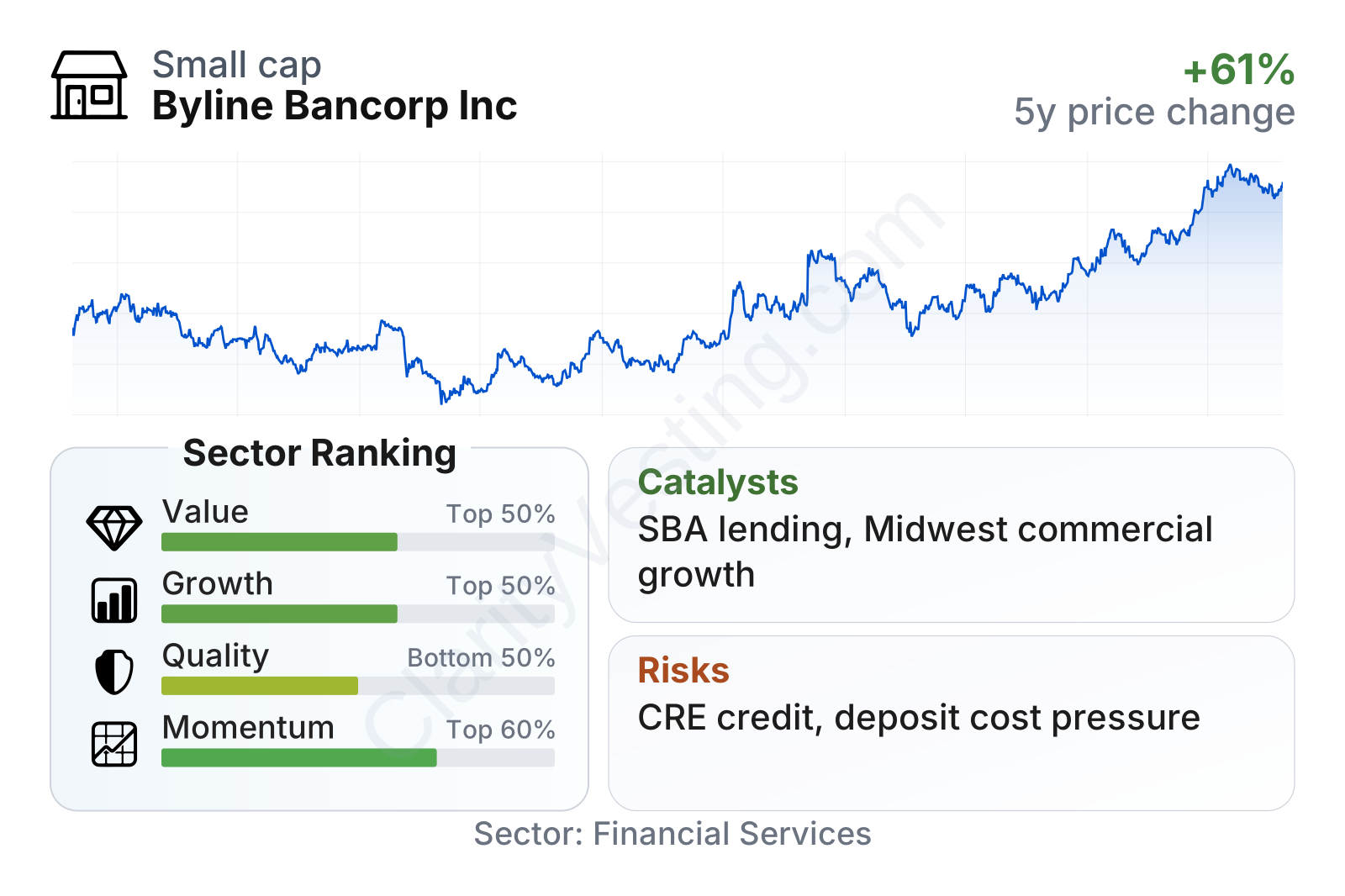
Byline sits in the smaller-bank range by market value, and its share price has trended upward strongly over the last three years with gains that outpaced the regional bank median. The metrics table points to a company that looks balanced rather than extreme: valuation is near the better half of the sector, growth is also in the better half, while quality is somewhat weaker relative to peers. The stock’s beta is below 1, suggesting lower share-price volatility than the broader market, which is not unusual for a profitable regional bank with a focused footprint.
The combination of a modest earnings multiple, a price-to-book ratio slightly above its own long stretch of sub-1.0 to low-1.1 readings, and profitability that remains solid but not elite creates a mixed but understandable setup. In short, the market is recognizing improved operating performance, though it is not valuing the company as if it were among the strongest banks in the sector.
Growth
Regional banking is not a high-growth industry in the way software or semiconductors can be, but it remains a necessary and durable part of the economy. Banks that can grow deposits, maintain sound credit quality, and build fee-generating specialties can still compound value over time. Byline operates in two economically important Midwestern markets and focuses on business customers, which tends to create more cross-selling opportunities than a bank built mainly around basic retail accounts.
Its strategy is coherent. Commercial and small business banking can generate attractive customer relationships, while SBA lending offers a differentiating niche. That matters because banks with some fee income diversity are less dependent on pure interest-rate spreads. Byline has also shown decent multi-year growth in revenue per share and book value per share, which suggests it has been adding economic value rather than only getting larger on paper.
Earnings per share have been relatively steady, with some year-to-year noise rather than a straight line. After a dip in 2022, earnings recovered and moved higher again through 2025. That pattern suggests the franchise has been resilient through changing rate conditions, even if growth has not been smooth every single year.
Book value per share has moved up clearly over the last several years. For a bank, that is an important sign because book value reflects the underlying capital base supporting future lending and earnings. A rising book value per share often signals that retained profits are building shareholder equity in a meaningful way.
A visible catalyst is the banking environment itself. If loan demand remains healthy in its core markets and deposit competition becomes more manageable, Byline could continue to benefit from a stronger earnings mix. Another favorable point is that the company’s recent revenue growth has been ahead of the sector median, showing that it has not simply been drifting with the industry. Public company updates in 2026 have also indicated continued normal business execution rather than a defensive restructuring, which supports the view that management is still operating from a position of relative stability.
Risks
This article is for informational purposes only and does not constitute financial advice. Some content is AI-generated. See Disclaimer


