Stock Analysis · Blackstone Mortgage Trust Inc (BXMT)
Overview
Blackstone Mortgage Trust Inc. is a mortgage real estate investment trust, or mortgage REIT. Instead of owning office buildings, apartments, or warehouses directly, it mainly lends money against commercial real estate. Its focus is on large senior loans, meaning it usually sits at the top of the repayment stack if a property runs into trouble. The company is externally managed by Blackstone, one of the world’s largest alternative asset managers, which gives BXMT access to relationships, property market intelligence, and deal flow that many smaller mortgage REITs do not have.
Its portfolio is centered on floating-rate loans backed by commercial properties, with an emphasis on institutional-quality assets. In practice, BXMT earns income from the spread between the interest it receives on its loans and the cost of the financing it uses to fund those loans. That makes the business more like a specialized lender than a traditional property owner.
The company’s revenue sources are concentrated and fairly straightforward:
- Interest income from commercial real estate loans: the dominant source of revenue, generally representing well above 90% of total earnings power. This includes interest collected on senior mortgage loans secured by office, hotel, multifamily, industrial, and other commercial properties.
- Fee income and other lending-related income: a much smaller contribution, typically a low-single-digit share when present. This can include origination fees, amendment fees, and similar items tied to financing activity.
- Other investment-related income: limited and variable, usually immaterial compared with loan interest income.
Over the last several years, reported revenue expanded sharply during the higher-rate period because floating-rate loans repriced upward, but that did not fully translate into stronger bottom-line results because financing costs, credit provisions, and realized or unrealized losses also increased. That is an important point for long-term readers: in this business, revenue alone can give an incomplete picture.
The business mix shows a lender with very high dependence on interest income. It also shows how sensitive results are to funding costs and credit charges: revenue remained large in recent years, but net income became much more volatile.
Key Figures
| Metric | Value | Sector ⓘ |
|---|---|---|
| Date | Oct 17, 2026 | |
| Context | ||
| Sector | Real Estate | |
| Industry | REIT - Mortgage | |
| Market Cap ⓘ | $1.78B | |
| Beta ⓘ | 0.96 | |
Value (Cheapness) | ||
| P/E Ratio ⓘ | 132.25 | 17.38 |
| P/B Ratio ⓘ | 0.56 | 0.85 |
| FCF Yield ⓘ | 6.62% | 7.38% |
| Dividend Yield ⓘ | 17.50% | 4.85% |
| EBIT / EV ⓘ | N/A | 3.78% |
| PEG ⓘ | 254.80 | |
Growth (Business expansion) | ||
| Revenue Growth ⓘ | -73.10% | 5.30% |
| RPS Growth (5Y CAGR) ⓘ | 27.23% | 6.02% |
| EPS Growth (5Y CAGR) ⓘ | -32.44% | -11.37% |
| BVPS Growth (5Y CAGR) ⓘ | -9.21% | 0.45% |
| Margin Growth (5Y Trend) ⓘ | -9.37% | -0.22% |
| FCF Growth (5Y CAGR) ⓘ | -7.84% | 5.40% |
| DPS Growth (5Y CAGR) ⓘ | -6.27% | 5.02% |
Quality (Business durability) | ||
| ROIC (Latest) ⓘ | N/A | 5.69% |
| ROE (Latest) ⓘ | 0.45% | 7.56% |
| ROA (Latest) ⓘ | 0.08% | 2.85% |
| ROIC (5Y Median) ⓘ | 3.94% | 4.22% |
| ROE (5Y Median) ⓘ | 5.49% | 6.03% |
| ROA (5Y Median) ⓘ | 1.00% | 2.44% |
| Net Debt / EBIT (Latest) ⓘ | N/A | 7.59 |
| Net Debt / EBIT (5Y Median) ⓘ | 17.60 | 8.40 |
| Net Debt / EBITDA (Latest) ⓘ | 13.89 | 5.27 |
| Net Debt / Assets ⓘ | 79.27% | 37.76% |
| EBITDA / Interest ⓘ | 1.19 | 4.10 |
| Operating Margin (Latest) ⓘ | N/A | 35.29% |
| Operating Margin (5Y Median) ⓘ | 72.19% | 37.31% |
| Debt to Equity (Latest) ⓘ | 484.89% | 88.87% |
| Profit Margin (Latest) ⓘ | 3.84% | 19.61% |
| Free Cash Flow (Latest) ⓘ | $118.12M | |
Momentum (Price trend) | ||
| 3Y Return ⓘ | -30.33% | +30.75% |
| 12M Return (excl. last month) ⓘ | -24.59% | +4.36% |
| 6M Return ⓘ | -42.75% | -2.52% |
| Price vs. 200-Day MA ⓘ | -33.09% | -2.34% |
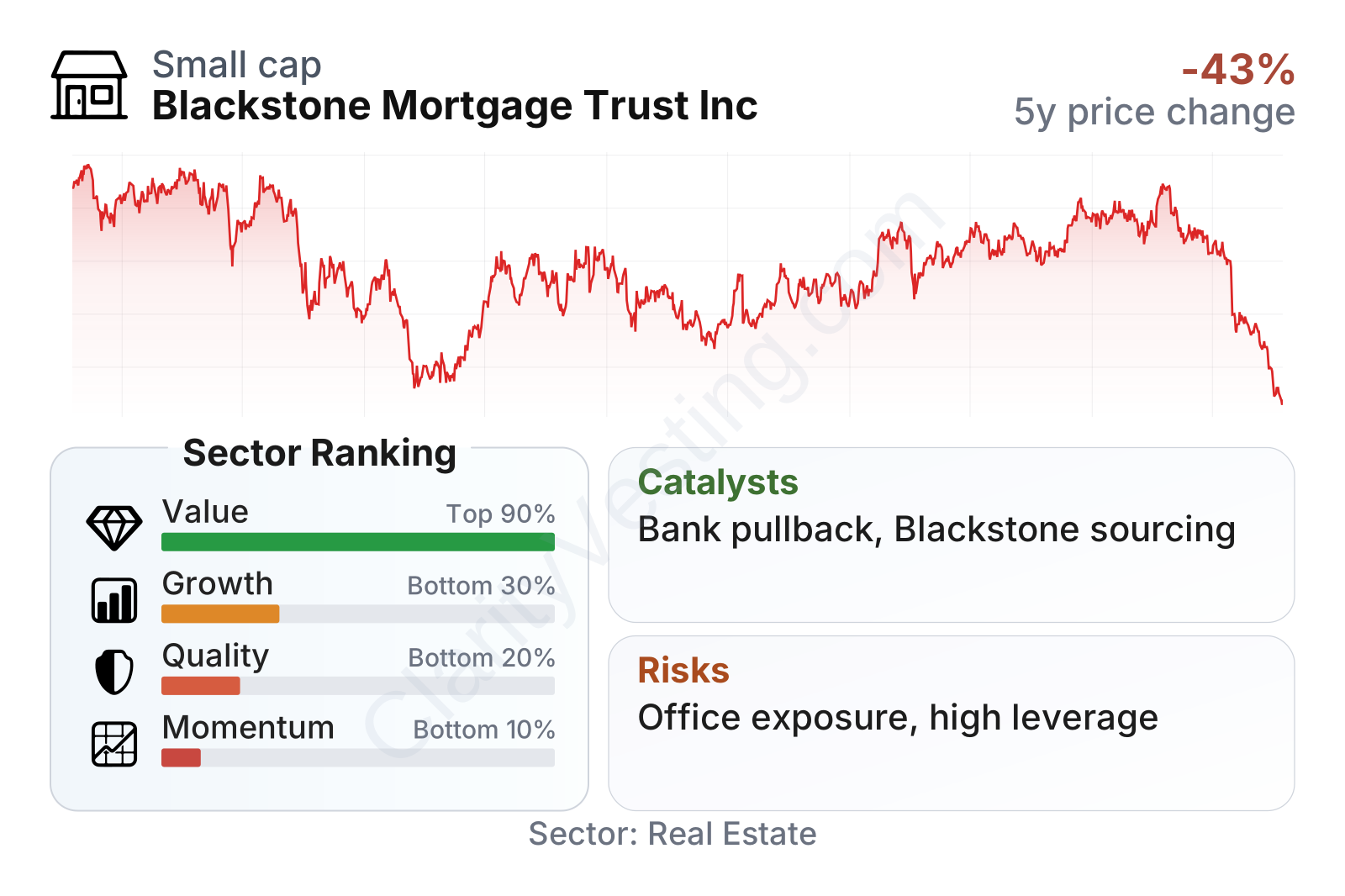
BXMT is a mid-sized publicly listed mortgage REIT with a market value around $2 billion and a beta close to 1, so its share price has broadly moved with the market rather than behaving like an extreme outlier. The most striking feature in the metrics table is the contrast between income appeal and operating weakness. The dividend yield is far above the sector median, and the price-to-book ratio is below the sector median, which makes the stock look inexpensive on asset value measures. At the same time, growth, quality, and momentum rank near the bottom of the sector.
The weak quality readings reflect low current profitability, heavy leverage, and thin interest coverage. Growth readings are also mixed: long-term revenue per share has risen strongly over five years, but earnings per share, book value per share, free cash flow, and the dividend trend have all moved in the wrong direction. That combination suggests the market is discounting the shares not because the business is small, but because confidence in the earnings base remains limited.
Growth
BXMT operates in commercial real estate credit, a sector that should remain relevant for a long time because property owners continuously need refinancing, recapitalizations, and new debt. In that sense, it is part of a durable market. The more important question is whether the current phase of that market supports profitable growth. After the sharp interest-rate reset of the last few years, many commercial real estate borrowers face tighter financing conditions, lower property values in some categories, and more selective lenders. That environment can create opportunities for experienced credit platforms, especially those able to write large loans when banks pull back.
That is where Blackstone’s platform matters. BXMT’s affiliation with Blackstone can help it source larger and more complex financings, particularly with institutional sponsors. If traditional banks continue shrinking parts of their commercial real estate exposure, non-bank lenders like BXMT could have more room to originate loans at stronger structures and wider spreads. This is one of the clearest long-term catalysts for the business.
Revenue per share climbed sharply from 2021 through 2023 before easing in 2024 and 2025. That pattern fits the company’s floating-rate model: higher benchmark rates boosted interest income, but the later decline shows that the exceptional benefit from repricing is fading. For long-term growth to look healthier, new originations and credit normalization matter more than simply relying on elevated rates.
The dividend per share was relatively stable through 2023 and then moved lower in 2024 and 2025. That trend does not automatically rule out future recovery, but it does show that the business has been adjusting to a tougher earnings environment. A meaningful improvement would likely require better credit performance, steadier distributable earnings, and successful redeployment of capital into attractive new loans.
Recent company updates have highlighted portfolio management, repayments, and selective origination activity rather than aggressive expansion. That is a rational strategy in the current environment. It suggests management is prioritizing credit discipline and liquidity while waiting for better lending conditions. If refinancing stress in commercial real estate continues to create openings for senior lenders with institutional backing, BXMT could benefit from a more favorable competitive setup than in easier credit markets.
Risks
This article is for informational purposes only and does not constitute financial advice. Some content is AI-generated. See Disclaimer


