Stock Analysis · BOXABL Inc (BXBL)
Overview
BOXABL Inc is a factory-built housing company focused on small, modular homes that are designed to be shipped efficiently and assembled quickly on site. The company’s best-known product is the Casita, a compact housing unit aimed at uses such as accessory dwelling units, workforce housing, disaster relief, and small residential projects. The broader idea behind the business is to bring manufacturing methods into homebuilding in order to reduce construction time, simplify logistics, and potentially lower costs.
BOXABL is still in an early commercial stage, so its revenue base remains narrow and not yet diversified like a mature homebuilder. Based on recent public filings, revenue appears to come primarily from product sales tied to housing units and related project activity. Public disclosures do not provide a detailed revenue breakdown by segment in a way that supports reliable percentage splits across multiple categories. In practical terms, the business currently depends mostly on housing unit production and deliveries, while other potential income streams such as licensing, services, or large-scale development partnerships remain limited or not yet material in reported results.
The financial profile also shows that the company is still building toward scale rather than operating as an established high-volume manufacturer. Revenue has been modest relative to operating costs, and losses have remained large as BOXABL continues spending on administration, production capability, and product development.
The long-term pattern is clear: BOXABL has not yet translated its manufacturing vision into an efficient income statement. Revenue has stayed low, cost of revenue has remained above sales, and overhead has been significant. That combination explains why the company is still in a heavy investment and cash-burning phase.
Key Figures
| Metric | Value | Sector ⓘ |
|---|---|---|
| Date | Nov 14, 2026 | |
| Context | ||
| Sector | Consumer Cyclical | |
| Industry | Residential Construction | |
| Market Cap ⓘ | $1.32B | |
| Beta ⓘ | N/A | |
Value (Cheapness) | ||
| P/E Ratio ⓘ | N/A | 17.68 |
| P/B Ratio ⓘ | 34.69 | 2.77 |
| FCF Yield ⓘ | -2.07% | 7.36% |
| Dividend Yield ⓘ | N/A | 2.55% |
| EBIT / EV ⓘ | -1.56% | 7.05% |
| PEG ⓘ | N/A | |
Growth (Business expansion) | ||
| Revenue Growth ⓘ | 77.40% | 5.20% |
| RPS Growth (5Y CAGR) ⓘ | -48.15% | 8.97% |
| EPS Growth (5Y CAGR) ⓘ | N/A | -12.17% |
| BVPS Growth (5Y CAGR) ⓘ | -17.95% | 5.63% |
| Margin Growth (5Y Trend) ⓘ | N/A | -0.17% |
| FCF Growth (5Y CAGR) ⓘ | N/A | 5.89% |
| DPS Growth (5Y CAGR) ⓘ | N/A | 10.17% |
Quality (Business durability) | ||
| ROIC (Latest) ⓘ | N/A | 11.44% |
| ROA (Latest) ⓘ | -52.02% | 5.57% |
| ROIC (5Y Median) ⓘ | N/A | 10.52% |
| ROA (5Y Median) ⓘ | -55.81% | 5.37% |
| Net Debt / EBIT (Latest) ⓘ | N/A | 2.06 |
| Net Debt / EBIT (5Y Median) ⓘ | N/A | 2.24 |
| Net Debt / EBITDA (Latest) ⓘ | N/A | 1.45 |
| Net Debt / Assets ⓘ | N/A | 21.26% |
| EBITDA / Interest ⓘ | N/A | 9.63 |
| Operating Margin (Latest) ⓘ | -1092.22% | 9.14% |
| Operating Margin (5Y Median) ⓘ | -4760.81% | 9.64% |
| Debt to Equity (Latest) ⓘ | N/A | 73.06% |
| Profit Margin (Latest) ⓘ | N/A | 5.35% |
| Free Cash Flow (Latest) ⓘ | -$27.32M | |
Momentum (Price trend) | ||
| 3Y Return ⓘ | -82.49% | +20.92% |
| 12M Return (excl. last month) ⓘ | -62.86% | 0.00% |
| 6M Return ⓘ | -83.63% | +1.89% |
| Price vs. 200-Day MA ⓘ | -80.01% | +1.11% |
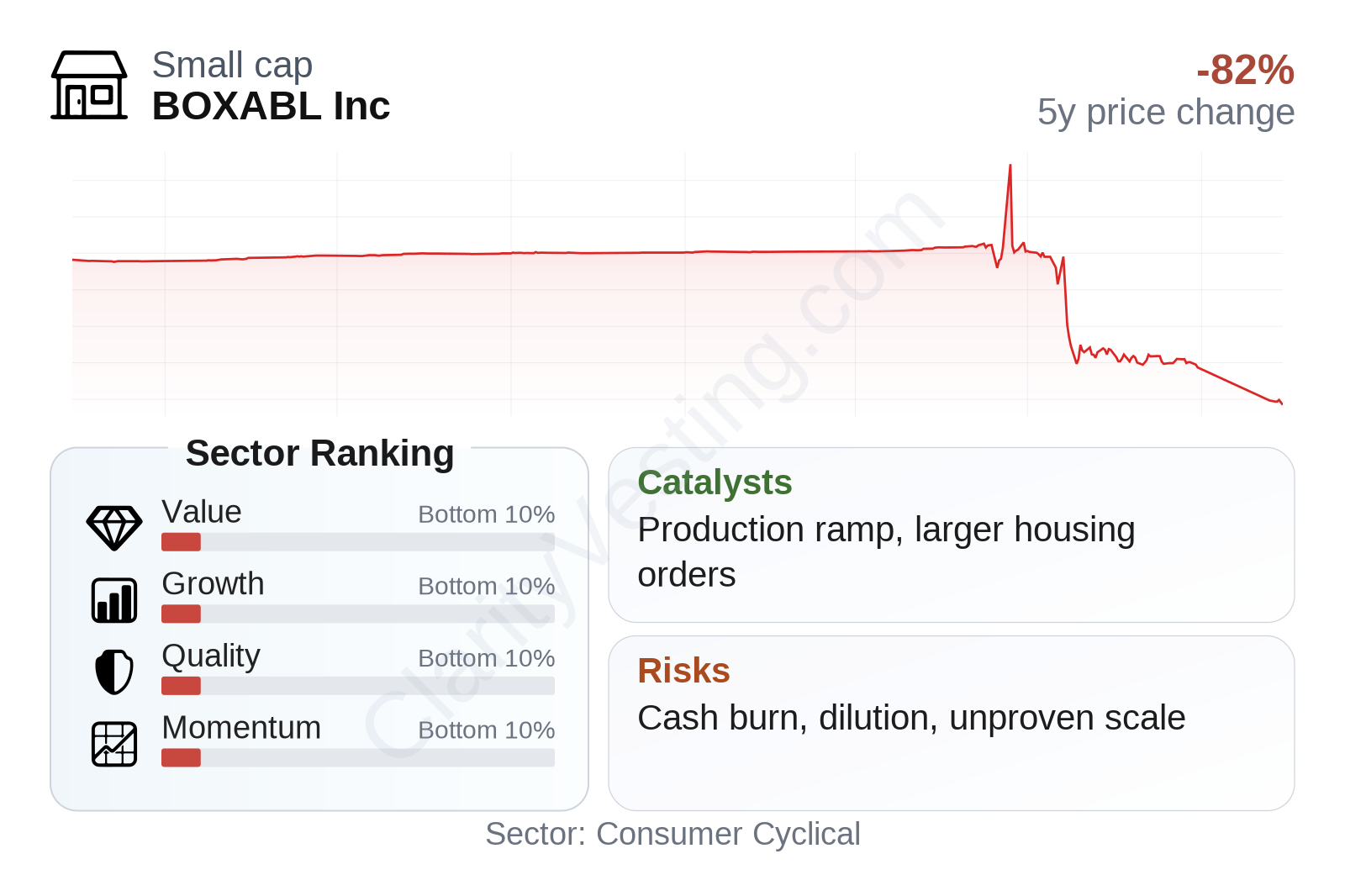
BOXABL currently looks weak on most core financial factors compared with the broader residential construction group. The company’s market value still reflects meaningful expectations, yet profitability, cash generation, and balance-sheet efficiency remain far below sector norms. The valuation side stands out in particular: the price-to-book ratio is extremely high versus the industry median, while free cash flow yield and operating returns are negative. Recent share performance has also been very poor, with the stock far below its earlier 2026 level and well under its long-term trend line.
Growth
BOXABL operates in a part of the housing market that has genuine long-term relevance. The United States continues to face housing affordability problems, labor shortages in construction, and demand for faster, more standardized building methods. Factory-built housing and modular construction are often presented as possible solutions because they can reduce on-site labor needs, shorten build times, and improve repeatability. In that sense, the company is pointed at a real structural need rather than a niche with no obvious tailwind.
The company’s strategy also makes sense on paper. If BOXABL can standardize production, improve factory utilization, and turn a simple product into a repeatable platform, it could theoretically benefit from scale in a way that traditional site-built construction often cannot. The model becomes more attractive if the company secures larger institutional, government, or developer orders, because factory economics generally improve when production runs are more predictable.
Recent revenue growth rates have been very high, but they need to be interpreted carefully. The percentages look strong partly because the starting base was extremely small. That means growth is real, but it does not yet prove that BOXABL has reached durable commercial scale. What matters more over the next phase is whether sales can continue rising while gross losses narrow and production becomes more efficient.
Cash flow remains the key test. Although free cash flow has improved from very weak levels, it is still deeply negative. This shows that the company is consuming cash as it builds operations, which is common for early-stage industrial businesses, but it also means future growth depends on access to funding and on management’s ability to convert demand into actual delivered units at better economics.
A meaningful catalyst would be evidence that BOXABL can move from small deliveries and pilot-style activity into repeatable production at much higher volume. Other potentially important opportunities include partnerships with public agencies, large developers, or organizations looking for workforce and emergency housing. Recent company communications have continued to emphasize production ramp efforts, regulatory progress, and expansion of delivery capabilities, all of which matter because the investment case depends less on concept validation and more on execution at scale.
Risks
This article is for informational purposes only and does not constitute financial advice. Some content is AI-generated. See Disclaimer