Stock Analysis · BlackRock World Mining Trust plc (BWMTF)
Overview
BlackRock World Mining Trust plc is a London-listed investment trust focused on the global mining and metals industry. Rather than operating mines itself, it invests shareholders’ capital in a portfolio of mining companies around the world. That gives the trust exposure to commodities such as copper, iron ore, gold, and other metals tied to industrial activity, electrification, and resource demand. The trust is managed within BlackRock’s broader natural resources platform, which adds scale, research depth, and access to management teams across the sector.
Its economic engine is different from a traditional operating company. Revenue and earnings mostly come from the performance of its investment portfolio rather than from selling products or services. In practical terms, returns are driven by changes in the market value of the holdings, dividend income received from portfolio companies, and, to a smaller extent, tactical use of debt and derivative instruments where permitted by the trust’s mandate.
The main sources of revenue are typically the following:
- Net realized and unrealized gains on investments: usually the dominant driver over time, and in strong commodity markets it can represent well above 70% of total return-related income. This includes share price movements of the mining companies held in the portfolio.
- Dividend income from portfolio holdings: often the second-largest contributor, especially when large diversified miners are generating strong cash flow and paying distributions to shareholders.
- Other income and portfolio-related items: a smaller component that can include option premiums, foreign exchange effects, and other investment-related flows depending on the reporting period.
Because this is an investment trust, those proportions can swing sharply from year to year. Recent results show exactly that pattern: very strong gains in favorable periods, losses when mining equities pull back, and then a sharp rebound when commodity sentiment improves. The cost base itself appears relatively light compared with the size of the portfolio, which is important because more of the upside can pass through to net asset value when markets are favorable.
The profit pattern is highly cyclical, with positive years in 2021 and 2022, losses in 2023 and 2024, and a very strong recovery in 2025. What stands out is that operating expenses stayed comparatively small while reported results moved mainly with portfolio valuations, which is typical for a listed investment vehicle exposed to volatile resource equities.
Key Figures
| Metric | Value | Sector ⓘ |
|---|---|---|
| Date | Oct 17, 2026 | |
| Context | ||
| Sector | Financial Services | |
| Industry | Asset Management | |
| Market Cap ⓘ | $1.05B | |
| Beta ⓘ | 1.02 | |
Value (Cheapness) | ||
| P/E Ratio ⓘ | 4.40 | 12.26 |
| P/B Ratio ⓘ | 1.85 | 1.23 |
| FCF Yield ⓘ | 17.81% | 10.40% |
| Dividend Yield ⓘ | 3.43% | 3.02% |
| EBIT / EV ⓘ | N/A | 8.14% |
| PEG ⓘ | N/A | |
Growth (Business expansion) | ||
| Revenue Growth ⓘ | 72.00% | 9.35% |
| RPS Growth (5Y CAGR) ⓘ | 24.07% | 12.19% |
| EPS Growth (5Y CAGR) ⓘ | -18.34% | -9.53% |
| BVPS Growth (5Y CAGR) ⓘ | -0.04% | 4.99% |
| Margin Growth (5Y Trend) ⓘ | -9.34% | -3.86% |
| FCF Growth (5Y CAGR) ⓘ | N/A | 4.81% |
| DPS Growth (5Y CAGR) ⓘ | -14.74% | 8.79% |
Quality (Business durability) | ||
| ROIC (Latest) ⓘ | N/A | 9.49% |
| ROE (Latest) ⓘ | 42.24% | 13.90% |
| ROA (Latest) ⓘ | 38.58% | 1.55% |
| ROIC (5Y Median) ⓘ | N/A | 7.86% |
| ROE (5Y Median) ⓘ | 16.58% | 12.17% |
| ROA (5Y Median) ⓘ | 14.69% | 1.30% |
| Net Debt / EBIT (Latest) ⓘ | N/A | 0.96 |
| Net Debt / EBIT (5Y Median) ⓘ | N/A | 0.73 |
| Net Debt / EBITDA (Latest) ⓘ | N/A | 0.92 |
| Operating Margin (Latest) ⓘ | N/A | 22.30% |
| Operating Margin (5Y Median) ⓘ | 117.76% | 24.63% |
| Debt to Equity (Latest) ⓘ | 6.05% | 58.56% |
| Profit Margin (Latest) ⓘ | 96.63% | 26.57% |
| Free Cash Flow (Latest) ⓘ | $186.32M | |
Momentum (Price trend) | ||
| 3Y Return ⓘ | +67.33% | +88.33% |
| 12M Return (excl. last month) ⓘ | +112.94% | +19.38% |
| 6M Return ⓘ | +112.94% | +4.75% |
| Price vs. 200-Day MA ⓘ | +78.78% | +3.50% |
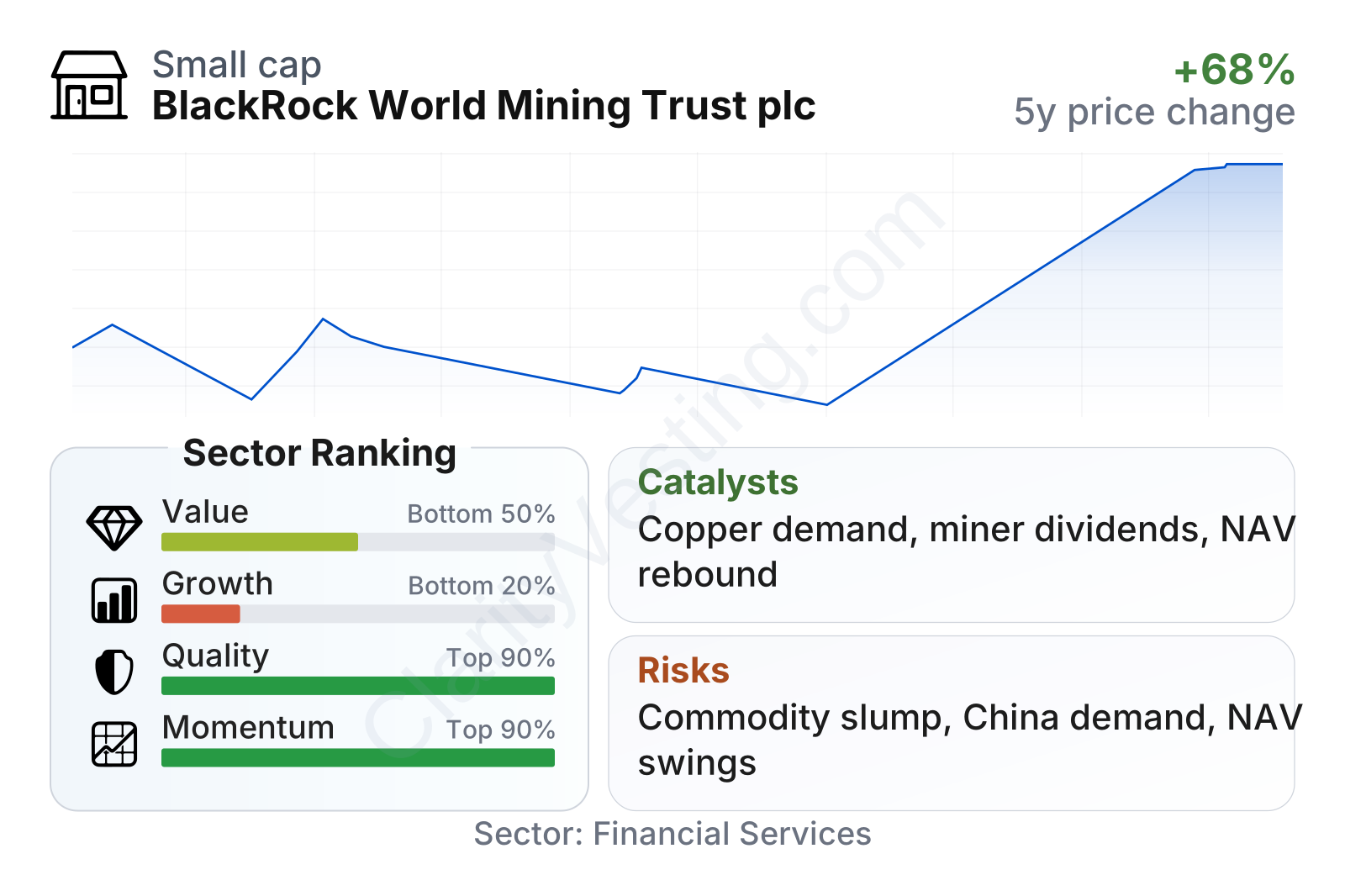
BlackRock World Mining Trust is a relatively small listed vehicle in market value terms, with share-price volatility close to the broader equity market based on a beta of about 1.0. The factor profile is unusual but understandable for a mining-focused trust. Quality and momentum rank very strongly versus much of the financial sector, while growth ranks poorly because accounting earnings and book value can be volatile from year to year.
Valuation metrics look mixed on the surface. The trust shows a low earnings multiple versus the sector median and a free cash flow yield that is comfortably above the sector median, but price-to-book is higher than the sector median. That combination suggests the market is paying up for recent portfolio strength, even though the accounting profile still reflects the sector’s cyclical swings.
Profitability measures are exceptionally high relative to the broader financial sector, with return on equity above 40%, return on assets near 39%, and a profit margin close to 97%. For an investment trust, those numbers reflect market gains flowing through the income statement rather than the economics of a conventional operating business. Balance-sheet leverage appears modest, with debt to equity around 6%, which is conservative for a vehicle exposed to a volatile underlying sector.
Share-price momentum has been especially strong. The stock has risen from roughly $7 in early 2022 to about $11.7 by October 2026, and the shorter-term performance has been much stronger than the sector median. That points to a market that has become considerably more constructive on mining exposure and on this trust’s portfolio positioning.
Growth
The trust operates in a sector with long-term structural support, even though the path is rarely smooth. Mining is essential to electrification, grid upgrades, renewable power equipment, electric vehicles, battery supply chains, and broader infrastructure renewal. Copper is especially important in that theme, while iron ore, aluminum-related inputs, and selected precious metals also remain strategically relevant. That backdrop gives specialized mining exposure a credible long-duration demand case.
BlackRock World Mining Trust’s strategy also makes sense for this environment. An actively managed portfolio can shift between diversified mining majors, more specialized producers, royalty names, and sometimes earlier-stage opportunities depending on where value and momentum appear strongest. That flexibility matters in mining, where different commodities can move in very different cycles. BlackRock’s global investment platform is a practical advantage here because mining analysis requires country knowledge, commodity expertise, and ongoing monitoring of capital allocation by portfolio companies.
The recent rebound in earnings and book value after the weaker 2023-2024 stretch suggests the trust remains highly geared to improving mining equity prices. For long-term readers, the key point is not smooth linear growth, but exposure to a sector where stronger commodity prices and disciplined capital returns from miners can produce powerful recoveries.
Book value per share has been uneven rather than steadily compounding, dropping materially in 2023 and 2024 before recovering in 2025. That pattern is normal for a mining-focused trust: underlying asset values move with commodity prices, investor sentiment, and changes in the valuation of large portfolio holdings. The recovery matters because it shows the trust can rebuild net asset value when the cycle turns favorable again.
A meaningful catalyst is the broader supply-and-demand balance for key metals. New mine supply is often slow to develop because of permitting, capex intensity, and geopolitical complexity. If demand from electrification and infrastructure remains firm while supply stays constrained, mining equities can continue to benefit. Another catalyst is cash generation by large miners: when commodity prices are supportive, portfolio companies often raise dividends or repurchase shares, which can lift both the trust’s income stream and the valuation of its holdings.
Risks
This article is for informational purposes only and does not constitute financial advice. Some content is AI-generated. See Disclaimer


