Stock Analysis · BW LPG Limited (BWLP)
Overview
BW LPG Limited is a shipping company focused on transporting liquefied petroleum gas, or LPG, by sea. LPG mainly includes propane and butane, fuels and petrochemical feedstocks used for home heating, cooking, industrial processes, and plastics production. The company operates a large fleet of very large gas carriers, commonly called VLGCs, which move cargoes between major exporting regions such as the United States and the Middle East and importing regions in Asia, Europe, India, and other markets.
Its business is relatively easy to understand: producers and traders need ships to move LPG across oceans, and BW LPG earns money by providing that transport capacity. Revenue depends mostly on freight rates, vessel availability, trading conditions, and the size and efficiency of its fleet. The company has also expanded its commercial platform through fleet optimization, chartering activities, and work around dual-fuel LPG-powered vessels, which can improve fuel efficiency and lower emissions.
The company’s revenue mix is not disclosed in the simple segment style seen in many industrial companies because BW LPG is mainly a shipping operator built around one core activity. Based on company reporting, the largest sources of revenue are broadly the following:
- Voyage and time charter revenue from LPG shipping: approximately 85% to 95% of total revenue in most periods. This is the core business and includes earnings from transporting LPG cargoes on owned and chartered vessels.
- Product services and trading-related shipping activities: approximately 5% to 15%. This can include commercial optimization, charter-in/charter-out effects, and other freight-related activities tied to the shipping platform.
- Other operating revenue: typically less than 5%. This may include ancillary maritime income and smaller service items.
Over the last several years, the business has shown a clear pattern: revenue climbed sharply from about $1.2 billion in 2021 to around $3.7 billion in 2025, but profit did not rise in a straight line because shipping rates and operating conditions are cyclical. Gross profit and operating income expanded strongly in 2023, then moderated in 2024 and 2025 as conditions normalized. Even so, the company remained profitable.
The operating profile shows a business with high revenue scale but also meaningful exposure to voyage costs and market swings. Revenue has grown materially since 2021, while net income has remained positive throughout the period, though below the 2023 peak.
Key Figures
| Metric | Value | Sector ⓘ |
|---|---|---|
| Date | Oct 24, 2026 | |
| Context | ||
| Sector | Energy | |
| Industry | Oil & Gas Midstream | |
| Market Cap ⓘ | $3.78B | |
| Beta ⓘ | 0.10 | |
Value (Cheapness) | ||
| P/E Ratio ⓘ | 8.32 | 15.40 |
| P/B Ratio ⓘ | 2.16 | 1.71 |
| FCF Yield ⓘ | 15.86% | 8.24% |
| Dividend Yield ⓘ | 10.58% | 3.52% |
| EBIT / EV ⓘ | 13.12% | 7.45% |
| PEG ⓘ | N/A | |
Growth (Business expansion) | ||
| Revenue Growth ⓘ | -3.10% | 26.85% |
| RPS Growth (5Y CAGR) ⓘ | 29.24% | 6.78% |
| EPS Growth (5Y CAGR) ⓘ | 2.75% | -14.41% |
| BVPS Growth (5Y CAGR) ⓘ | 3.73% | 6.08% |
| Margin Growth (5Y Trend) ⓘ | -8.37% | 0.55% |
| FCF Growth (5Y CAGR) ⓘ | 31.40% | 2.75% |
| DPS Growth (5Y CAGR) ⓘ | 17.27% | 16.79% |
Quality (Business durability) | ||
| ROIC (Latest) ⓘ | 19.91% | 11.30% |
| ROA (Latest) ⓘ | 13.13% | 6.00% |
| ROIC (5Y Median) ⓘ | 16.97% | 10.35% |
| ROA (5Y Median) ⓘ | 9.04% | 5.46% |
| Net Debt / EBIT (Latest) ⓘ | 1.10 | 1.64 |
| Net Debt / EBIT (5Y Median) ⓘ | 2.02 | 1.82 |
| Net Debt / EBITDA (Latest) ⓘ | 0.77 | 1.08 |
| Net Debt / Assets ⓘ | 18.55% | 17.29% |
| EBITDA / Interest ⓘ | 18.28 | 9.53 |
| Operating Margin (Latest) ⓘ | 16.32% | 16.21% |
| Operating Margin (5Y Median) ⓘ | 17.45% | 20.55% |
| Debt to Equity (Latest) ⓘ | 48.61% | 52.27% |
| Profit Margin (Latest) ⓘ | 12.64% | 8.79% |
| Free Cash Flow (Latest) ⓘ | $598.75M | |
Momentum (Price trend) | ||
| 3Y Return ⓘ | +233.90% | +68.93% |
| 12M Return (excl. last month) ⓘ | +90.60% | +42.90% |
| 6M Return ⓘ | +49.10% | +9.18% |
| Price vs. 200-Day MA ⓘ | +33.57% | +9.87% |
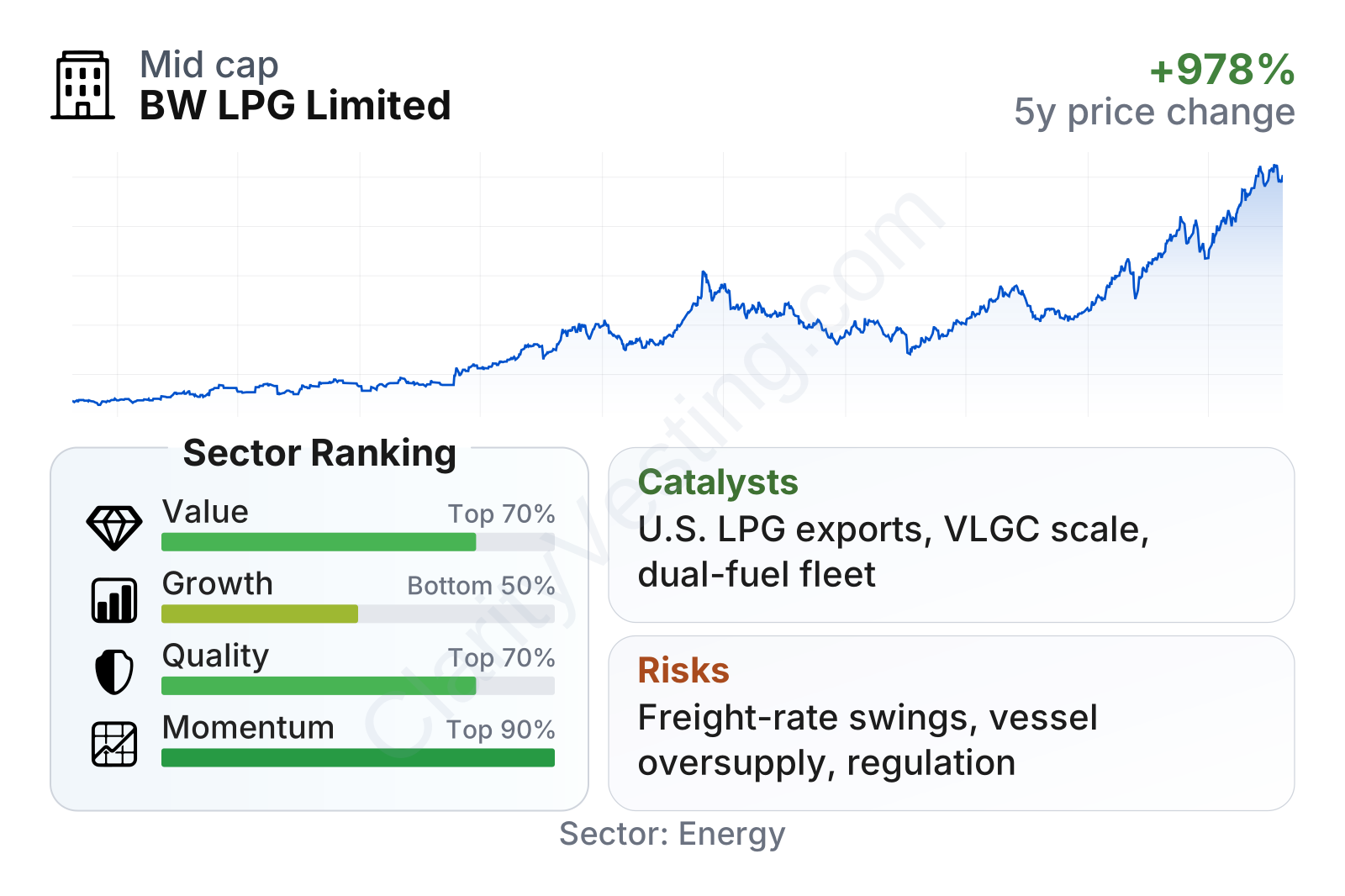
BW LPG is a mid-to-large shipping company by market value, and its recent factor profile looks strongest in momentum and cash generation. Valuation metrics appear lower than many sector peers, with a price-to-earnings ratio around 8 and free cash flow yield around 16%, while the trailing dividend yield near 11% is also well above the sector median. Quality measures are solid as well: return on invested capital is close to 20%, profit margin is around 13%, and leverage is moderate, with debt to equity just under 49% and interest coverage comfortably above most peers. The weaker area is short-term growth, as revenue has recently softened versus a sector that has generally posted stronger top-line growth.
Growth
BW LPG operates in a part of the energy value chain that still has a credible long-term role. LPG demand is supported by household fuel use in emerging markets, petrochemical demand, and exports from low-cost producing regions, especially the United States. That does not make the sector immune to cycles, but it does mean the company is linked to a global trade flow with durable underlying demand rather than a purely short-lived trend.
The company’s strategy broadly makes sense for future growth because scale matters in shipping. A larger fleet can improve customer coverage, operating flexibility, and vessel deployment. BW LPG has positioned itself as one of the biggest owners and operators in the VLGC market, which gives it commercial relevance with large cargo customers. Its investments in LPG dual-fuel propulsion also matter: these vessels can lower fuel costs and support compliance with tightening environmental rules, which may help preserve competitiveness over time.
Recent sales growth has been volatile. After very strong year-over-year expansion through much of 2022, 2023, and parts of 2024, growth turned negative in several more recent quarters. That is important context: BW LPG is not a steady compounding industrial business. It is a cyclical transporter whose revenue rises and falls with freight rates, utilization, and trading patterns.
Cash generation has also been uneven, but the broader picture remains constructive. Free cash flow moved from a strong positive level to a temporary negative period and then returned to a sizable positive figure. For a shipping company, this is a healthier pattern than it may first appear, because vessel acquisitions, fleet upgrades, and timing effects can create large swings. The more important point is that BW LPG has recently been able to convert its asset base into meaningful cash again.
Several catalysts could support future performance. U.S. LPG export growth remains one of the most important industry drivers because longer shipping distances usually improve vessel demand. Port and canal constraints can also tighten vessel supply in practice by increasing voyage times. In addition, if older ships are retired faster due to environmental regulation, efficient fleets such as BW LPG’s may benefit from a firmer rate environment. Company announcements in recent periods have also highlighted capital allocation discipline, dividends, and continued operational focus, all of which can strengthen market confidence when freight conditions are supportive.
Risks
This article is for informational purposes only and does not constitute financial advice. Some content is AI-generated. See Disclaimer


