Stock Analysis · Bureau Veritas SA (BVVBY)
Overview
Bureau Veritas is a testing, inspection, and certification company. In simple terms, it helps businesses, governments, and asset owners check whether products, infrastructure, industrial sites, ships, buildings, and supply chains meet safety, quality, environmental, and regulatory standards. Its role is often independent verification: the company does not usually manufacture the product being checked; it assesses whether that product or process complies with rules or specifications.
This business model is spread across many end markets, which helps reduce dependence on any single customer or industry. Based on the company’s latest annual reporting, revenue is mainly organized by business line as follows:
- Consumer Products Services: approximately 27% of revenue. This includes testing and certification for textiles, toys, electronics, hardlines, and retail supply chains.
- Industry: approximately 23%. This covers inspections, asset integrity, and compliance services for industrial facilities, energy projects, and process industries.
- Marine & Offshore: approximately 16%. This includes ship classification, marine certification, and technical services for vessels and offshore assets.
- Buildings & Infrastructure: approximately 16%. This area focuses on construction-related testing, building compliance, and infrastructure inspection.
- Certification: approximately 10%. This includes management-system certifications such as quality, health and safety, environmental, and related standards.
- Agri-Food & Commodities: approximately 8%. This covers testing, inspection, and assurance for agricultural products and traded commodities.
Geographically, Bureau Veritas is also diversified, with meaningful exposure to Europe, Asia-Pacific, the Americas, and the Middle East and Africa. That matters for long-term analysis because many of its services are recurring or tied to compliance needs that continue even in slower economic periods.
The financial flow over recent years shows a business that has steadily increased revenue since 2021, while operating profit and net income have also trended upward overall. Some line items move sharply from year to year because of accounting presentation, but the broader picture is one of a large, cash-generative service group with resilient profitability.
Key Figures
| Metric | Value | Sector ⓘ |
|---|---|---|
| Date | Oct 17, 2026 | |
| Context | ||
| Sector | Industrials | |
| Industry | Consulting Services | |
| Market Cap ⓘ | $13.60B | |
| Beta ⓘ | 0.72 | |
Value (Cheapness) | ||
| P/E Ratio ⓘ | 23.26 | 22.10 |
| P/B Ratio ⓘ | 8.53 | 1.97 |
| FCF Yield ⓘ | 12.29% | 6.38% |
| Dividend Yield ⓘ | 3.49% | 1.94% |
| EBIT / EV ⓘ | N/A | 4.79% |
| PEG ⓘ | 2.19 | |
Growth (Business expansion) | ||
| Revenue Growth ⓘ | 2.00% | 9.30% |
| RPS Growth (5Y CAGR) ⓘ | 6.04% | 7.81% |
| EPS Growth (5Y CAGR) ⓘ | -31.51% | -13.06% |
| BVPS Growth (5Y CAGR) ⓘ | 0.79% | 6.14% |
| Margin Growth (5Y Trend) ⓘ | 0.31% | 0.88% |
| FCF Growth (5Y CAGR) ⓘ | 4.13% | 11.01% |
| DPS Growth (5Y CAGR) ⓘ | 22.47% | 9.48% |
Quality (Business durability) | ||
| ROIC (Latest) ⓘ | 26.63% | 10.84% |
| ROA (Latest) ⓘ | 16.41% | 5.41% |
| ROIC (5Y Median) ⓘ | 13.51% | 9.38% |
| ROA (5Y Median) ⓘ | 7.32% | 4.95% |
| Net Debt / EBIT (Latest) ⓘ | 1.32 | 2.08 |
| Net Debt / EBIT (5Y Median) ⓘ | 1.82 | 2.27 |
| Net Debt / EBITDA (Latest) ⓘ | 0.96 | 1.39 |
| Net Debt / Assets ⓘ | 30.03% | 19.28% |
| EBITDA / Interest ⓘ | 9.32 | 9.58 |
| Operating Margin (Latest) ⓘ | 12.27% | 10.50% |
| Operating Margin (5Y Median) ⓘ | 14.53% | 10.29% |
| Debt to Equity (Latest) ⓘ | 183.48% | 65.48% |
| Profit Margin (Latest) ⓘ | 7.46% | 6.67% |
| Free Cash Flow (Latest) ⓘ | $1.67B | |
Momentum (Price trend) | ||
| 3Y Return ⓘ | +38.09% | +61.68% |
| 12M Return (excl. last month) ⓘ | +6.14% | +12.58% |
| 6M Return ⓘ | -2.99% | 0.00% |
| Price vs. 200-Day MA ⓘ | -0.69% | +0.02% |
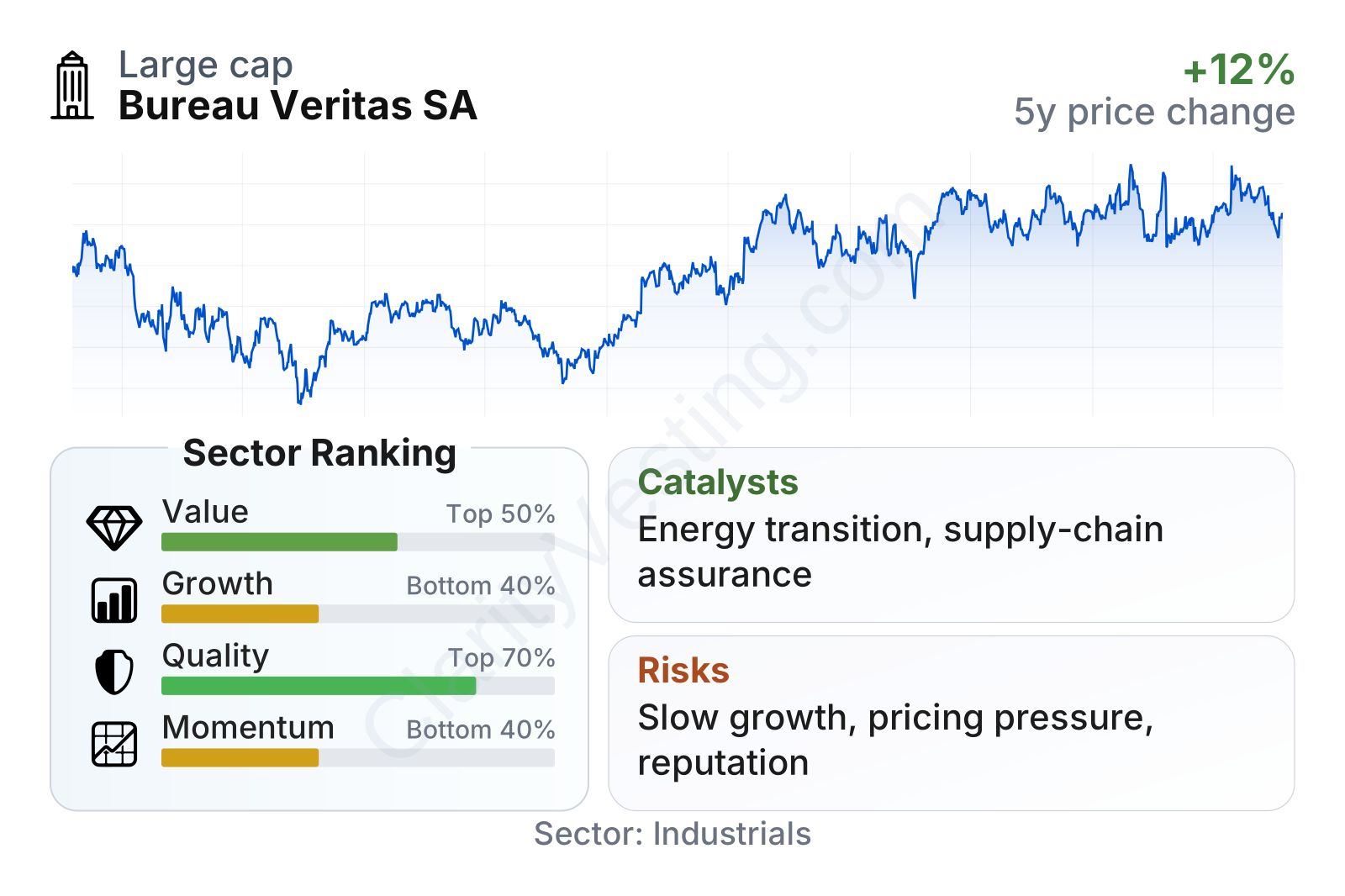
The market profile is that of a large industrial services group with relatively low share-price volatility, as shown by a beta below 1. Valuation looks mixed rather than plainly cheap: the earnings multiple sits near the sector median, but the price-to-book ratio is much higher, reflecting the market’s willingness to pay for a business with strong returns and intangible franchise value.
Quality is where Bureau Veritas stands out most clearly. Returns on invested capital and assets are well above sector medians, operating margins are ahead of peers, and leverage measured against EBIT or EBITDA remains contained. Free cash flow generation is also strong, with a cash flow yield above the sector median and a dividend yield around 3.5%, also above the median for the group.
The weaker area is growth. Recent revenue growth has been modest, five-year free cash flow growth has been slower than the sector median, and momentum indicators are not especially strong. The share price has risen meaningfully over the last several years, but more slowly than the median stock in its sector, and it has been roughly flat to slightly soft in the shorter term.
Growth
Bureau Veritas operates in a sector with durable long-term demand. Testing, inspection, and certification are supported by tightening regulations, more complex global supply chains, energy transition projects, higher quality requirements, product traceability, and the growing need to document environmental and social claims. These drivers are not tied to a single short-lived trend; they come from structural changes in how companies manage risk and compliance.
The company’s strategy also makes practical sense for future expansion. Management has continued to emphasize higher-growth and higher-value areas such as sustainability services, building and infrastructure testing, energy transition, data and digital assurance, and supply-chain traceability. These services are attractive because customers increasingly need outside verification to satisfy regulators, business partners, insurers, and end consumers.
A notable catalyst is the broad wave of decarbonization and electrification spending. New energy assets, grid investments, battery value chains, offshore wind, and industrial efficiency projects typically require inspection, certification, and conformity assessment at multiple stages. Bureau Veritas already has relevant capabilities across industry, marine, infrastructure, and certification, which gives it room to participate across several parts of that buildout rather than depending on one niche.
Another opportunity comes from supply-chain quality control and responsible sourcing. Consumer brands and manufacturers are under pressure to verify product safety, chemical content, labor standards, and origin claims. This plays directly into Bureau Veritas’s consumer products and certification activities. In addition, marine regulation is becoming more demanding, which can support recurring work in vessel classification and related compliance services.
Recent company communications have also pointed to ongoing bolt-on acquisitions and portfolio development aimed at strengthening exposure to faster-growing segments and geographies. For a business like Bureau Veritas, disciplined acquisitions can be useful because scale, technical expertise, accreditation, and customer relationships matter, and acquired specialist capabilities can often be distributed through a much larger commercial network.
Risks
This article is for informational purposes only and does not constitute financial advice. Some content is AI-generated. See Disclaimer


