Stock Analysis · Bureau Veritas SA (BVRDF)
Overview
Bureau Veritas is a testing, inspection, and certification group, often shortened in the industry to TIC. In simple terms, it helps companies, governments, and asset owners verify that products, buildings, ships, industrial sites, supply chains, and management systems meet safety, quality, environmental, and regulatory standards. Its role is usually not to manufacture or own the asset, but to independently check whether it complies with rules or performs as expected.
This business model matters because compliance and risk control are recurring needs. A company may need Bureau Veritas before a project starts, during construction or production, and again during operation, renewal, or recertification. That creates a mix of recurring work and activity tied to long industrial and infrastructure cycles.
Bureau Veritas reports revenue across six main business lines. Based on the latest annual reporting, the revenue mix is approximately:
- Consumer Products Services: about 24% — testing and certification for consumer goods, textiles, hardlines, toys, electrical products, and supply-chain quality checks.
- Industry: about 21% — inspection, conformity assessment, and technical services for energy, process industries, construction-related industrial assets, and large capital projects.
- Marine & Offshore: about 15% — ship classification, offshore asset verification, and related technical compliance services.
- Certification: about 14% — audits and certification for standards such as quality, environmental, health and safety, and other management systems.
- Buildings & Infrastructure: about 14% — technical control, construction supervision, code compliance, and asset integrity services for buildings and public works.
- Agri-Food & Commodities: about 12% — inspection and testing for agricultural products, minerals, metals, and commodity trade flows.
Geographically, Bureau Veritas is highly diversified, with business spread across Europe, the Americas, Asia-Pacific, the Middle East, and Africa. That broad footprint reduces dependence on any one end market, although it also exposes the company to global trade conditions and uneven economic cycles.
Over the last several years, revenue and operating profit have generally moved upward, while margins have remained solid. Cash generation has also been strong, which is important in a service business where reputation, technical expertise, and local presence are major assets.
The long-term pattern points to a company that has expanded revenue from roughly €5.0 billion in 2021 to about €6.5 billion in 2025, while maintaining healthy profitability. The broad picture is one of steady scaling rather than a boom-and-bust profile.
Key Figures
| Metric | Value | Sector ⓘ |
|---|---|---|
| Date | Oct 10, 2026 | |
| Context | ||
| Sector | Industrials | |
| Industry | Consulting Services | |
| Market Cap ⓘ | $14.09B | |
| Beta ⓘ | 0.72 | |
Value (Cheapness) | ||
| P/E Ratio ⓘ | 24.05 | 22.32 |
| P/B Ratio ⓘ | 8.85 | 1.98 |
| FCF Yield ⓘ | 11.10% | 6.34% |
| Dividend Yield ⓘ | 2.90% | 1.95% |
| EBIT / EV ⓘ | N/A | 4.71% |
| PEG ⓘ | 2.21 | |
Growth (Business expansion) | ||
| Revenue Growth ⓘ | 2.00% | 9.25% |
| RPS Growth (5Y CAGR) ⓘ | 7.10% | 7.75% |
| EPS Growth (5Y CAGR) ⓘ | 1.91% | -13.37% |
| BVPS Growth (5Y CAGR) ⓘ | 0.79% | 6.12% |
| Margin Growth (5Y Trend) ⓘ | 0.31% | 0.81% |
| FCF Growth (5Y CAGR) ⓘ | 5.17% | 11.01% |
| DPS Growth (5Y CAGR) ⓘ | 23.70% | 9.48% |
Quality (Business durability) | ||
| ROIC (Latest) ⓘ | 26.18% | 10.70% |
| ROA (Latest) ⓘ | 14.10% | 5.38% |
| ROIC (5Y Median) ⓘ | 13.61% | 9.26% |
| ROA (5Y Median) ⓘ | 7.32% | 4.94% |
| Net Debt / EBIT (Latest) ⓘ | 1.23 | 2.08 |
| Net Debt / EBIT (5Y Median) ⓘ | 1.73 | 2.29 |
| Net Debt / EBITDA (Latest) ⓘ | 0.94 | 1.43 |
| Net Debt / Assets ⓘ | 30.03% | 19.34% |
| EBITDA / Interest ⓘ | 10.47 | 9.54 |
| Operating Margin (Latest) ⓘ | 15.12% | 10.34% |
| Operating Margin (5Y Median) ⓘ | 14.53% | 10.29% |
| Debt to Equity (Latest) ⓘ | 183.48% | 65.52% |
| Profit Margin (Latest) ⓘ | 7.46% | 6.63% |
| Free Cash Flow (Latest) ⓘ | $1.56B | |
Momentum (Price trend) | ||
| 3Y Return ⓘ | +41.96% | +61.33% |
| 12M Return (excl. last month) ⓘ | -2.16% | +14.82% |
| 6M Return ⓘ | +1.28% | +3.53% |
| Price vs. 200-Day MA ⓘ | +11.50% | +0.88% |
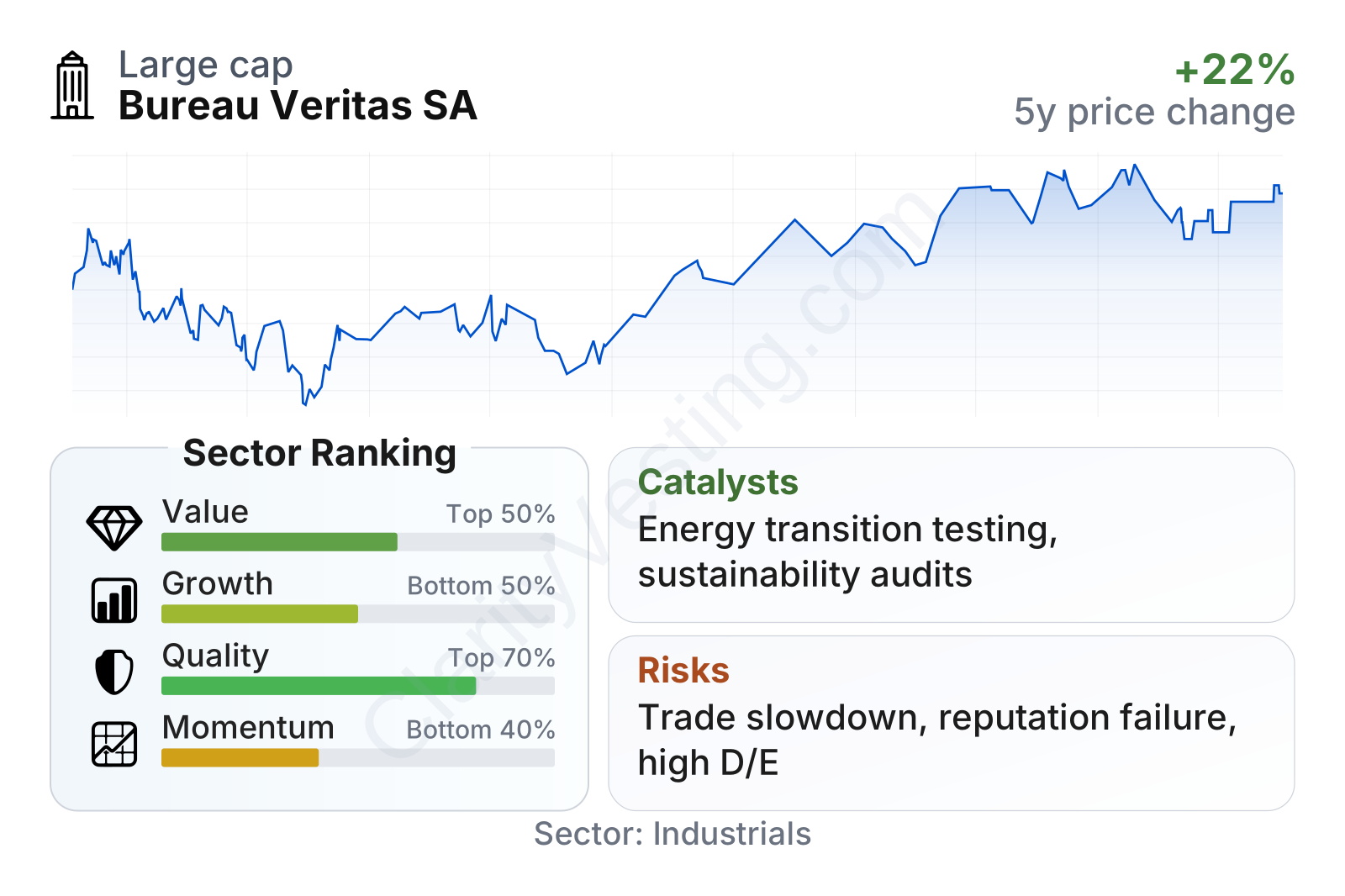
Bureau Veritas sits in the large-cap range for its industry and has shown lower share-price volatility than the broader market, with a beta below 1. The quality profile is notably strong: returns on capital and assets are well above typical sector levels, operating margins are comfortably ahead of the median, and free cash flow generation is robust. Growth metrics are more mixed, however. Recent revenue growth has been modest compared with the broader industrial services universe, even if longer-term earnings and cash flow have remained positive. The stock’s valuation is not extreme on earnings, but it does reflect the market’s willingness to pay a premium for a durable, high-return business.
Growth
Bureau Veritas operates in a sector with durable structural demand. Testing, inspection, and certification tends to benefit from tighter regulation, more complex supply chains, energy transition projects, higher product traceability requirements, and rising expectations around sustainability and risk management. These drivers do not depend only on economic expansion; many are compliance-led and therefore relatively persistent.
The company’s strategy also makes sense for long-term growth. Bureau Veritas has been pushing toward higher-value services, including sustainability-related verification, building efficiency, cyber and digital assurance, and services linked to energy transition infrastructure. It is also active in areas such as battery supply chains, renewables, low-carbon projects, and responsible sourcing, where customers increasingly need independent validation.
That said, growth has recently been moderate rather than rapid. The latest year-over-year revenue growth is around 2%, below the sector median. This does not necessarily signal a weak business model; it suggests Bureau Veritas is currently acting more like a stable compounder than a high-growth operator. For long-term analysis, the key question is whether new demand areas can gradually lift that pace without hurting margins.
One important catalyst is the rising cost of non-compliance for clients. As regulations multiply across environmental claims, product safety, industrial emissions, building standards, and supply-chain accountability, independent verification becomes more valuable. Another catalyst is the company’s position in mission-critical activities where certification or inspection is required before assets can operate, products can ship, or contracts can close.
Recent company updates have also highlighted continued portfolio sharpening and investment in higher-growth niches, including sustainability and data-driven services. That is significant because the TIC industry often rewards firms that can cross-sell across clients, geographies, and technical domains rather than relying only on volume growth.
Risks
This article is for informational purposes only and does not constitute financial advice. Some content is AI-generated. See Disclaimer


