Stock Analysis · First Busey Corp (BUSE)
Overview
First Busey Corp is a regional financial services company built around community banking. Through Busey Bank and related subsidiaries, it provides traditional banking services such as commercial and consumer loans, deposit accounts, treasury management, and wealth-related services. Its footprint is centered in the Midwest and Florida, with business tied closely to local households, small and mid-sized businesses, commercial real estate clients, and institutional relationships.
The company’s revenue mix is still dominated by banking activities, especially the spread between what it earns on loans and securities and what it pays on deposits and borrowings. Noninterest revenue adds a smaller but useful layer of diversification through wealth management, payment-related fees, service charges, and other banking fees. Based on recent annual disclosures, the broad revenue sources can be summarized as follows:
- Net interest income: about 75% to 85% of total revenue in a typical year. This is the core banking engine and includes income from commercial loans, commercial real estate, consumer lending, and investment securities, minus funding costs.
- Wealth management and trust fees: about 6% to 10%. This includes asset management, fiduciary, estate, and related advisory services.
- Service charges and card/payment-related fees: about 4% to 8%. This includes deposit account fees, interchange income, and transaction services.
- Other noninterest income: about 3% to 7%. This can include mortgage-related activity, brokerage or investment services, and miscellaneous banking fees.
That mix matters for long-term analysis because First Busey is not a pure fee-based financial company. Its results are influenced mainly by lending volumes, deposit costs, credit quality, and interest-rate conditions, while fee businesses help cushion the swings.
The multi-year revenue path points to a larger organization today than it was a few years ago, but with profitability moving less smoothly than revenue. Sales have risen meaningfully since 2021, while expenses and interest costs have also climbed, showing that scale alone has not fully translated into stronger returns.
Key Figures
| Metric | Value | Sector ⓘ |
|---|---|---|
| Date | Oct 24, 2026 | |
| Context | ||
| Sector | Financial Services | |
| Industry | Banks - Regional | |
| Market Cap ⓘ | $2.46B | |
| Beta ⓘ | 0.74 | |
Value (Cheapness) | ||
| P/E Ratio ⓘ | 12.30 | 12.46 |
| P/B Ratio ⓘ | 1.15 | 1.25 |
| FCF Yield ⓘ | 8.45% | 9.82% |
| Dividend Yield ⓘ | 3.41% | 2.94% |
| EBIT / EV ⓘ | 6.84% | 8.11% |
| PEG ⓘ | 1.91 | |
Growth (Business expansion) | ||
| Revenue Growth ⓘ | -0.90% | 9.10% |
| RPS Growth (5Y CAGR) ⓘ | 11.03% | 12.31% |
| EPS Growth (5Y CAGR) ⓘ | -13.68% | -6.97% |
| BVPS Growth (5Y CAGR) ⓘ | 4.14% | 5.02% |
| Margin Growth (5Y Trend) ⓘ | -18.45% | -4.00% |
| FCF Growth (5Y CAGR) ⓘ | 2.57% | 4.71% |
| DPS Growth (5Y CAGR) ⓘ | 3.02% | 8.92% |
Quality (Business durability) | ||
| ROIC (Latest) ⓘ | 4.31% | 9.18% |
| ROE (Latest) ⓘ | 9.56% | 13.93% |
| ROA (Latest) ⓘ | 1.27% | 1.57% |
| ROIC (5Y Median) ⓘ | 6.93% | 7.80% |
| ROE (5Y Median) ⓘ | 9.54% | 12.15% |
| ROA (5Y Median) ⓘ | 1.02% | 1.28% |
| Net Debt / EBIT (Latest) ⓘ | -1.30 | 1.02 |
| Net Debt / EBIT (5Y Median) ⓘ | 0.20 | 0.72 |
| Net Debt / EBITDA (Latest) ⓘ | -1.10 | 0.88 |
| Operating Margin (Latest) ⓘ | 16.52% | 22.30% |
| Operating Margin (5Y Median) ⓘ | 23.14% | 24.50% |
| Debt to Equity (Latest) ⓘ | 19.48% | 59.34% |
| Profit Margin (Latest) ⓘ | 29.51% | 26.42% |
| Free Cash Flow (Latest) ⓘ | $207.62M | |
Momentum (Price trend) | ||
| 3Y Return ⓘ | +80.76% | +95.73% |
| 12M Return (excl. last month) ⓘ | +25.92% | +17.30% |
| 6M Return ⓘ | +18.66% | +6.07% |
| Price vs. 200-Day MA ⓘ | +11.42% | +5.36% |
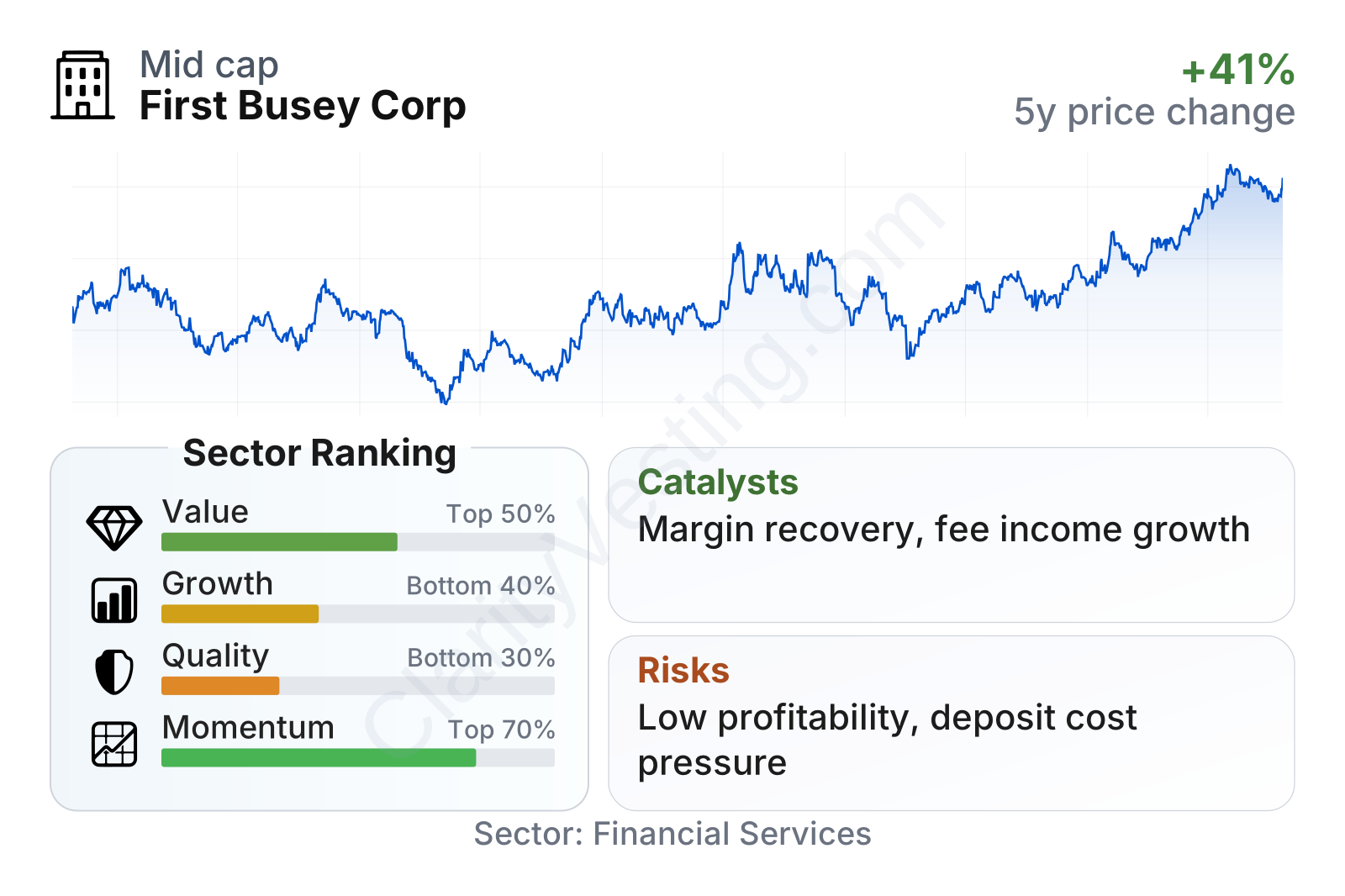
First Busey sits in the mid-cap range for a regional bank and has shown lower share-price volatility than the broader market, as reflected by a beta below 1. In the factor breakdown, valuation appears close to or slightly below the sector median on earnings and book value measures, while quality and growth rank weaker relative to peers. Momentum is more favorable, suggesting the market has recently given the shares more credit even though the underlying operating profile still looks mixed.
The recent stock-price trend has been constructive after a difficult period for regional banks in 2023. Even so, the longer view matters more here: the business has remained profitable, but returns and growth have not clearly separated it from the pack.
Growth
Regional banking is a mature sector, not a high-growth one, but it can still compound steadily when a bank expands relationships, gathers low-cost deposits, adds commercial clients, and grows fee income alongside lending. First Busey’s strategy broadly fits that model. It combines community banking with wealth management and has used acquisitions in the past to expand market presence and capabilities. That approach makes strategic sense because scale can improve efficiency and deepen customer ties, especially in commercial banking and treasury services.
At the sector level, the long-term demand backdrop is stable rather than explosive. Businesses and consumers continue to need credit, cash management, and advisory services, and local banks can remain relevant when they know their markets well. For First Busey, the more important question is not whether banking demand exists, but whether it can grow faster than funding costs and operating expenses.
The earnings trend shows that this has been uneven. Earnings per share declined from 2021 through 2024 before recovering in 2025, which suggests the company has been navigating a tougher margin environment rather than producing clean, uninterrupted expansion.
Book value per share has moved upward over the five-year span despite the pressure on profitability, which is an encouraging sign for a bank because book value is a key measure of balance-sheet strength and long-term value creation. The pace, however, has been modest compared with stronger regional-bank performers.
A meaningful catalyst is the possibility of improving net interest margin if funding pressures ease or if the company can reprice loans more effectively than deposits. Another one is continued growth in wealth management and fee-based businesses, which can reduce dependence on interest-rate swings. The recent improvement in share performance also suggests the market may be anticipating a more normal earnings environment after the sector’s stress period.
Recent public company updates also point to continued focus on relationship banking, balance-sheet management, and integration of business lines rather than a dramatic strategic pivot. That is usually positive for a community-oriented bank: execution and discipline matter more than grand transformation plans.
Risks
This article is for informational purposes only and does not constitute financial advice. Some content is AI-generated. See Disclaimer


