Stock Analysis · Anheuser-Busch InBev SA/NV (BUDFF)
Overview
Anheuser-Busch InBev SA/NV is one of the world’s largest beer producers. The company sells beer and other alcoholic drinks through a portfolio of global brands, international premium labels, and local favorites. Its best-known names include Budweiser, Corona, Stella Artois, Michelob ULTRA, Busch, Brahma, and many regional brands. The business operates across North America, Middle Americas, South America, EMEA, and Asia Pacific, with products sold through retailers, bars, restaurants, stadiums, and e-commerce channels.
Revenue mainly comes from selling beverages, but the business is diversified by geography and brand tier. Based on recent annual reporting, the mix can be approximated as follows:
- North America: about 29% of revenue. This includes the U.S. and Canada, with large exposure to Budweiser, Michelob ULTRA, Busch, and other mainstream and premium brands.
- Middle Americas: about 22% of revenue. This region includes Mexico, Colombia, Peru, Ecuador, and several Central American and Caribbean markets.
- South America: about 20% of revenue. Brazil is especially important here, alongside Argentina and other nearby markets.
- EMEA: about 17% of revenue. This covers Europe, the Middle East, and Africa, where Stella Artois and local brands are meaningful contributors.
- Asia Pacific: about 12% of revenue. This includes China, South Korea, India, and other Asian markets, with premiumization playing a major role.
Within that geographic structure, a major part of the company’s economic model comes from premium and super-premium beer, high-volume core brands, and pricing power. Beer still represents the overwhelming majority of sales, while smaller contributions come from beyond-beer categories, digital commerce initiatives, and packaging-related revenue streams.
The business profile is attractive for long-term analysis because beer tends to be a resilient category, brand loyalty can be strong, and scale matters. AB InBev’s global distribution network, purchasing power, and advertising reach are difficult to replicate.
The profit flow over the last several years points to a business that has been improving operating income and net income faster than revenue. Sales have moved up gradually, while gross profit and operating profit have shown a steadier expansion, suggesting better pricing, mix, and cost discipline. Interest expense remains meaningful, but it has become more manageable relative to earnings than it was a few years ago.
Key Figures
| Metric | Value | Sector ⓘ |
|---|---|---|
| Date | Nov 01, 2026 | |
| Context | ||
| Sector | Consumer Defensive | |
| Industry | Beverages - Brewers | |
| Market Cap ⓘ | $157.38B | |
| Beta ⓘ | 0.78 | |
Value (Cheapness) | ||
| P/E Ratio ⓘ | 16.24 | 18.64 |
| P/B Ratio ⓘ | 1.88 | 1.16 |
| FCF Yield ⓘ | 15.87% | 12.22% |
| Dividend Yield ⓘ | 2.04% | 2.71% |
| EBIT / EV ⓘ | 10.90% | 6.07% |
| PEG ⓘ | 1.66 | |
Growth (Business expansion) | ||
| Revenue Growth ⓘ | 9.10% | 4.10% |
| RPS Growth (5Y CAGR) ⓘ | 4.04% | 6.22% |
| EPS Growth (5Y CAGR) ⓘ | -3.95% | -13.87% |
| BVPS Growth (5Y CAGR) ⓘ | 3.63% | 3.26% |
| Margin Growth (5Y Trend) ⓘ | 3.02% | -0.17% |
| FCF Growth (5Y CAGR) ⓘ | 6.28% | 4.88% |
| DPS Growth (5Y CAGR) ⓘ | 19.82% | 6.57% |
Quality (Business durability) | ||
| ROIC (Latest) ⓘ | N/A | 11.83% |
| ROA (Latest) ⓘ | N/A | 6.19% |
| ROIC (5Y Median) ⓘ | 6.72% | 10.49% |
| ROA (5Y Median) ⓘ | 2.75% | 5.44% |
| Net Debt / EBIT (Latest) ⓘ | 2.72 | 1.93 |
| Net Debt / EBIT (5Y Median) ⓘ | 4.97 | 2.32 |
| Net Debt / EBITDA (Latest) ⓘ | 2.18 | 1.37 |
| Net Debt / Assets ⓘ | 29.61% | 20.45% |
| EBITDA / Interest ⓘ | 6.50 | 9.66 |
| Operating Margin (Latest) ⓘ | 25.85% | 8.88% |
| Operating Margin (5Y Median) ⓘ | 24.38% | 9.61% |
| Debt to Equity (Latest) ⓘ | 77.35% | 70.87% |
| Profit Margin (Latest) ⓘ | 15.42% | 5.40% |
| Free Cash Flow (Latest) ⓘ | $24.97B | |
Momentum (Price trend) | ||
| 3Y Return ⓘ | +53.26% | +21.77% |
| 12M Return (excl. last month) ⓘ | +30.13% | +2.49% |
| 6M Return ⓘ | +8.24% | +1.61% |
| Price vs. 200-Day MA ⓘ | +9.62% | +2.70% |
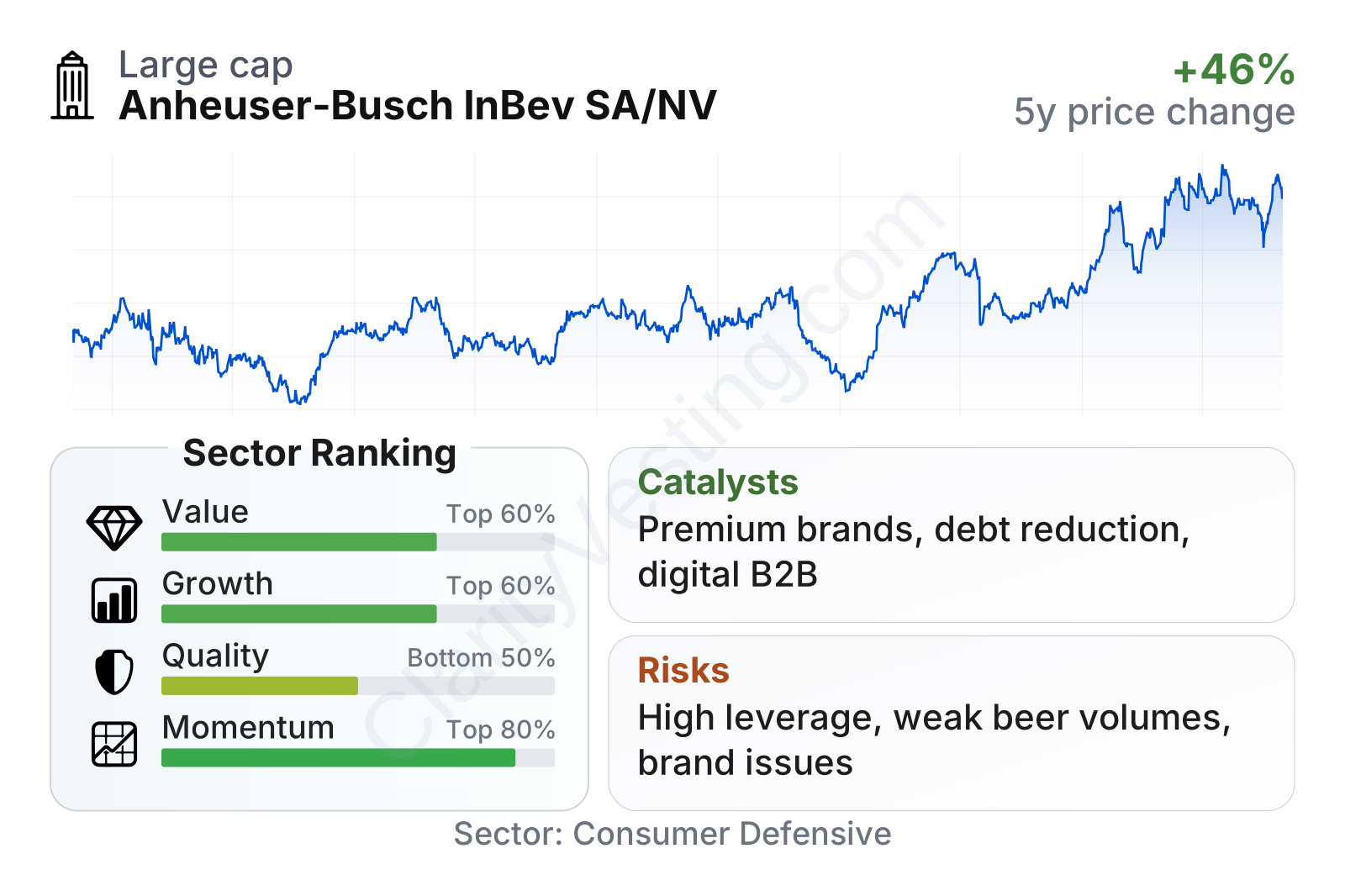
AB InBev is a very large consumer staples company with below-market share price volatility, which fits the profile of a mature global brand operator rather than a highly cyclical stock. On valuation, the business screens around the middle of its sector on earnings, but free cash flow generation stands out more favorably. Growth is respectable rather than exceptional, with revenue and cash flow trends better than much of the sector, while profitability is clearly stronger than average. The weaker area is balance-sheet quality, where leverage is still higher than many peers even after years of debt reduction.
The share price trend has been positive over the last three years, with stronger momentum than much of the consumer defensive group. That usually reflects a market that has become more confident in earnings durability, margin resilience, and deleveraging progress.
Growth
The beer industry is not a high-growth sector in the way software or semiconductors can be, but it is a large global category with durable demand, pricing power, and room for premiumization. In mature markets, volume growth is often modest, yet revenue can still rise through mix improvement and selective price increases. In emerging markets, rising incomes and urbanization can support additional demand over time. That makes the sector more of a steady compounder than a fast-expanding market.
AB InBev’s strategy for growth is built around a few logical priorities: expanding premium brands, improving revenue per hectoliter, using digital platforms to deepen retailer relationships, and growing in underpenetrated markets. This approach makes sense for a company of its size. It is harder for a market leader to deliver dramatic volume expansion, so the more realistic path is to increase value per unit sold, strengthen brand equity, and improve execution across distribution and marketing.
Recent revenue growth has been uneven but generally positive, with annual gains that have outpaced the broader sector median in the latest comparison. Over a longer stretch, the growth profile looks moderate rather than rapid, which is consistent with a dominant brewer operating at global scale. A more encouraging sign is that margin trends and free cash flow growth have improved along with revenue, meaning growth has not depended only on volume.
One important catalyst is premiumization. Brands such as Corona, Stella Artois, and Michelob ULTRA give the company exposure to consumers willing to spend more for brand image, lifestyle positioning, or product differentiation. Another catalyst is digital commerce and business-to-business platforms, which can improve order frequency, route efficiency, and customer retention while also generating better data on consumer behavior.
Recent company communications have also highlighted ongoing debt reduction and continued focus on cash generation. That matters because as leverage declines, more of the operating improvement can translate into equity value rather than being absorbed by financing costs. In addition, continued development of alcohol-free and adjacent products could offer incremental growth, even if these categories remain smaller than traditional beer.
Risks
This article is for informational purposes only and does not constitute financial advice. Some content is AI-generated. See Disclaimer


