Stock Analysis · Anheuser Busch Inbev NV (BUD)
Overview
Anheuser-Busch InBev is one of the world’s largest brewing companies. It sells beer, flavored alcoholic beverages, and some non-beer drinks through a portfolio that includes global brands such as Budweiser, Corona, Stella Artois, and Michelob Ultra, along with many local and regional labels. The company operates across North America, Middle Americas, South America, Europe, the Middle East and Africa, and Asia Pacific, giving it unusually broad geographic exposure for a consumer staples business.
Its revenue mainly comes from selling packaged beverages to retailers, wholesalers, bars, restaurants, and other on-premise channels. Public filings show that beer remains the core of the business, while premium brands, digital sales tools for retailers, and expansion in faster-growing markets are important supporting drivers.
Based on the company’s reporting structure, the main sources of revenue can be summarized as follows:
- Beer and beer-based brands: approximately 90%+ of revenue. This includes global brands, local mainstream beers, and premium and super-premium offerings sold across all major regions.
- Other beverage categories: approximately less than 10%. This includes beyond-beer products such as ready-to-drink beverages, flavored malt beverages, and selected non-alcoholic offerings where the company participates.
- By geography, not product: the business is diversified across regions rather than dependent on one country alone, with major contributions from North America, Middle Americas, South America, and EMEA, while Asia Pacific remains strategically important for premiumization and long-term volume growth.
The business model is attractive in a simple way: AB InBev owns brands that consumers already know, distributes them at massive scale, and uses pricing, marketing, and operating efficiency to turn that scale into cash flow. Over the last several years, revenue has been relatively stable around the high tens of billions of dollars, while operating income and net income have improved, helped by better margins and lower interest expense.
The financial flow shows a business with steady sales, improving gross profit, and a clearer conversion of revenue into earnings than a few years ago. Interest expense has also moved down from earlier peaks, which matters because debt reduction has been a major part of the company’s investment case for years.
Key Figures
| Metric | Value | Sector ⓘ |
|---|---|---|
| Date | Oct 17, 2026 | |
| Context | ||
| Sector | Consumer Defensive | |
| Industry | Beverages - Brewers | |
| Market Cap ⓘ | $154.16B | |
| Beta ⓘ | 0.78 | |
Value (Cheapness) | ||
| P/E Ratio ⓘ | 16.87 | 17.88 |
| P/B Ratio ⓘ | 1.81 | 1.29 |
| FCF Yield ⓘ | 16.46% | 12.39% |
| Dividend Yield ⓘ | 1.72% | 2.85% |
| EBIT / EV ⓘ | 12.28% | 6.43% |
| PEG ⓘ | 1.58 | |
Growth (Business expansion) | ||
| Revenue Growth ⓘ | 11.00% | 4.10% |
| RPS Growth (5Y CAGR) ⓘ | 3.01% | 6.18% |
| EPS Growth (5Y CAGR) ⓘ | -9.81% | -13.59% |
| BVPS Growth (5Y CAGR) ⓘ | 3.63% | 3.20% |
| Margin Growth (5Y Trend) ⓘ | 2.16% | -0.15% |
| FCF Growth (5Y CAGR) ⓘ | 5.30% | 4.10% |
| DPS Growth (5Y CAGR) ⓘ | 18.73% | 6.79% |
Quality (Business durability) | ||
| ROIC (Latest) ⓘ | N/A | 12.34% |
| ROA (Latest) ⓘ | N/A | 6.30% |
| ROIC (5Y Median) ⓘ | 6.72% | 10.49% |
| ROA (5Y Median) ⓘ | 2.75% | 5.44% |
| Net Debt / EBIT (Latest) ⓘ | 2.44 | 1.96 |
| Net Debt / EBIT (5Y Median) ⓘ | 4.97 | 2.35 |
| Net Debt / EBITDA (Latest) ⓘ | 2.00 | 1.38 |
| Net Debt / Assets ⓘ | 29.66% | 21.51% |
| EBITDA / Interest ⓘ | 5.03 | 9.46 |
| Operating Margin (Latest) ⓘ | 28.60% | 8.87% |
| Operating Margin (5Y Median) ⓘ | 24.06% | 9.53% |
| Debt to Equity (Latest) ⓘ | 77.34% | 72.35% |
| Profit Margin (Latest) ⓘ | 14.90% | 5.40% |
| Free Cash Flow (Latest) ⓘ | $25.38B | |
Momentum (Price trend) | ||
| 3Y Return ⓘ | +53.01% | +20.92% |
| 12M Return (excl. last month) ⓘ | +36.31% | +2.13% |
| 6M Return ⓘ | +5.47% | +1.26% |
| Price vs. 200-Day MA ⓘ | +3.16% | +1.39% |
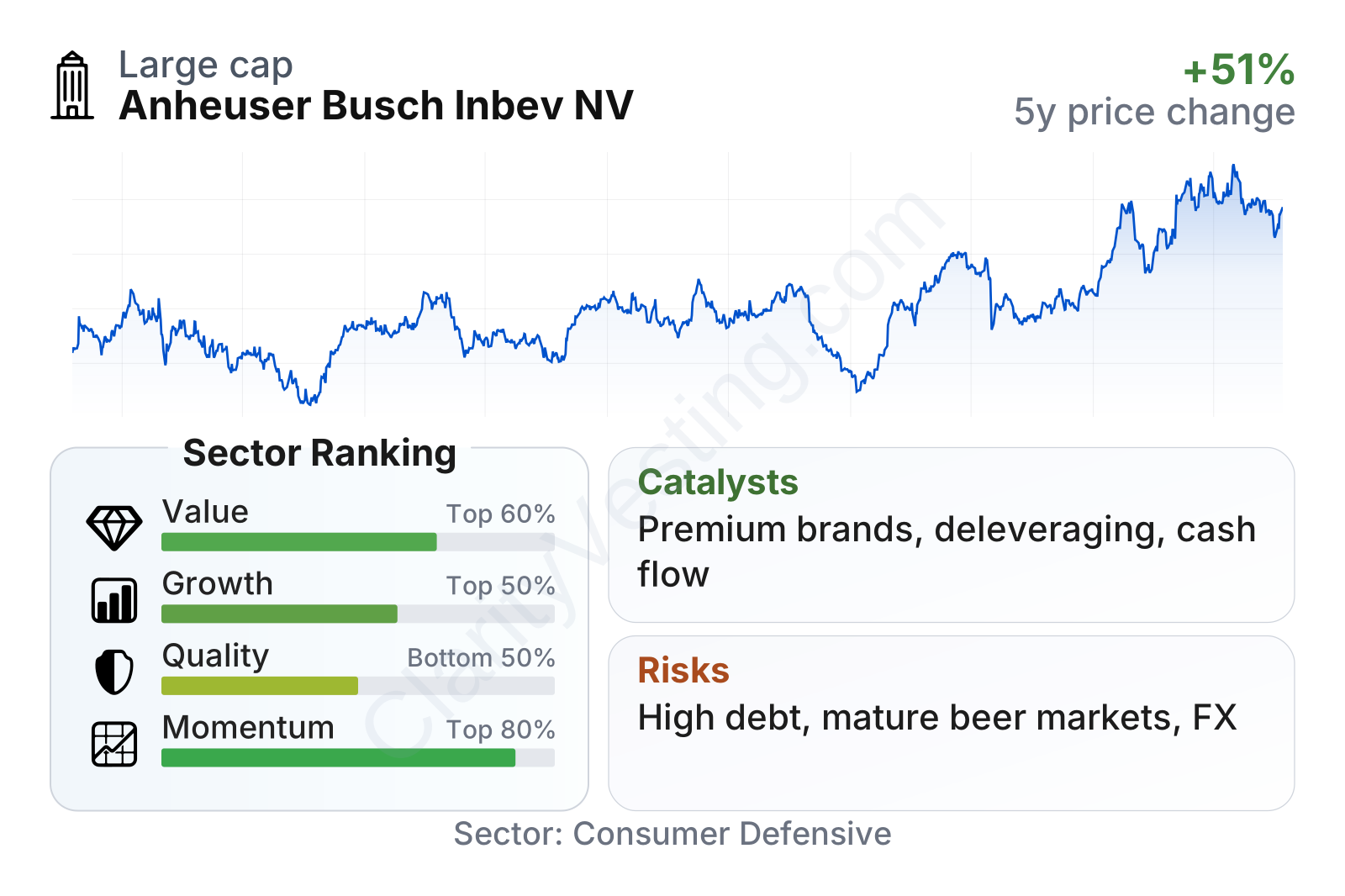
AB InBev is a very large consumer defensive company with relatively low share-price volatility, reflected in a beta below 1. In the factor breakdown, value and growth sit around the better half of the sector, momentum is stronger than average, while quality looks weaker mainly because leverage still weighs on return metrics. Profitability itself is not the problem: margins and free cash flow compare well with many peers, but balance-sheet efficiency remains the main drag.
Growth
The beer industry is not a classic high-growth sector, but it is also not disappearing. For long-term analysis, the more important question is whether a brewer can raise revenue faster than volumes alone would suggest. AB InBev’s strategy is built around premiumization, brand mix, disciplined pricing, and expansion in markets where beer consumption and income growth still have room to rise. That is a sensible approach for a mature consumer category.
The company also has useful growth levers beyond simply selling more cases. Management has emphasized premium brands, no-alcohol and low-alcohol options, digital platforms for retailers and distributors, and stronger execution in emerging markets. These initiatives matter because they can improve revenue per hectoliter and margins even if total industry volumes remain modest.
Revenue growth has not been perfectly smooth, but the broader pattern suggests a business that can still produce periods of above-sector expansion. The latest year-over-year growth level is ahead of the sector median, even though some quarterly moves were distorted by comparability effects. That makes the recent trend more encouraging than a quick glance at older quarterly volatility might imply.
Cash generation is one of the strongest parts of the company’s profile. Free cash flow is large in absolute terms and its multi-year trend has generally improved. That gives AB InBev flexibility to reduce debt, support dividends, invest in marketing, and continue building its digital and premium portfolio. For a mature staples company, that kind of cash production is often more important than headline volume growth.
A meaningful catalyst in recent years has been the continued cleanup of the balance sheet after the heavy debt burden created by prior acquisitions. As financing costs moderate and leverage gradually declines, more of the operating improvement can reach equity holders. Another catalyst is the company’s premium brand portfolio, especially where international brands can take share in markets that are still underpenetrated in higher-priced beer segments.
Recent company updates have also pointed to continued brand investment, ongoing premiumization, and commercial execution in key markets. None of these alone transforms the company, but together they support a practical long-term growth path: modest sales growth, stronger mix, firmer margins, and rising cash conversion.
Risks
This article is for informational purposes only and does not constitute financial advice. Some content is AI-generated. See Disclaimer


