Stock Analysis · Blackrock Municipal Target Term Closed Fund (BTT)
Overview
BlackRock Municipal Target Term Trust is a closed-end fund managed by BlackRock. Rather than operating like a traditional company that sells products or services, it owns a portfolio of municipal bonds and seeks to provide current income that is generally exempt from regular U.S. federal income tax, while also returning capital around its target term structure. Its assets are primarily invested in long-term municipal obligations issued by states, cities, local authorities, and other public-sector borrowers.
The fund’s economic engine is different from that of an operating business. Its results come mainly from the income and market value behavior of the bond portfolio, offset by financing and operating costs. Based on the structure of municipal bond closed-end funds and the fund’s recent reports, the main sources influencing revenue and earnings are the following:
- Interest income from municipal bonds: the dominant source of recurring investment income, generated by coupons paid on the fund’s holdings.
- Net realized and unrealized gains or losses: changes in the market value of the bond portfolio and gains or losses when securities are sold. This can be a major driver of yearly results and can make reported income volatile.
- Other investment-related income: a much smaller category that can include short-term holdings or ancillary investment income when applicable.
On the cost side, the largest drags are typically borrowing costs tied to leverage, management fees, and other operating expenses. Recent results show a sharp swing from losses in the difficult rate environment of 2022 and 2023 to positive net income in 2024 and 2025, which is consistent with improving bond valuations and still-meaningful tax-exempt income generation.
Because this is a municipal bond fund, its portfolio mix matters more than conventional product segments. The trust’s filings show diversification across many municipal issuers and sectors rather than dependence on one customer or one business line. That diversification can reduce issuer-specific risk, but performance still depends heavily on interest rates, credit conditions, and the municipal bond market.
The financial flow has become much healthier over the last two fiscal years. After deep accounting losses during the rate shock period, the trust moved back to positive revenue and net income, while interest expense remained a meaningful but manageable headwind because of leverage.
Key Figures
| Metric | Value | Sector ⓘ |
|---|---|---|
| Date | Oct 24, 2026 | |
| Context | ||
| Sector | Financial Services | |
| Industry | Asset Management | |
| Market Cap ⓘ | $1.40B | |
| Beta ⓘ | 0.46 | |
Value (Cheapness) | ||
| P/E Ratio ⓘ | 28.96 | 12.46 |
| P/B Ratio ⓘ | 0.90 | 1.25 |
| FCF Yield ⓘ | 8.88% | 9.82% |
| Dividend Yield ⓘ | 2.53% | 2.94% |
| EBIT / EV ⓘ | N/A | 8.11% |
| PEG ⓘ | N/A | |
Growth (Business expansion) | ||
| Revenue Growth ⓘ | 1.80% | 9.10% |
| RPS Growth (5Y CAGR) ⓘ | -7.56% | 12.31% |
| EPS Growth (5Y CAGR) ⓘ | N/A | -6.97% |
| BVPS Growth (5Y CAGR) ⓘ | 0.17% | 5.02% |
| Margin Growth (5Y Trend) ⓘ | 92.28% | -4.00% |
| FCF Growth (5Y CAGR) ⓘ | -0.36% | 4.71% |
| DPS Growth (5Y CAGR) ⓘ | -8.97% | 8.92% |
Quality (Business durability) | ||
| ROIC (Latest) ⓘ | N/A | 9.18% |
| ROE (Latest) ⓘ | 6.54% | 13.93% |
| ROA (Latest) ⓘ | 4.26% | 1.57% |
| ROIC (5Y Median) ⓘ | N/A | 7.80% |
| ROE (5Y Median) ⓘ | 2.31% | 12.15% |
| ROA (5Y Median) ⓘ | 1.91% | 1.28% |
| Net Debt / EBIT (Latest) ⓘ | N/A | 1.02 |
| Net Debt / EBIT (5Y Median) ⓘ | N/A | 0.72 |
| Net Debt / EBITDA (Latest) ⓘ | 5.84 | 0.88 |
| Operating Margin (Latest) ⓘ | N/A | 22.30% |
| Operating Margin (5Y Median) ⓘ | 186.92% | 24.50% |
| Debt to Equity (Latest) ⓘ | 53.57% | 59.34% |
| Profit Margin (Latest) ⓘ | 57.38% | 26.42% |
| Free Cash Flow (Latest) ⓘ | $124.37M | |
Momentum (Price trend) | ||
| 3Y Return ⓘ | +23.26% | +95.73% |
| 12M Return (excl. last month) ⓘ | +1.05% | +17.30% |
| 6M Return ⓘ | -2.86% | +6.07% |
| Price vs. 200-Day MA ⓘ | -1.42% | +5.36% |
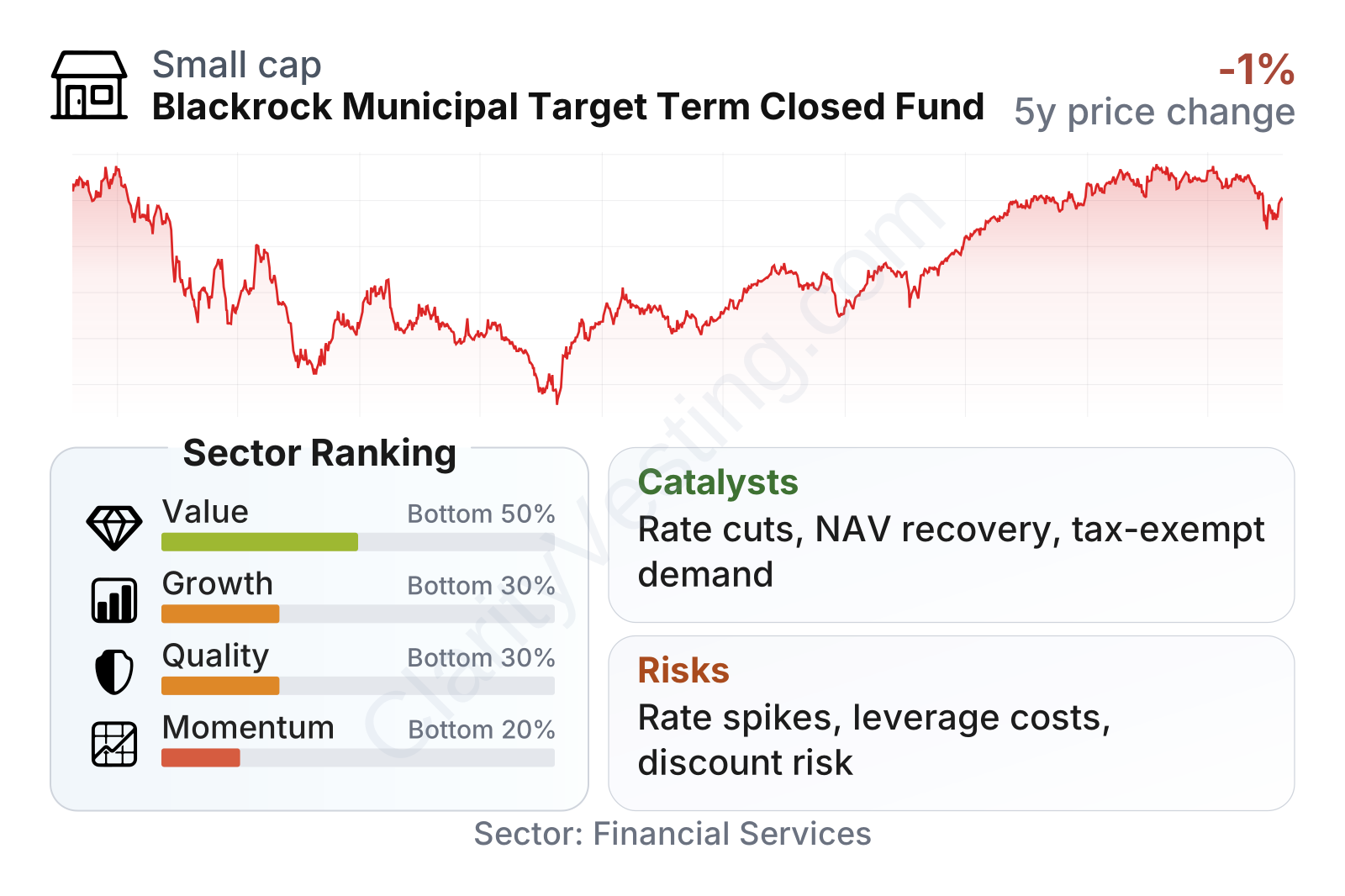
BTT is a mid-sized closed-end fund with a relatively low beta of 0.46, which fits the profile of an income-oriented bond vehicle rather than a high-volatility equity security. The factor profile is mixed: value metrics look acceptable, helped by a price-to-book ratio below the sector median, but growth and momentum rank weakly. Profitability measures can appear unusual for funds because accounting earnings often swing with portfolio marks, so book value stability, leverage, and distribution coverage are usually more important than a simple earnings snapshot.
The share price has broadly recovered from the 2022 rate-driven drawdown and is now near the upper end of its multi-year range. That suggests sentiment has improved, but it also means the easy rebound phase may be less relevant than before. The table also points to moderate leverage, with debt-to-equity near 53%, yet leverage relative to EBITDA is high, which underlines the sensitivity of closed-end funds to financing costs and market moves.
Growth
BTT is tied to the municipal bond market, a mature sector rather than a high-growth one. That said, long-term demand for tax-exempt income has structural support from high-income households, advisors building income portfolios, and investors seeking diversification away from equities. Municipal financing also remains essential for public infrastructure, transportation, utilities, schools, and hospitals, which supports a steady supply of bonds.
For a fund like BTT, “growth” is less about expanding sales and more about preserving net asset value, generating tax-exempt income, and narrowing any discount between market price and portfolio value. The strategy can make sense in a period where policy rates eventually stabilize or decline, because falling yields typically support bond prices. That backdrop can improve both net asset value and the market’s willingness to value municipal bond funds more favorably.
The earnings picture has improved materially from the stressed period in 2022. Even though EPS is not the best standalone tool for judging a bond fund, the direction matters: large losses have narrowed significantly, showing that the portfolio has moved out of the worst phase of rate pressure.
Book value per share has been volatile rather than steadily compounding, which is normal for interest-rate-sensitive funds but still important for long-term analysis. The latest level appears to have stabilized after a sharp drop and rebound cycle, indicating that underlying portfolio value has become more resilient as the rate environment settled.
A practical catalyst is the path of U.S. interest rates. If borrowing costs ease and long-term municipal yields decline, leveraged municipal funds can see a double benefit: lower financing expense and higher bond prices. In addition, municipal credit fundamentals have generally remained supported by tax collections, essential-service revenue streams, and historically low default rates compared with many other fixed-income segments. BlackRock’s scale, credit research platform, and trading reach also give the fund access to broad municipal market coverage that smaller managers may find harder to match.
Recent corporate developments around BlackRock’s closed-end fund platform have also focused on distribution policies, portfolio management oversight, and shareholder updates rather than business disruption. There is no obvious company-specific expansion catalyst here; the bigger opportunity is macro-driven: more favorable rate conditions and continued demand for federally tax-exempt income.
Risks
This article is for informational purposes only and does not constitute financial advice. Some content is AI-generated. See Disclaimer


