Stock Analysis · British Land Company (BTLCY)
Overview
British Land Company is one of the largest listed real estate owners and developers in the United Kingdom. It focuses mainly on high-quality properties in London and other major UK locations, with a portfolio centered on campuses, retail parks, shopping centers, and mixed-use developments. In simple terms, the company makes money by owning places where businesses operate, consumers shop, and communities live, then collecting rent, improving those assets, and in some cases creating value through redevelopment and selective property sales.
Its business model is built around recurring rental income, but the economics of a real estate company are broader than a typical operating business. Reported profit can move sharply from year to year because property valuations rise and fall, financing costs change, and development projects are recognized over long timeframes.
The main revenue sources are broadly the following:
- Rental income from commercial properties: the core source of cash generation. This includes office campuses and other workspace assets, especially in London, along with retail destinations and retail parks across the UK.
- Retail portfolio income: a significant share of rent comes from retail parks and shopping assets, where tenants include grocery, value, and omnichannel retailers.
- Campus and office income: another major stream, tied to office leasing, campus-style developments, and mixed-use urban locations that aim to attract large employers.
- Development and repositioning gains: the company can create additional value by upgrading sites, completing developments, and improving occupancy or rental terms.
- Property disposals and valuation movements: these are not stable operating revenue in the usual sense, but they can materially affect reported earnings in any given year.
Based on the latest annual reporting structure, British Land is increasingly oriented toward two main operating pillars: campus and urban logistics-linked or retail park-style assets, while reducing exposure to weaker parts of traditional retail. Exact percentages can vary year by year depending on disposals, developments, and valuation changes, so the most useful takeaway for long-term readers is that recurring rent remains the backbone of the business, with portfolio recycling acting as an important secondary value driver.
The recent income profile also shows how variable accounting results can be. Revenue has moved within a fairly narrow range over the last several years, while net income has swung from large losses to solid profits as property values and operating income changed. That pattern is common in listed property groups and makes cash generation, occupancy, and balance-sheet discipline more important than headline profit alone.
The recent flow of income points to a business that has regained stronger profitability after a difficult period. Gross profit has remained substantial, administrative costs have been relatively controlled, and the latest year shows a clearer recovery in operating and net profit, even though interest expense has continued to rise.
Key Figures
| Metric | Value | Sector ⓘ |
|---|---|---|
| Date | Nov 21, 2026 | |
| Context | ||
| Sector | Real Estate | |
| Industry | REIT - Diversified | |
| Market Cap ⓘ | $5.87B | |
| Beta ⓘ | 1.21 | |
Value (Cheapness) | ||
| P/E Ratio ⓘ | 8.55 | 17.59 |
| P/B Ratio ⓘ | N/A | 1.58 |
| FCF Yield ⓘ | 10.17% | 5.76% |
| Dividend Yield ⓘ | 5.33% | 4.81% |
| EBIT / EV ⓘ | N/A | 4.97% |
| PEG ⓘ | 6.87 | |
Growth (Business expansion) | ||
| Revenue Growth ⓘ | 16.90% | 5.70% |
| RPS Growth (5Y CAGR) ⓘ | -3.15% | 5.96% |
| EPS Growth (5Y CAGR) ⓘ | -74.52% | -3.46% |
| BVPS Growth (5Y CAGR) ⓘ | -11.29% | 0.32% |
| Margin Growth (5Y Trend) ⓘ | 50.09% | -0.65% |
| FCF Growth (5Y CAGR) ⓘ | N/A | 5.08% |
| DPS Growth (5Y CAGR) ⓘ | 8.21% | 5.00% |
Quality (Business durability) | ||
| ROIC (Latest) ⓘ | N/A | 5.13% |
| ROE (Latest) ⓘ | 14.14% | 7.64% |
| ROA (Latest) ⓘ | 9.01% | 3.05% |
| ROIC (5Y Median) ⓘ | 3.65% | 4.20% |
| ROE (5Y Median) ⓘ | 6.15% | 6.03% |
| ROA (5Y Median) ⓘ | 4.01% | 2.41% |
| Net Debt / EBIT (Latest) ⓘ | N/A | 7.59 |
| Net Debt / EBIT (5Y Median) ⓘ | 8.47 | 8.34 |
| Net Debt / EBITDA (Latest) ⓘ | 3.84 | 5.43 |
| Net Debt / Assets ⓘ | 30.81% | 38.21% |
| EBITDA / Interest ⓘ | 3.34 | 4.20 |
| Operating Margin (Latest) ⓘ | N/A | 34.59% |
| Operating Margin (5Y Median) ⓘ | 57.12% | 37.64% |
| Debt to Equity (Latest) ⓘ | 52.34% | 90.32% |
| Profit Margin (Latest) ⓘ | 76.35% | 20.10% |
| Free Cash Flow (Latest) ⓘ | $597.69M | |
Momentum (Price trend) | ||
| 3Y Return ⓘ | +50.56% | +27.88% |
| 12M Return (excl. last month) ⓘ | +20.12% | +1.16% |
| 6M Return ⓘ | +12.67% | -3.06% |
| Price vs. 200-Day MA ⓘ | +6.33% | -0.73% |
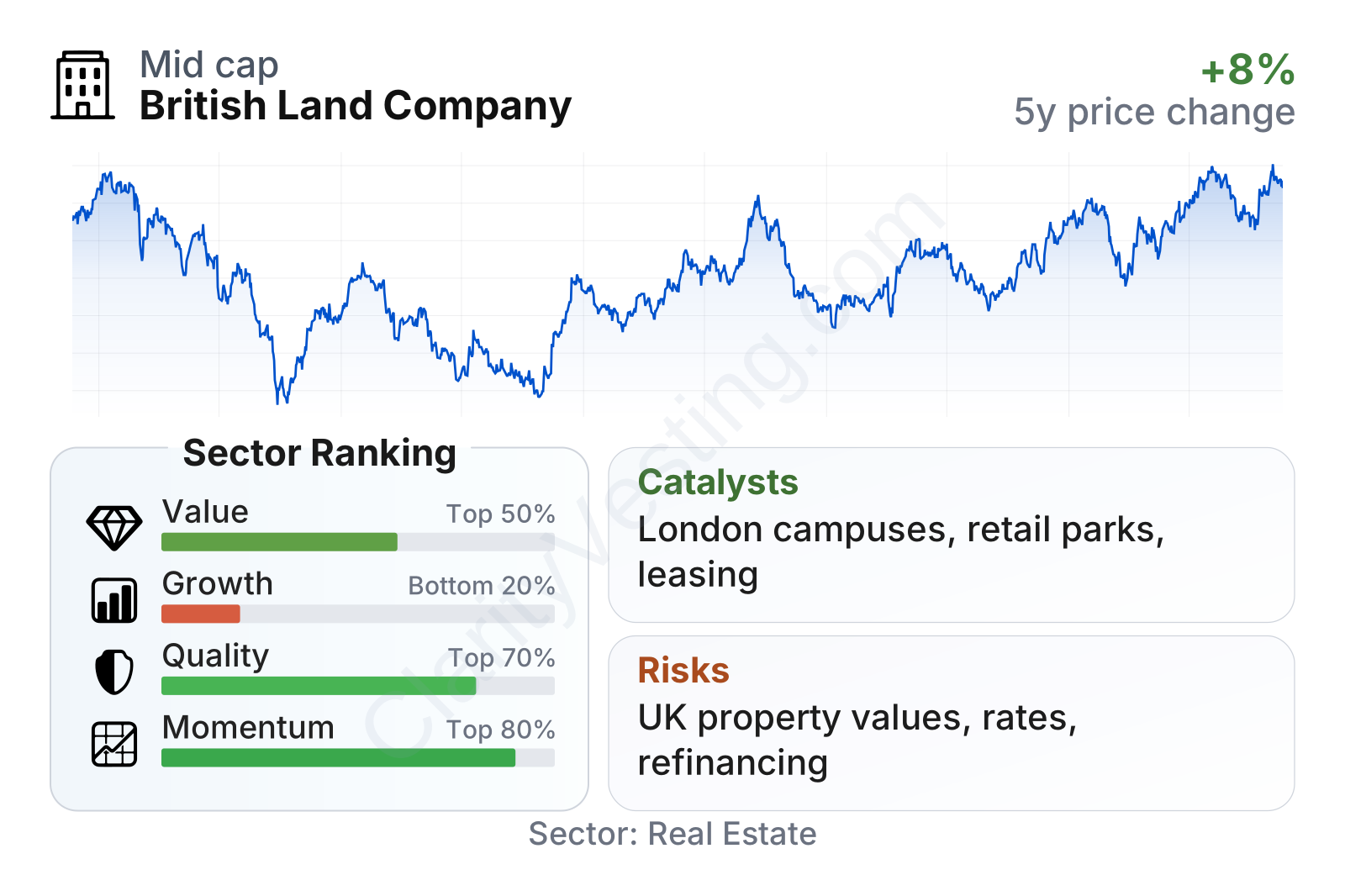
British Land sits in the large-cap range for its niche and has a stock that tends to move somewhat more than the broader market, with beta a little above 1. On valuation, it screens cheaper than many real estate peers on earnings and offers a free-cash-flow yield around 10% and a dividend yield a little above 5%, both stronger than sector medians. Quality indicators are mixed but broadly respectable: return on equity and return on assets are above sector norms, leverage against assets is lower than average, and net debt to EBITDA is below the sector median. The weaker area is growth. Recent year-over-year revenue growth has been positive, but the longer five-year record for revenue per share, earnings per share, and book value per share has been weak, which explains why the growth factor ranks near the bottom of the sector despite healthier momentum in the stock price.
The share price history reflects that pattern. After a sharp decline through 2022 and into 2023, the stock has recovered meaningfully and is now above the levels seen a year earlier. That rebound suggests the market has become more constructive on UK commercial real estate, but it also means some of the easy recovery from depressed sentiment has already happened.
Growth
British Land operates in a sector that is not a high-growth industry in the usual sense, but parts of it are benefiting from structural change. The most attractive themes today are modern London campuses, retail parks that serve omnichannel retailers, and urban logistics or fulfillment-linked space. These segments are more resilient than older commodity office space or weaker traditional shopping centers because tenants increasingly want high-quality locations, energy-efficient buildings, and sites that support both physical and online retail activity.
The company’s strategy broadly matches those themes. Over recent years, it has been recycling capital away from lower-conviction assets and toward campuses, retail parks, and development opportunities where management sees stronger tenant demand and better long-term returns. That makes strategic sense because it aligns the portfolio with areas of the UK property market that have held up better in occupancy and rental growth.
Revenue per share has been uneven rather than consistently rising. There was a drop after 2022, some recovery in 2024, another dip in 2025, and a partial rebound in 2026. That is not the profile of a smooth compounder, but it does show that the business has stabilized after a tougher stretch. For a real estate owner, the more important question is whether rents, occupancy, and asset quality are moving in the right direction, because those are the foundations for longer-term revenue growth.
The dividend trend is steadier than the revenue trend. After a step up from 2022 to 2023, the annual dividend per share has remained broadly stable around the 2023-2026 period. That suggests management sees cash generation as strong enough to support a meaningful payout, even while navigating higher interest costs and ongoing portfolio changes.
A key catalyst is development optionality. British Land owns and manages assets in locations where redevelopment can materially improve rental income and asset values over time. Another support is the possibility of better property valuations if financing conditions ease and UK real estate investment markets continue recovering. In addition, demand for well-located, high-specification space in London and for retail parks with strong tenant economics could provide further rental uplift.
Recent company updates have also pointed to continued leasing activity, active asset management, and ongoing capital recycling. None of these are dramatic one-off events, but together they support the idea that British Land is trying to turn a cyclical recovery into a more durable improvement in portfolio quality.
Risks
This article is for informational purposes only and does not constitute financial advice. Some content is AI-generated. See Disclaimer


