Stock Analysis · B2Gold Corp (BTG)
Overview
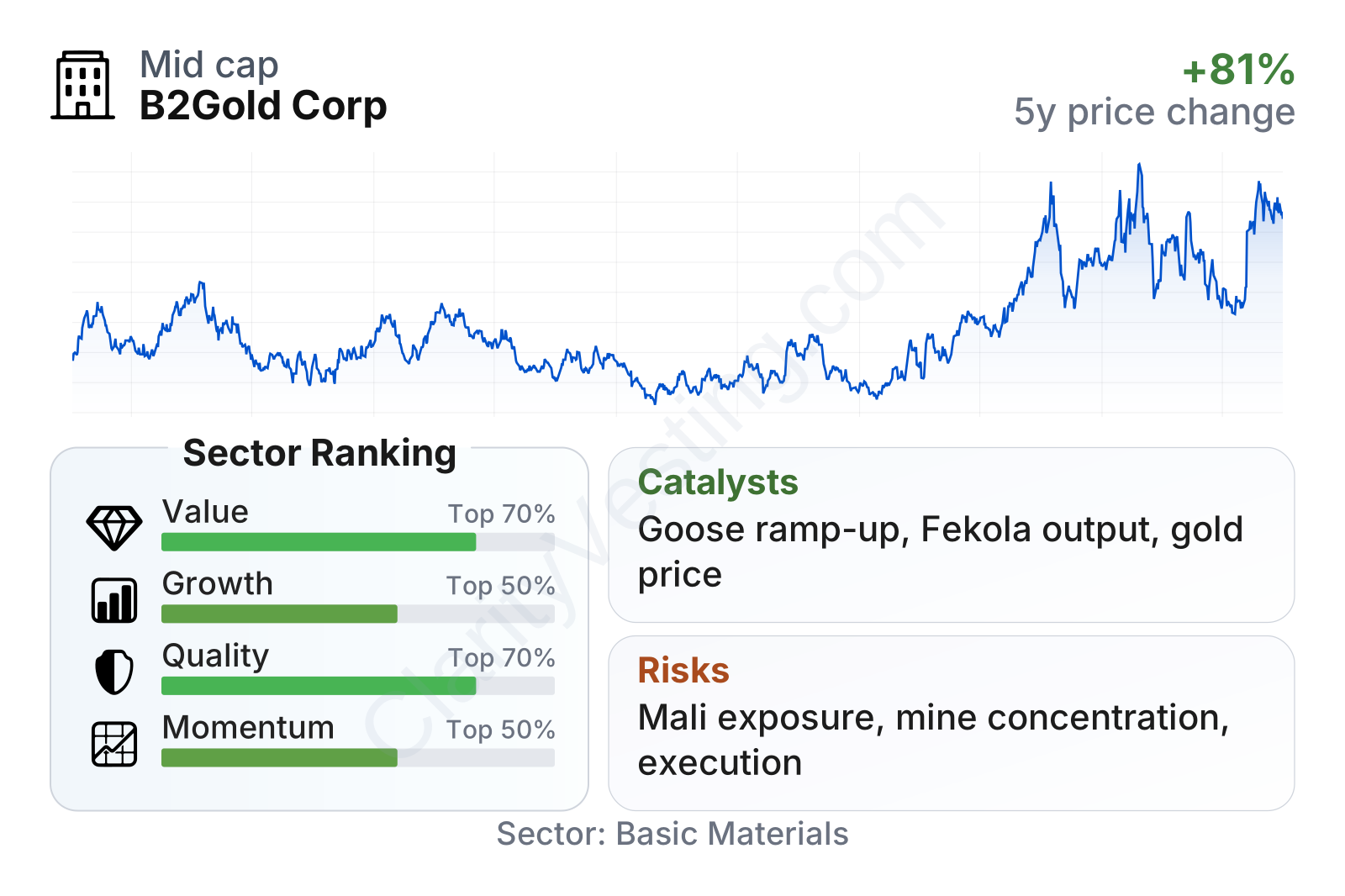
B2Gold Corp is a gold mining company. It explores for gold, develops mines, and then produces and sells gold from those operations. The group’s main producing assets are in Mali, the Philippines, and Namibia, and it is also advancing new development projects, most notably the Goose Project in Canada. In simple terms, B2Gold earns money by taking gold out of the ground and selling it into the global market, where revenue is heavily influenced by how much gold it produces and the gold price at the time of sale.
The business is relatively straightforward, but the source of revenue is concentrated. Based on recent company reporting, the large majority of sales comes from gold. A small additional contribution can come from silver and other by-product metals sold alongside gold production, depending on the mine.
- Gold sales: approximately 95% to 99% of revenue. This is the core business and includes production from operating mines such as Fekola, Masbate, and Otjikoto.
- Silver and other by-product revenue: approximately 1% to 5% of revenue. This includes smaller volumes recovered during mining and processing.
Geographically, revenue is tied to a few key mines rather than a broad spread of businesses. That concentration is important for long-term analysis: if one major mine performs well, results can improve quickly, but disruptions at one site can also materially affect the group.
The financial flow over the last several years shows a business that remained capable of generating strong gross profit from its mining operations, but with earnings volatility caused by non-cash charges, taxes, and mine-related project spending. Revenue expanded sharply in 2025 after a weaker 2024 period, which fits the profile of a miner moving through a heavy investment phase and then recovering.
Key Figures
| Metric | Value | Sector ⓘ |
|---|---|---|
| Date | Oct 03, 2026 | |
| Context | ||
| Sector | Basic Materials | |
| Industry | Gold | |
| Market Cap ⓘ | $7.05B | |
| Beta ⓘ | 1.46 | |
Value (Cheapness) | ||
| P/E Ratio ⓘ | 9.37 | 17.61 |
| P/B Ratio ⓘ | 1.98 | 1.77 |
| FCF Yield ⓘ | 2.40% | 5.87% |
| Dividend Yield ⓘ | 1.52% | 2.06% |
| EBIT / EV ⓘ | 18.15% | 6.43% |
| PEG ⓘ | 4.71 | |
Growth (Business expansion) | ||
| Revenue Growth ⓘ | 14.00% | 11.30% |
| RPS Growth (5Y CAGR) ⓘ | 5.64% | 4.46% |
| EPS Growth (5Y CAGR) ⓘ | -2.29% | -13.11% |
| BVPS Growth (5Y CAGR) ⓘ | -2.92% | 5.51% |
| Margin Growth (5Y Trend) ⓘ | -8.74% | -1.57% |
| FCF Growth (5Y CAGR) ⓘ | -37.02% | 0.55% |
| DPS Growth (5Y CAGR) ⓘ | -18.18% | 6.02% |
Quality (Business durability) | ||
| ROIC (Latest) ⓘ | 14.68% | 9.31% |
| ROA (Latest) ⓘ | 13.89% | 4.94% |
| ROIC (5Y Median) ⓘ | 9.83% | 7.91% |
| ROA (5Y Median) ⓘ | 6.99% | 3.93% |
| Net Debt / EBIT (Latest) ⓘ | 0.12 | 1.40 |
| Net Debt / EBIT (5Y Median) ⓘ | -0.58 | 1.70 |
| Net Debt / EBITDA (Latest) ⓘ | 0.09 | 0.91 |
| Net Debt / Assets ⓘ | 2.95% | 13.69% |
| EBITDA / Interest ⓘ | 31.48 | 11.93 |
| Operating Margin (Latest) ⓘ | 36.58% | 13.07% |
| Operating Margin (5Y Median) ⓘ | 31.25% | 11.86% |
| Debt to Equity (Latest) ⓘ | 11.48% | 40.43% |
| Profit Margin (Latest) ⓘ | 21.33% | 6.57% |
| Free Cash Flow (Latest) ⓘ | $169.52M | |
Momentum (Price trend) | ||
| 3Y Return ⓘ | +100.72% | +65.06% |
| 12M Return (excl. last month) ⓘ | +35.07% | +36.05% |
| 6M Return ⓘ | +16.23% | +1.89% |
| Price vs. 200-Day MA ⓘ | +10.12% | +1.03% |
B2Gold is a mid-to-large gold producer by public market size. The table points to a mixed but interesting profile: valuation measures are not stretched on earnings, operating quality is clearly above much of the sector, and balance sheet pressure appears limited. Growth indicators are more uneven because recent years included project spending, operational swings, and a major downturn in reported profitability before a rebound. Price behavior has also been stronger than much of the sector over the medium term, although the stock has remained volatile, which is normal for gold miners.
Growth
Gold mining is part of a mature industry, but the sector can still grow when companies add reserves, build new mines, improve recovery rates, or benefit from stronger gold prices. B2Gold operates in a part of the market that remains strategically relevant because gold often attracts demand during periods of inflation, geopolitical tension, central bank accumulation, or lower confidence in paper currencies. That does not make the industry a steady compounding sector like software or healthcare, but it can create strong earnings windows for efficient producers.
B2Gold’s long-term growth strategy makes sense in mining terms. The company has built its model around a small number of operating mines that fund development of new assets. The biggest current growth driver is the Goose Project in Nunavut, Canada. This matters because it could add production from a mining-friendly jurisdiction and reduce some of the company’s exposure to higher-risk operating regions over time. For a miner, adding a new producing asset is one of the clearest ways to extend corporate life and support future output.
Revenue growth has been volatile, which is common in this industry, but the broader trend shows the business can ramp quickly when production and pricing line up. The most recent yearly growth pace remains positive and above the sector median, even after a very strong surge in late 2025 that creates a tougher comparison base. That pattern suggests momentum is still present, but future growth is unlikely to be smooth quarter to quarter.
Cash generation tells a similar story. Free cash flow moved from healthy positive levels to a negative period during heavier investment, then recovered strongly. For long-term analysis, that rebound is important because miners ultimately need cash, not just accounting earnings, to fund new projects, maintain dividends, and preserve balance sheet flexibility. B2Gold’s current free cash flow is positive again, but it still needs to show that this can be sustained once development spending and mine ramp-ups settle into a more normal pattern.
Another potential catalyst is reserve replacement and project advancement beyond Goose. In mining, future value depends on how well a company can replace what it extracts. B2Gold has continued to invest in exploration around existing assets and in development-stage projects. If these programs convert into longer mine lives or higher production plans, that could materially improve the company’s long-term production outlook.
Risks
This article is for informational purposes only and does not constitute financial advice. Some content is AI-generated. See Disclaimer