Stock Analysis · Boston Scientific Corp (BSX)
Overview
Boston Scientific is a large medical device company that develops and sells products used by physicians in hospitals, outpatient centers, and clinics. Its devices are mainly used in minimally invasive procedures, which means treating patients through catheters, scopes, implants, and other tools rather than major surgery. The company is focused on areas where demand is supported by aging populations, higher rates of chronic disease, and a healthcare system that increasingly favors procedures that can shorten recovery time.
Its business is organized across two broad segments: MedSurg and Cardiovascular. In recent filings, MedSurg has been the slightly larger contributor, while Cardiovascular remains close behind. Based on recent annual reporting, the company’s revenue mix is approximately:
- Endoscopy: about 27% of revenue. This includes devices used to diagnose and treat conditions in the gastrointestinal tract and lungs, including advanced endoscopic procedures.
- Cardiology: about 24%. This business includes interventional cardiology products, structural heart therapies, and related devices used to treat coronary and heart valve conditions.
- Urology: about 19%. This covers products for kidney stones, benign prostate enlargement, and other urologic procedures.
- Rhythm Management: about 16%. This includes pacemakers, implantable defibrillators, and electrophysiology products for heart rhythm disorders.
- Neuromodulation: about 14%. This area includes implantable devices for chronic pain and certain neurological disorders.
The business has become larger and more diversified over time through internal product launches and acquisitions. That matters because no single category dominates the company to an extreme degree, which reduces dependence on one therapy area. At the same time, several of its fastest-growing businesses are tied to specialty procedures where physicians can become highly trained on specific systems, making relationships and installed expertise valuable.
Over the last several years, revenue has expanded strongly while operating income and net income have risen even faster. Gross profit has increased materially, and research spending has also moved up, showing that Boston Scientific is still funding product development while scaling the business.
Key Figures
| Metric | Value | Sector ⓘ |
|---|---|---|
| Date | Oct 03, 2026 | |
| Context | ||
| Sector | Healthcare | |
| Industry | Medical Devices | |
| Market Cap ⓘ | $63.26B | |
| Beta ⓘ | 0.57 | |
Value (Cheapness) | ||
| P/E Ratio ⓘ | 17.74 | 24.06 |
| P/B Ratio ⓘ | 2.60 | 3.08 |
| FCF Yield ⓘ | 5.73% | 3.07% |
| Dividend Yield ⓘ | N/A | 2.05% |
| EBIT / EV ⓘ | 5.50% | 0.63% |
| PEG ⓘ | 0.63 | |
Growth (Business expansion) | ||
| Revenue Growth ⓘ | 7.50% | 7.50% |
| RPS Growth (5Y CAGR) ⓘ | 12.82% | 8.70% |
| EPS Growth (5Y CAGR) ⓘ | -0.79% | -18.20% |
| BVPS Growth (5Y CAGR) ⓘ | 8.48% | 3.95% |
| Margin Growth (5Y Trend) ⓘ | 6.61% | -0.58% |
| FCF Growth (5Y CAGR) ⓘ | 29.12% | 0.88% |
| DPS Growth (5Y CAGR) ⓘ | N/A | 6.80% |
Quality (Business durability) | ||
| ROIC (Latest) ⓘ | 11.09% | 3.29% |
| ROA (Latest) ⓘ | 8.34% | 3.02% |
| ROIC (5Y Median) ⓘ | 6.60% | 4.75% |
| ROA (5Y Median) ⓘ | 4.71% | 1.93% |
| Net Debt / EBIT (Latest) ⓘ | 2.86 | 1.33 |
| Net Debt / EBIT (5Y Median) ⓘ | 4.02 | 1.83 |
| Net Debt / EBITDA (Latest) ⓘ | 2.19 | 0.99 |
| Net Debt / Assets ⓘ | 26.73% | 5.33% |
| EBITDA / Interest ⓘ | 15.19 | 9.63 |
| Operating Margin (Latest) ⓘ | 20.12% | 9.25% |
| Operating Margin (5Y Median) ⓘ | 15.85% | 7.80% |
| Debt to Equity (Latest) ⓘ | 50.64% | 28.99% |
| Profit Margin (Latest) ⓘ | 17.50% | 3.60% |
| Free Cash Flow (Latest) ⓘ | $3.62B | |
Momentum (Price trend) | ||
| 3Y Return ⓘ | -18.14% | +37.48% |
| 12M Return (excl. last month) ⓘ | -54.43% | +20.85% |
| 6M Return ⓘ | -30.27% | +9.73% |
| Price vs. 200-Day MA ⓘ | -30.25% | +4.69% |
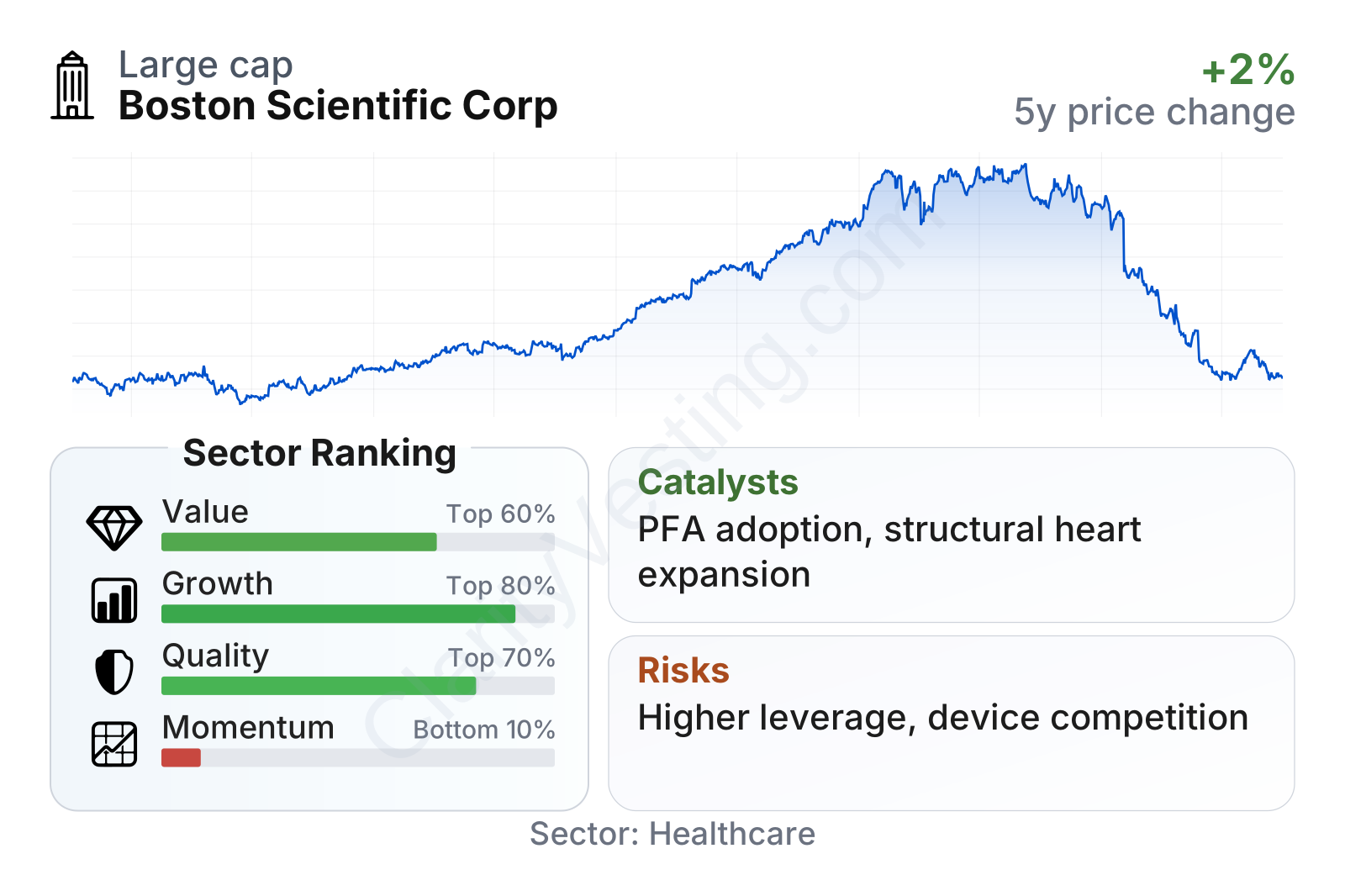
Boston Scientific combines above-average profitability with solid growth and a valuation profile that looks less demanding than many healthcare peers. Returns on capital and assets are comfortably ahead of sector medians, margins are notably stronger than typical medical device companies, and free cash flow generation is substantial. The weaker area is recent share-price momentum, which has been far below the broader healthcare group after a steep decline in 2026.
The company is also relatively defensive from a market-behavior perspective, with a beta below 1. In simple terms, the stock has historically been less volatile than the overall market, although that did not prevent a sharp drawdown in the most recent period.
Growth
Boston Scientific operates in attractive parts of healthcare. Many of its products are used in procedures linked to long-term demand drivers: more elderly patients, rising obesity and cardiovascular disease, broader use of minimally invasive treatments, and continued innovation in specialized devices. These are not short-lived themes. They tend to support steady procedure volumes over many years, especially when new products can improve outcomes or make treatment possible for more patients.
The company’s strategy also looks coherent. It has been building scale in categories where physicians value product performance, clinical data, and training support. That is especially relevant in electrophysiology, structural heart, advanced endoscopy, and neuromodulation. Boston Scientific has repeatedly used acquisitions to add technologies, then plugged them into its global sales network. When that approach works, it can produce faster growth than relying only on legacy products.
Recent revenue growth has remained positive throughout the period shown, though the pace has cooled from the very strong levels seen in 2024 and 2025. Even after that moderation, growth remains around the sector median on a year-over-year basis, while the longer five-year revenue-per-share trend is stronger than typical healthcare peers. That suggests the underlying expansion has not been just a one-quarter spike.
Cash generation is another important part of the growth profile. Free cash flow has climbed sharply over the last several years and now stands in the multi-billion-dollar range. That gives Boston Scientific more flexibility to fund research, expand manufacturing, pursue acquisitions, and manage debt without relying heavily on outside financing.
A meaningful catalyst has been the company’s progress in electrophysiology and pulsed field ablation, an emerging approach to treating atrial fibrillation. This market has attracted major industry attention because it may improve procedure efficiency and safety compared with older energy sources in some settings. Boston Scientific has been investing heavily here, and broader physician adoption could support growth if execution remains strong. Structural heart and interventional categories also remain important opportunities, particularly as clinical evidence and reimbursement support wider use.
Recent company communications have also highlighted ongoing product launches and international expansion. For a device company, that matters because growth does not depend only on selling more to existing hospitals; it also comes from entering new geographies, adding new indications, and increasing use of a platform once physicians are trained on it.
Risks
This article is for informational purposes only and does not constitute financial advice. Some content is AI-generated. See Disclaimer