Stock Analysis · Block Inc (BSQKZ)
Overview
Block Inc is a financial technology company best known for building payment and commerce tools for businesses and consumer financial apps for individuals. Its ecosystem has two main pillars: Square, which serves sellers with payment acceptance, software, banking, and commerce tools; and Cash App, which offers peer-to-peer payments, debit cards, savings features, stock and bitcoin services, and other consumer finance functions. The company also owns music-streaming platform TIDAL and bitcoin-focused initiatives such as Bitkey and Proto, but these are much smaller parts of the business.
For long-term analysis, gross profit is usually more useful than total revenue for Block because bitcoin-related sales create very large revenue numbers but carry thin margins. On that basis, the business is more balanced than headline revenue suggests, with Square and Cash App both contributing meaningful economic value.
Based on recent company reporting, Block’s main sources of revenue can be summarized as follows:
- Bitcoin revenue: approximately 40% to 45% of total revenue in recent periods. This mainly reflects bitcoin sold to Cash App customers. It is large in dollar terms but relatively low-margin.
- Transaction-based revenue: approximately 25% to 30%. This includes payment processing activity from sellers using Square and related merchant services.
- Subscription and services-based revenue: approximately 15% to 20%. This includes software subscriptions, value-added merchant tools, Cash App card and banking-related activity, and other service revenue.
- Hardware revenue: approximately 2% to 4%. This covers point-of-sale devices and related equipment sold to merchants.
- Other revenue: usually a low-single-line residual category, including smaller business lines and ancillary items.
Another important way to look at Block is gross profit mix rather than revenue mix. In that view, Square and Cash App each account for a large share of the company’s economics, while bitcoin becomes far less significant because of its narrow spread.
Over the past several years, Block has improved the quality of its business mix. Total revenue rose from about $17.7 billion in 2021 to around $24.2 billion in 2025, while gross profit climbed much faster, from roughly $4.4 billion to about $10.4 billion. That pattern suggests the company is becoming more efficient at turning activity into profit.
The financial flow also shows a notable shift: gross profit has expanded strongly since 2021, while operating expenses have grown more slowly in the most recent period. Revenue has been almost flat between 2024 and 2025, but profitability held up because the mix improved and costs were better controlled.
Key Figures
| Metric | Value | Sector ⓘ |
|---|---|---|
| Date | Oct 31, 2026 | |
| Context | ||
| Sector | Technology | |
| Industry | Software - Infrastructure | |
| Market Cap ⓘ | $45.05B | |
| Beta ⓘ | 2.55 | |
Value (Cheapness) | ||
| P/E Ratio ⓘ | 133.91 | 29.73 |
| FCF Yield ⓘ | 8.62% | 3.96% |
| Dividend Yield ⓘ | N/A | 1.30% |
| EBIT / EV ⓘ | 2.29% | 2.90% |
| PEG ⓘ | 0.58 | |
Growth (Business expansion) | ||
| Revenue Growth ⓘ | 9.30% | 15.80% |
| RPS Growth (5Y CAGR) ⓘ | 2.50% | 8.54% |
| EPS Growth (5Y CAGR) ⓘ | N/A | -10.19% |
| Margin Growth (5Y Trend) ⓘ | 5.14% | 0.45% |
| FCF Growth (5Y CAGR) ⓘ | 45.33% | 9.80% |
| DPS Growth (5Y CAGR) ⓘ | N/A | 7.67% |
Quality (Business durability) | ||
| ROIC (Latest) ⓘ | 1.58% | 9.74% |
| ROIC (5Y Median) ⓘ | 4.70% | 8.31% |
| Net Debt / EBIT (Latest) ⓘ | -5.26 | 0.53 |
| Net Debt / EBIT (5Y Median) ⓘ | -1.30 | 0.46 |
| Net Debt / EBITDA (Latest) ⓘ | -3.71 | 0.29 |
| Net Debt / Assets ⓘ | -12.22% | 3.45% |
| EBITDA / Interest ⓘ | 6.53 | 13.54 |
| Operating Margin (Latest) ⓘ | 3.63% | 10.12% |
| Operating Margin (5Y Median) ⓘ | 2.38% | 8.50% |
| Debt to Equity (Latest) ⓘ | 32.53% | 35.18% |
| Profit Margin (Latest) ⓘ | 1.43% | 7.13% |
| Free Cash Flow (Latest) ⓘ | $3.88B | |
Momentum (Price trend) | ||
| 3Y Return ⓘ | +66.64% | +61.79% |
| 12M Return (excl. last month) ⓘ | +4.48% | +12.78% |
| 6M Return ⓘ | +38.82% | +7.85% |
| Price vs. 200-Day MA ⓘ | +10.40% | +5.43% |
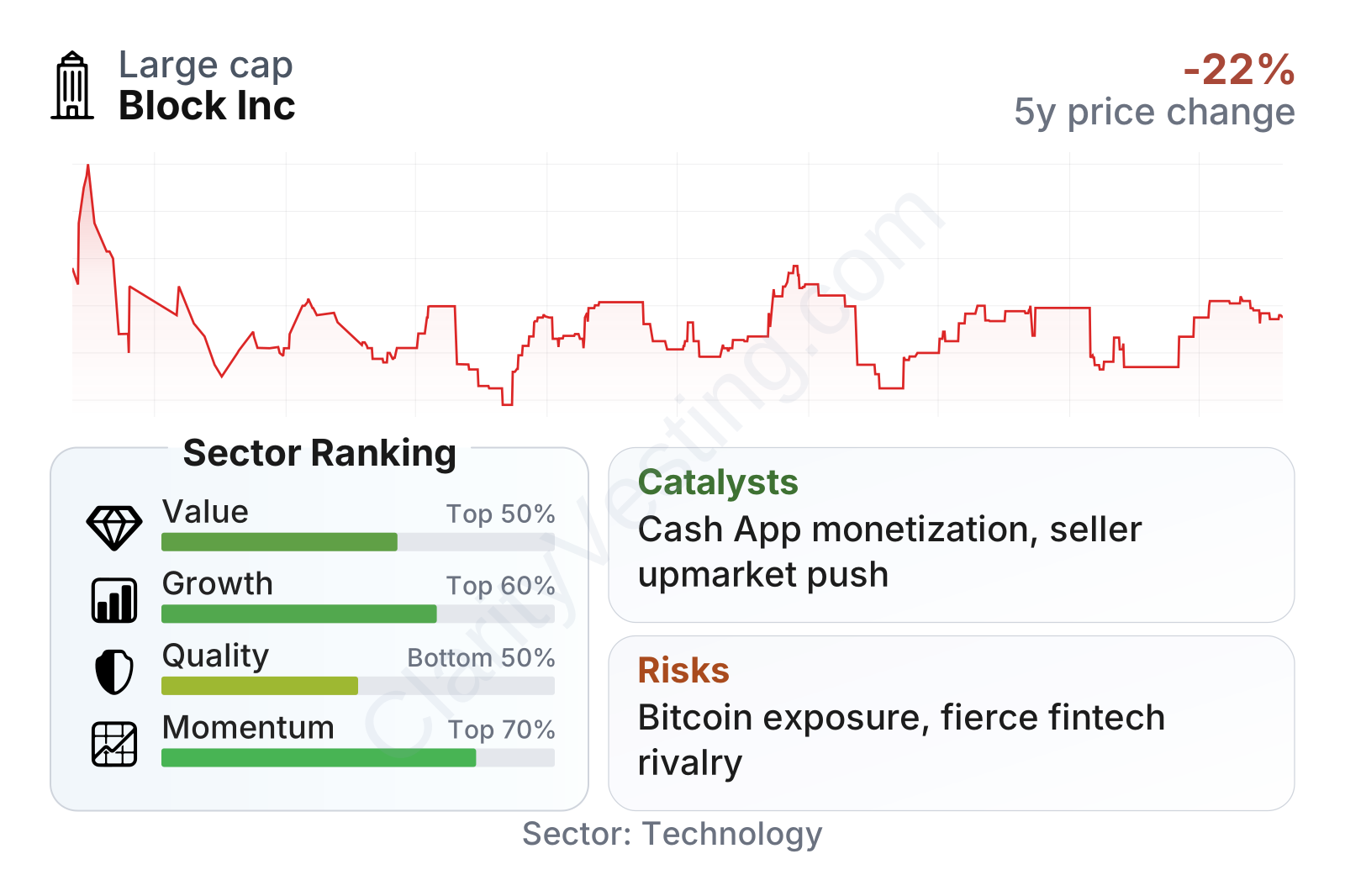
Block sits in the large-cap range and its stock has been volatile, with a beta above 2, meaning price swings have tended to be much stronger than the broader market. The share price history also reflects that pattern, with sharp drops and rebounds over the last few years rather than a smooth trend.
On valuation metrics, the picture is mixed. The earnings multiple is high, but that number is inflated by still-thin net margins. By contrast, cash generation looks much stronger: free cash flow yield is above the sector median, and the EV-to-EBIT profile also compares favorably. The PEG ratio below 1 suggests the valuation is not extreme if earnings continue to scale.
Growth factors are more moderate than spectacular. Recent revenue growth is below the sector median, and five-year revenue-per-share growth has also lagged many software peers. However, margin improvement and free cash flow expansion stand out much more positively. In other words, Block’s recent progress has come less from rapid top-line acceleration and more from becoming a more profitable business.
Quality is improving but still uneven. Operating margin is now slightly above the sector median, and the balance sheet is healthy with net cash rather than net debt. Interest coverage is solid, which lowers financial pressure. The weaker point is returns on capital and net profit margin, which remain below many established software leaders.
Growth
Block operates in several long-term growth markets: digital payments, merchant software, banking alternatives, consumer finance apps, and bitcoin-related financial services. These are all areas where cash usage continues to decline and more economic activity moves to software-driven platforms. That sector backdrop remains favorable over a multi-year horizon.
The company’s strategy is coherent because its products can reinforce one another. A small business may start with card acceptance, then add payroll, invoicing, lending, e-commerce tools, or restaurant software. On the consumer side, a Cash App user may begin with peer-to-peer transfers, then adopt the Cash App Card, direct deposit, savings features, and investing functions. This kind of ecosystem approach can raise customer retention and increase revenue per user over time.
One of the clearest catalysts is the company’s emphasis on gross profit growth instead of simply pushing payment volume. That matters because higher-quality revenue streams such as software, banking services, and merchant tools are more durable and usually carry better margins. The recent financial trend supports this strategy: revenue has grown at a moderate pace, but gross profit and free cash flow have increased much faster.
Another important growth lever is deeper penetration among larger sellers. Square historically had a strong position with small merchants, but Block has spent years expanding into more complex businesses that need omnichannel tools, vertical software, and integrated financial services. If successful, that can raise average customer value and make the seller business less dependent on very small merchants.
Cash App is also central to future expansion. The app already has broad consumer recognition in the United States, and management has been working to make it more of a primary financial relationship rather than just a transfer tool. More use of the debit card, paycheck deposit, savings, and borrowing features could lift monetization without requiring the same pace of new user growth.
Recent company communications have also highlighted operational discipline and efficiency. That is not as exciting as a new product launch, but for a company like Block it can be just as important. The recent jump in operating income and strong free cash flow indicate that scale is finally translating into more tangible financial results.
Risks
This article is for informational purposes only and does not constitute financial advice. Some content is AI-generated. See Disclaimer