Stock Analysis · Black Stone Minerals LP (BSM)
Overview
Black Stone Minerals LP is an energy royalty company. Instead of spending large amounts of capital to drill and operate wells itself, it mainly owns mineral and royalty interests across oil- and gas-producing regions in the United States. When operators develop wells on its acreage, Black Stone receives a share of production revenue. This makes its business model lighter than that of a traditional exploration and production company, because it generally has lower operating costs and limited direct drilling risk.
The company’s asset base is spread across several major basins, including the Permian, Haynesville, Eagle Ford, Bakken, and other producing regions. Its long-term value depends on three things: the quality of its acreage, the willingness of third-party operators to drill on that acreage, and commodity prices for oil, natural gas, and natural gas liquids.
Its revenue is mainly tied to production-based payments and leasing activity. Based on company reporting structure and the economics of the business, the main sources of revenue are approximately:
- Oil and natural gas royalty production revenue: about 80% to 90% — revenue collected from producing wells on acreage where Black Stone owns mineral or royalty interests.
- Lease bonus and other lease-related income: about 5% to 15% — upfront cash payments received when operators lease acreage for future drilling.
- Other revenue, including working-interest and miscellaneous income: usually less than 10% — this can include smaller non-core items and revenue from limited interests where economics differ from pure royalty ownership.
What stands out in the business model is how much revenue can turn into profit. Over the last several years, costs of revenue and overhead stayed relatively contained while revenue moved up and down with commodity prices and activity levels. That structure helps explain why earnings and cash generation can remain strong even when top-line growth is uneven.
Key Figures
| Metric | Value | Sector ⓘ |
|---|---|---|
| Date | Oct 17, 2026 | |
| Context | ||
| Sector | Energy | |
| Industry | Oil & Gas E&P | |
| Market Cap ⓘ | $3.18B | |
| Beta ⓘ | 0.12 | |
Value (Cheapness) | ||
| P/E Ratio ⓘ | 12.44 | 15.44 |
| P/B Ratio ⓘ | 2.82 | 1.73 |
| FCF Yield ⓘ | 8.14% | 8.20% |
| Dividend Yield ⓘ | 8.22% | 3.59% |
| EBIT / EV ⓘ | 8.99% | 7.46% |
| PEG ⓘ | 1.37 | |
Growth (Business expansion) | ||
| Revenue Growth ⓘ | 13.20% | 26.90% |
| RPS Growth (5Y CAGR) ⓘ | -4.80% | 6.90% |
| EPS Growth (5Y CAGR) ⓘ | -23.43% | -15.73% |
| BVPS Growth (5Y CAGR) ⓘ | 1.00% | 6.07% |
| Margin Growth (5Y Trend) ⓘ | 36.03% | 0.58% |
| FCF Growth (5Y CAGR) ⓘ | 5.35% | 1.86% |
| DPS Growth (5Y CAGR) ⓘ | 11.87% | 16.79% |
Quality (Business durability) | ||
| ROIC (Latest) ⓘ | 18.21% | 11.40% |
| ROA (Latest) ⓘ | 21.51% | 6.06% |
| ROIC (5Y Median) ⓘ | 20.96% | 10.30% |
| ROA (5Y Median) ⓘ | 23.48% | 5.42% |
| Net Debt / EBIT (Latest) ⓘ | 0.66 | 1.64 |
| Net Debt / EBIT (5Y Median) ⓘ | 0.08 | 1.83 |
| Net Debt / EBITDA (Latest) ⓘ | 0.58 | 1.08 |
| Net Debt / Assets ⓘ | 14.23% | 17.29% |
| EBITDA / Interest ⓘ | 26.83 | 9.64 |
| Operating Margin (Latest) ⓘ | 61.21% | 16.27% |
| Operating Margin (5Y Median) ⓘ | 62.45% | 20.39% |
| Debt to Equity (Latest) ⓘ | 17.60% | 54.76% |
| Profit Margin (Latest) ⓘ | 66.95% | 8.82% |
| Free Cash Flow (Latest) ⓘ | $258.54M | |
Momentum (Price trend) | ||
| 3Y Return ⓘ | +11.21% | +67.38% |
| 12M Return (excl. last month) ⓘ | +29.79% | +49.19% |
| 6M Return ⓘ | +14.59% | +7.07% |
| Price vs. 200-Day MA ⓘ | +5.62% | +9.56% |
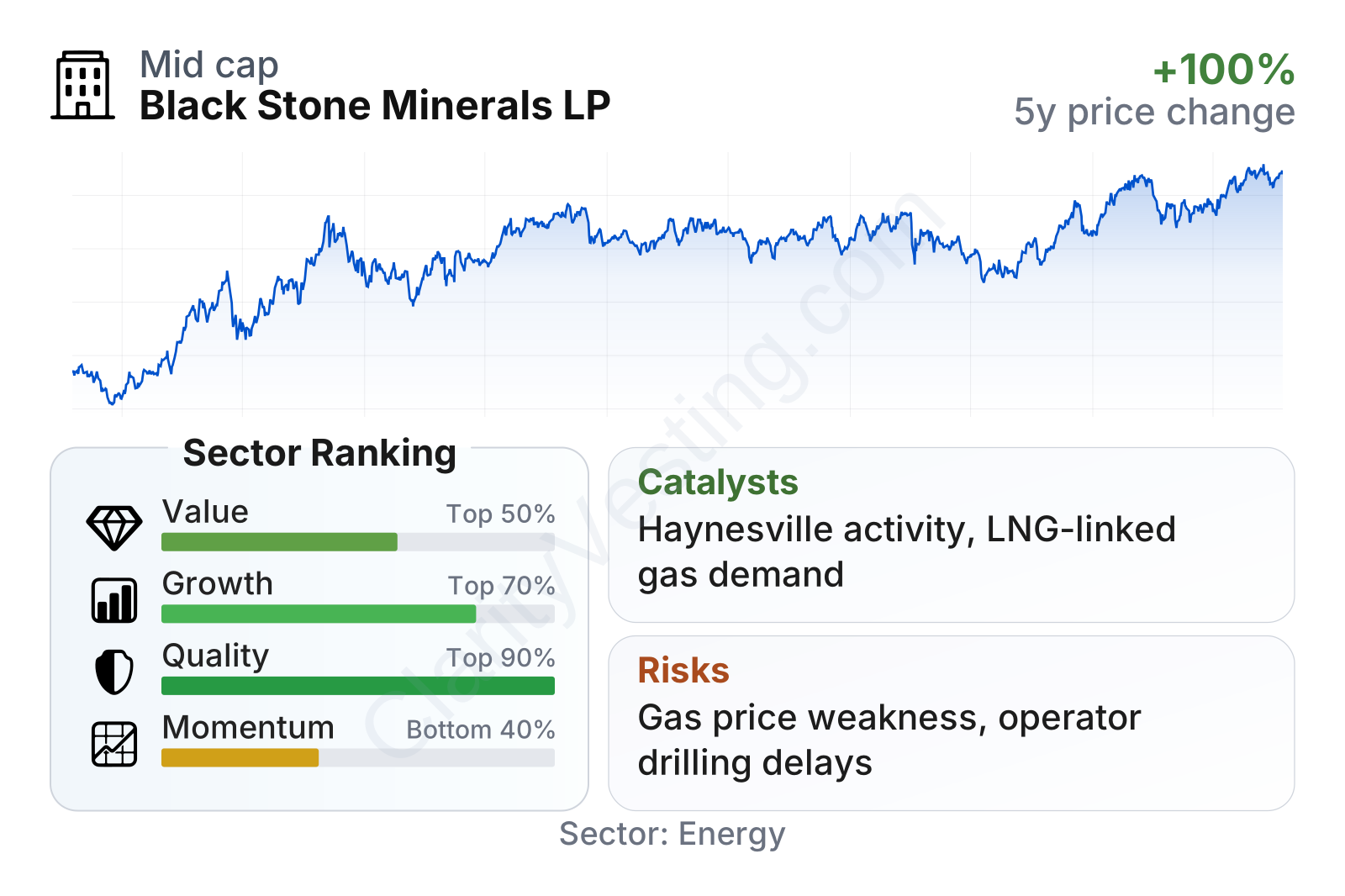
Black Stone Minerals is a mid-sized listed energy partnership with a market value around $3 billion. The factor profile is unusual in a good way: quality ranks near the top of the sector, value looks competitive, while growth and share-price momentum are less impressive. The company’s dividend yield is well above the sector median, profitability is exceptionally strong, and leverage remains low. On the other hand, longer-term revenue and earnings growth have been inconsistent, which fits the cyclical nature of a royalty business tied to commodity prices and outside operators’ drilling plans.
Growth
Black Stone operates in a sector that still has a role in the global energy system, but growth is not as straightforward as in a fast-scaling technology market. For this company, the key question is not whether hydrocarbons disappear soon, but whether high-quality U.S. basins continue attracting capital. On that point, the answer is still broadly favorable. Natural gas remains especially important because of LNG export growth, power demand, industrial use, and the need for flexible electricity generation. Black Stone has meaningful exposure to gas-weighted acreage, particularly in Haynesville, which can benefit if gas drilling activity improves.
The company’s strategy is sensible for long-term resilience. Royalty ownership avoids the heavy capital spending burden that producers face. That means Black Stone can participate in development upside without having to fund most of the drilling itself. This structure also allows management to preserve balance-sheet flexibility and return a large share of cash generated by the assets.
Revenue growth has been volatile. There was a surge during the strong commodity environment of 2022, followed by declines as prices normalized and activity cooled, and then a return to positive year-over-year growth in the latest periods. That pattern suggests the company is less of a steady compounder and more of a high-margin participation vehicle on productive acreage.
Free cash flow remains an important support for the business, even though it has come down from earlier peaks. The broader trend still shows meaningful cash generation, which is notable given the lighter operating model. For a royalty owner, this matters more than headline production growth alone, because cash can be used for distributions, debt management, or selective acquisitions of additional mineral interests.
A potential catalyst is stronger development activity on its acreage if oil prices stay supportive or if natural gas markets tighten. Another one is the long duration of mineral ownership itself: unlike depleting operating assets that require constant reinvestment, a well-located mineral position can continue generating value across multiple drilling cycles and future completion technologies. Recent operating updates from the company have also pointed to ongoing leasing and development activity in core regions, which supports the view that the acreage remains relevant to operators.
Risks
This article is for informational purposes only and does not constitute financial advice. Some content is AI-generated. See Disclaimer


