Stock Analysis · Basic-Fit N.V (BSFFF)
Overview
Basic-Fit N.V. is a European low-cost fitness club operator. The company runs large networks of affordable gyms, mainly in continental Europe, with a simple membership model centered on monthly subscriptions. Its proposition is straightforward: convenient locations, long opening hours, standardized clubs, and pricing aimed at making fitness accessible to a broad audience rather than only premium customers.
The business is primarily driven by recurring membership fees. In addition to subscriptions, Basic-Fit also earns smaller amounts from entry fees, personal training and coaching-related services, vending, and other in-club or digital add-ons. Based on the company’s reporting model and business structure, revenue is heavily concentrated in memberships, while ancillary services remain a modest contribution.
- Membership fees: approximately 85% to 95% of revenue. This is the core of the business and includes recurring monthly subscriptions from gym members.
- Other club and member-related revenue: approximately 5% to 15% of revenue. This can include joining fees, personal training, sports drinks or vending, partnerships, and other in-club services.
Geographically, the company is exposed mainly to Europe, with its largest markets including France, the Benelux region, Spain, and Germany. That gives Basic-Fit a multi-country platform, but still within a relatively focused regional footprint, which can help with brand consistency and operating scale.
One notable feature of the model is that each new club requires upfront investment, but once a club matures and reaches a stable membership base, it can become a strong contributor to recurring cash generation. That creates a profile where expansion can temporarily pressure accounting profits while still building future earning power.
The broad trend over recent years is clear: revenue has expanded sharply, operating income has improved from losses to positive territory, and net income has only recently turned positive. At the same time, interest costs have risen, which matters because expansion has been financed with meaningful debt and lease obligations.
Key Figures
| Metric | Value | Sector ⓘ |
|---|---|---|
| Date | Oct 24, 2026 | |
| Context | ||
| Sector | Consumer Cyclical | |
| Industry | Leisure | |
| Market Cap ⓘ | $2.08B | |
| Beta ⓘ | 0.93 | |
Value (Cheapness) | ||
| P/E Ratio ⓘ | 39.04 | 17.09 |
| P/B Ratio ⓘ | 5.30 | 1.64 |
| FCF Yield ⓘ | 34.74% | 8.68% |
| Dividend Yield ⓘ | N/A | 2.70% |
| EBIT / EV ⓘ | N/A | 6.69% |
| PEG ⓘ | N/A | |
Growth (Business expansion) | ||
| Revenue Growth ⓘ | 18.20% | 5.60% |
| RPS Growth (5Y CAGR) ⓘ | 42.19% | 9.01% |
| EPS Growth (5Y CAGR) ⓘ | N/A | -17.32% |
| BVPS Growth (5Y CAGR) ⓘ | -4.26% | 5.64% |
| Margin Growth (5Y Trend) ⓘ | 52.74% | -0.17% |
| FCF Growth (5Y CAGR) ⓘ | N/A | 5.02% |
| DPS Growth (5Y CAGR) ⓘ | N/A | 10.19% |
Quality (Business durability) | ||
| ROIC (Latest) ⓘ | 14.13% | 12.46% |
| ROA (Latest) ⓘ | 1.12% | 5.50% |
| ROIC (5Y Median) ⓘ | 5.37% | 10.68% |
| ROA (5Y Median) ⓘ | -0.09% | 5.44% |
| Net Debt / EBIT (Latest) ⓘ | 9.59 | 2.16 |
| Net Debt / EBIT (5Y Median) ⓘ | 26.11 | 2.29 |
| Net Debt / EBITDA (Latest) ⓘ | 2.30 | 1.48 |
| Net Debt / Assets ⓘ | 77.90% | 21.74% |
| EBITDA / Interest ⓘ | 6.27 | 9.17 |
| Operating Margin (Latest) ⓘ | 10.90% | 9.08% |
| Operating Margin (5Y Median) ⓘ | 7.96% | 9.56% |
| Debt to Equity (Latest) ⓘ | 800.79% | 75.99% |
| Profit Margin (Latest) ⓘ | 2.95% | 5.30% |
| Free Cash Flow (Latest) ⓘ | $721.16M | |
Momentum (Price trend) | ||
| 3Y Return ⓘ | +9.47% | +19.94% |
| 12M Return (excl. last month) ⓘ | +47.04% | -4.14% |
| 6M Return ⓘ | -23.42% | -3.03% |
| Price vs. 200-Day MA ⓘ | -13.03% | -0.66% |
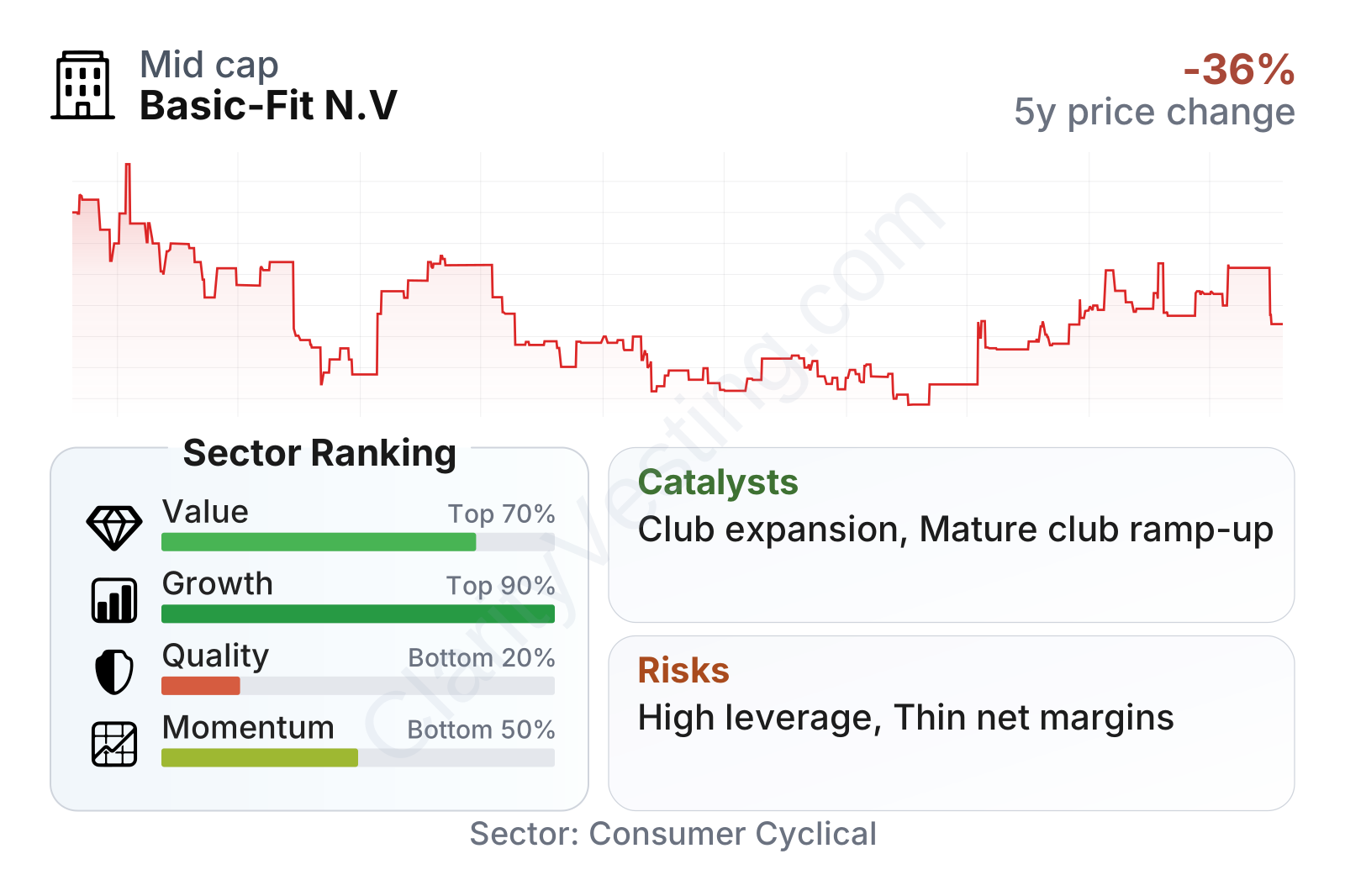
Basic-Fit is now a mid-sized listed company with a share price that has recovered strongly from its earlier lows. The business stands out for very strong growth relative to most consumer cyclical peers and for strong recent market momentum. Revenue growth is running well above the sector median, and operating margins have improved over time.
The weaker area is balance-sheet quality. Debt-related metrics are elevated versus the sector, and profitability at the bottom line remains thin despite progress in operating earnings. In other words, the company looks stronger operationally than it does financially, which is an important distinction for long-term analysis.
Growth
The fitness sector has several structural growth drivers. Health awareness continues to rise, gym memberships remain underpenetrated in many European markets, and low-cost operators often gain share when households become more price conscious. Basic-Fit’s positioning fits that backdrop well because it targets a wide audience with a standardized, affordable offer.
The company’s strategy also makes industrial sense. It is based on rolling out more clubs, clustering them by region, building brand recognition, and spreading central costs across a larger base. This can improve economics over time because marketing, procurement, technology, and operational know-how become more valuable as the network scales. The model is especially attractive if mature clubs continue to generate solid cash flow while new clubs ramp up.
Growth has been one of Basic-Fit’s clearest strengths. Recent year-over-year revenue growth is around the high-teens percentage range, comfortably above the sector median. Over a five-year view, revenue per share growth has also been unusually strong. That suggests the company has not only reopened and normalized after earlier disruptions, but has continued to add capacity and members at a pace that materially exceeds many consumer peers.
A further catalyst is operating leverage. Once a club passes its early ramp-up period, additional members can meaningfully improve profitability because many costs are fixed or semi-fixed. That means a larger estate of maturing clubs can lift earnings faster than revenue, provided utilization remains healthy and pricing discipline holds.
Recent company communication has also emphasized continued network expansion and the maturation of newer clubs. For a chain like Basic-Fit, this matters because the gap between reported earnings today and earning potential a few years from now can be significant if the opening pipeline converts into mature, cash-generating locations. In simple terms, the company is still in build-out mode rather than harvest mode.
Risks
This article is for informational purposes only and does not constitute financial advice. Some content is AI-generated. See Disclaimer


